Others football pundits entertain accidentally, but the
former Manchester United player is absorbing simply by being
himself

Football pundits have long been an upwardly mobile
species. This is a hungry breed, a lineage of strident,
well-groomed men for whom a sense of sofa-lolling entitlement has
recently given way to outright historical ascendancy. This process
has been marked by visible changes. In presentational terms there
has been an ascent-of-man-style rise from sallow, kipper-tied,
brown-suited figures enthroned behind looming wood veneer desks.
Through a more recent period of vaulting modernity where the
furniture shrunk back, desks became lighted coffee tables, and
suddenly knees and even ankles were exposed, stools perched upon
daintily, the pundit revealed in his full-frontal glory. Most
recently the football pundit has gone a step further, rising up on
to his hind legs and striding about the studio, fully erect,
conducting with both arms his swooshing
super-machines.
This season, change has come in other areas too. This weekend
Sky Sports' chief pundit Gary Neville will preside over a Super
Sunday triple-decker mega-bill that promises six whole hours of
total football-talk. If there is something unusual in this it is
that with Neville in the chair it is possible, finally, to actually
quite look forward to this bit, those long, idling moments in
between where there is no actual football, just the spectacle of
men talking urgently about football. Neville has solidified in
recent weeks, losing his ferrety callow quality, turning towards
the camera instead a full-face belligerence, a relentless and
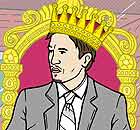
moreish zeal. I think we can say it now: there's a new sheriff in
town, a new king-pundit. And maybe the pundit is about to enter
another of his furtive growth spurts.
I always secretly liked Neville as a player, too. In his recent
book he described his own England career as "a massive waste
of time", but it wasn't always like that. Witness for example the
notable high of his performance in England's defeat by Argentina at
France 98, where Neville surged with bow-legged fury the length of
his touchline, a waddling English Cafu. Albeit it was easy to
forget all this later on as his interpretation of the role of
full-back was increasingly as a form of obstruction, an immobile
object to be skirted warily, like a dying dalek.
His waspishness has always been evident, as has a subtle quality
of outsiderdom. There is a story about the old lags at United
laughing out of their car windows at the sight of the young Neville
staying behind after training to practise throw-ins on his own
against a wall while they all sidled off to some appalling
shag-carpeted lounge bar. And it is this cussed, puritanical,
quietly nonconformist brio that is his great asset, a line in quiet
iconoclasm that is now being applied to the role of pundit.
It seems increasingly that Neville may be doing actual research;
that his approach to punditry may involve a rare desire to actually
tell you interesting things you didn't know about football. And
amid the bombast of Sky's plastic triumphalism, there is a quality
in him of restrained preacherly zeal, the brusqueness of an
ambitious young parish curate or a strident Scottish schoolmaster
with a flaringly adamant moustache.
There are plenty of other entertaining pundits. I always enjoy
watching Robbie Earle, for example, if only for his heroic air of
crisis management, the lingering suspicion that he is being held
hostage and forced to talk in a slow patient voice about banks of
four and midfield runners but is responding with great calm and
quiet dignity and will probably win some kind of civilian bravery
award when this is all over. I like Jamie Redknapp for his
thigh‑chafing eagerness, the burbling stream of consciousness
through which nuggets of jangling coherence will suddenly burst and
then evaporate in a puppyish confusion. I also like Glenn Hoddle,
mainly because he often seems to have wandered in from the world
next door where they use words differently and it's normal to say
things like: "They've gone backwards-facing. The distances are
good, but the movement needs a front-pivot." I even miss John
Barnes as an anchorman; he seemed pleasantly argumentative and
speaks so rapidly it is as though someone has spilt a glass of
water on the autocue keyboard and he is being forced to read out
things like "hello and soknonfonnmbnbdjhbdjinocf".
Neville is different, though. Others entertain accidentally, but
he is absorbing simply by being himself. I have a theory that one
day TV pundits will be considered just as important as managers,
driving as they do the great continental engines, the wheezing
bellows of football's surging public opinion. Perhaps they already
are, judging by André Villas-Boas's carefully strategised public
response this week to Neville's amusing suggestion that David Luiz
has been playing like he is being "controlled by a 10-year-old in
the crowd on a PlayStation".
It is tempting to condemn this overlap between the real and the
televised as yet another example of the secondary business of
talking about football usurping the real business of actually
playing it. But so central are the currents of public perception,
so powerful the tidal pressures of televised opinion on top-level
football that it seems inevitable the two must eventually coalesce
into a twin-headed public theatre. Nasally insistent, relentlessly
illuminating, Neville has become oddly unignorable of late. This
already sounds like progress.