Would Liverpool ever sack Kenny
Dalglish?
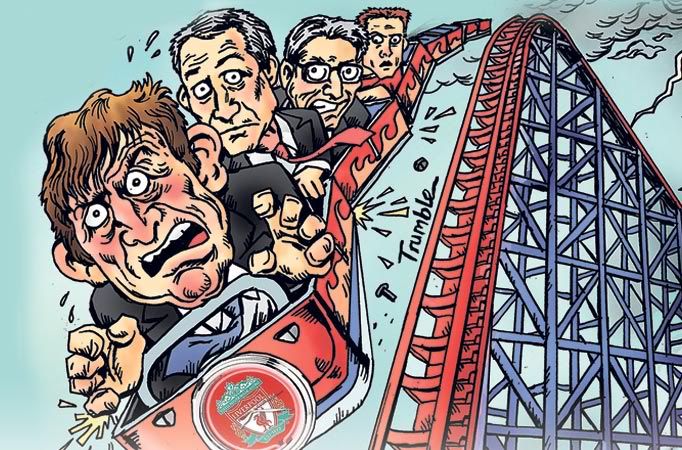
The down side of
appointing a bonafide legend is that it sometimes takes longer to
see when he is letting you down
Liverpool arrive in London this weekend to
face Chelsea ahead of a home match against Manchester City in a
double-header that will determine the present validity of their
designs on a top-four finish.
The possibility of failure in these two games raises
an intriguing question: would the club ever sack Kenny
Dalglish?
His position is, of course, not under threat sitting
as they do in sixth place with 11 games played, but in the minds of
those who triumphantly predicted the Reds would mount a title
challenge this season, King Kenny's crown has slipped a touch
already.
Liverpool invested considerable sums in players
after Dalglish replaced Roy Hodgson - who underperformed in an
impossible job clouded by uncertainty at boardroom level - and in
tandem with the return of a feel-good factor, everything appeared
in place for a title tilt.
They could yet enter the shake-up - wins at Stamford
Bridge and then against City would put them in the fray - but the
alternative outcome is more plausible and would increase the
pressure on Dalglish that is for now bubbling along as an
undercurrent.
Lost somewhere amid the frenzied final throes of
their last outing - a 0-0 home draw against Swansea - was the noise
of booing at Anfield.
It was not widespread but nevertheless indicative of
the murmurings of discontent that have greeted Liverpool's
concession of early ground on the Manchester clubs out in
front.
To boo King Kenny would have been tantamount to
blasphemy until recently and yet some supporters - perhaps those
with shorter memories and less patience than others - deemed it
necessary to voice their frustration at least at the performance if
not the manager.
It could easily be dismissed as an irrelevance but
equally may be a sign of antipathy towards Dalglish. He remains
well in credit - and so he should after his past glories with the
club as player and manager were supplemented by his fine work in
steadying the ship following Hodgson's turbulent reign.
But at what point does he begin to be judged on how
he has taken the club forward rather than his role in steadying the
ship?
This column asserted in January that Dalglish should
have stepped aside upon restoring order to allow a younger manager
with fresh ideas the chance to impose a new blueprint on the club
for the future.
Several readers of a Liverpool persuasion denounced
that opinion as sacrilege given Dalglish's status and vowed the
60-year-old would deliver success.
But what is success at Anfield these days? Surely a
club with as rich and illustrious history as Liverpool should be
competing in Europe's premier competition?
Title talk always seemed a little premature given
the need to bed new players in and fitness doubts surrounding Andy
Carroll and Steven Gerrard - Dalglish certainly has not failed if
Liverpool do not win the League given the resources and power of
those teams above them.
But a top-four finish, given the money spent -
albeit offset to a degree by the sales of Fernando Torres and Raul
Meireles - must surely be the principal expectation this
season?
After all, in 2011, Tottenham have only brought in
Scott Parker, Steven Pienaar, Brad Friedel and secured a loan deal
for Emmanuel Adebayor while Liverpool have brought in Luis Suarez,
Carroll, Charlie Adam, Stewart Downing, Jordan Henderson and Jose
Enrique among others at not inconsiderable cost.
Although Enrique has impressed, Henderson, at
£20million, has been a thorough disappointment, Carroll has looked
nothing like a £35m striker while Downing and Adam are yet to
perform with the consistency that suggests they are the difference
between the top seven and the top four.
Of course, nearly all criticism of Dalglish is
dismissed as either jealously or a failure to understand the soul
of the club. Some of it has been wide of the mark. His record is
roughly the same as Hodgson's was during his tenure but the
statistics are unfairly balanced because 10 matches came in the
Europa League against largely inferior opposition.
Hodgson managed Liverpool for only 20 League games
and amassed 25 points, while Dalglish registered 37 from his first
20 games.
Equally, his outbursts towards officials and fixture
scheduling have been interpreted as signs of pressure but any top
manager complains about the system in order to work the
angles.
But Dalglish has his faults, just like any manager,
and the down side of appointing a bonafide legend is that it
sometimes takes longer to see when he is letting you down. The jury
is still out.
Liverpool have more than two-thirds of the season to
succeed but surely questions should be asked if Dalglish fails to
deliver Champions League football?
The saddest indictment on Liverpool's start is they
now lie level on points with Arsenal, who were in a turmoil over
the summer that spilled into the current campaign.
Is the Europa League really good enough for
Liverpool? Perhaps the club's luminous history clouds judgment.
Perhaps Dalglish's iconic standing does too.
But that's the problem with messiahs - if they prove
to be false prophets, letting go is all the more difficult because
it is an admission everything you believed in was wrong. And where
do you go from there?


