• FA may have to consider cultural differences
• Liverpool player denies allegation of racial abuse
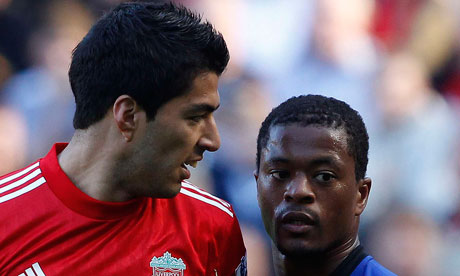
Patrice Evra has been informed that he may have
difficulty proving he was the victim of racial abuse from
Luis
Suárez, because of a
counter-argument that certain variations of the N-word are not
deemed offensive where the Liverpool
player grew up, in Uruguay.
The Manchester
United defender has accused Suárez of using racist
language during a 1-1 draw at Anfield on 15 October and is
waiting to discover whether, almost a month later, the Football
Association will charge the Liverpool striker with misconduct.
Top-level sources at Old Trafford say the offending word was
uttered in Spanish and allegedly was a derivative of "negro", with
Evra stating that it was used "at least 10 times".
However, Suárez has categorically denied racially abusing the
Senegal‑born France player and the FA's investigators are having to
consider the different context with which words that would be
considered offensive in England are commonly used in Uruguay and
other Spanish-speaking countries.
"Negrito", for example, could have shocking connotations for
someone without full knowledge of the nuances of the language. But
the counter-argument is that this is one of several derivations
that are used in many countries, with no derogatory meaning – often
in the same way someone could be called "pal" or "
mate". An illustration of this comes in the form of the message
Dani Pacheco, the Liverpool player who is currently on loan at Rayo
Vallecano, sent to his Spain Under-21 team-mate Thiago Alcântara
via Twitter on Friday. It begins: "Negrito, enjoy yourself …"
This was a conversation between two friends. In Uruguay, it is
quite common for commentators to use the same word to describe
Premier League players. Visitors to the country can be taken aback
by this form of language. But other derivatives are also commonly
used, often to describe people of all races in affectionate terms,
including family members.
Whether Evra was aware of these nuances at the time is not
clear, but he and United have subsequently been informed that the
case does not merely rest on what Suárez said but also, crucially,
the context in which his words were used. The two players were
arguing at the time and it is beyond argument that Suárez was
trying to wind up his opponent, but the crux of the matter is the
meaning of whatever was said and differentiating between something
that would not be offensive in one country but shocking in
another.
Suárez, backed by Liverpool, has repeatedly protested his
innocence. The forward, who scored all four goals as Uruguay beat
Chile 4-0 on Friday, has not publicly disclosed the words he used.
He said last week that it was not an insult but just a "way of
expressing myself. I called him something his team-mates at
Manchester call him, and even they were surprised by his
reaction."
The complexities of a difficult, highly sensitive case help to
explain why the FA has taken so long to decide whether to take
action against Suárez. The player's poor grasp of English has also
contributed, as all his interviews have been in Spanish, requiring
careful translation.
Any case against him would also have to prove that, having
played in Europe since 2006, he should be aware of what is
acceptable or not. However, this would be a difficult task. If
Suárez accepts he used one of the N‑words, he would have the scope
to argue it is a common and inoffensive term for someone of his
background, citing a clash of language and culture between one
player from South America and Europe.
Liverpool have let it be known they will ask the FA to take
action against Evra if the governing body concludes that Suárez has
no case to answer. However, the latest revelations throw up
the possibility that both players have given a legitimate account
of what happened, rather than it being a case of one man's
word against another.
Kenny Dalglish, the Liverpool manager, has voiced his objections
about the length of time the case is taking the FA, but it is still
not clear when an announcement will be made. The case is so complex
it may be that the FA needs to take advice from South America about
the relevant linguistic issues before deciding whether or not to
proceed any further.
