• Owner says club's global following has huge financial
potential
• Henry sees similarities with revitalised Boston Red Sox
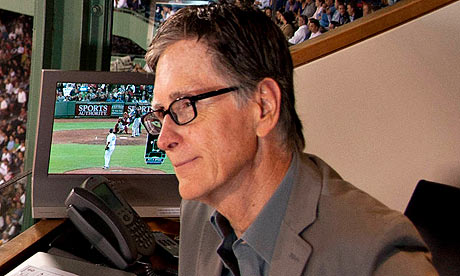
John W
Henry, the principal owner
of Liverpool,
has acknowledged he knew "virtually nothing" of English football or
the football club before his Fenway Sports Group took over at
Anfield a year ago this Saturday. Tom Werner, the chairman of
Fenway and now of Liverpool, said he too had barely heard of the
club, but was aware of the "EPL" – English Premier League – and its
popularity, and "certainly knew about Manchester
United".
During three days of exclusive
access in the United States with Henry, Werner and key executives
of Fenway, which owns the Boston Red Sox baseball team, they
explained the prime attraction of buying Liverpool lay in the
financial potential of the club's global following.
Lifelong fans of baseball, whose support is mostly restricted to
the US, they began to take an interest in Liverpool after
comprehending the scale of international interest in the Premier
League on television and via the internet – and the prospects of
being able to make money from it.
Asked what he knew about English football, and Liverpool, before
an email from a Fenway Park employee alerted him to the Merseyside
club's financial difficulties last August, Henry replied:
"Very little. We knew virtually nothing about Liverpool Football
Club nor EPL."
Henry said as Liverpool's difficult financial predicament was
outlined to him last year, he saw parallels with the Red Sox, the
MLB team Fenway bought in 2002. Before the takeover, the Red Sox
had not won a World Series for 84 years, and the team's stadium,
Fenway Park, was showing its age. Liverpool offered Henry a new
challenge, to revitalise a football club as Fenway has with the Red
Sox – although a spectacular September collapse this season has
plunged the team into turmoil. He saw Liverpool as an opportunity
to apply a similar strategy, but in an international sport with a
following that hugely outstrips that of baseball.
Following that email, Henry and Werner attended a presentation
given by Philip Hall, an executive at Inner Circle Sports, the New
York‑based merchant bankers which specialises in the takeovers of
English football clubs. Inner Circle acted for Tom Hicks and George
Gillett when they bought Liverpool in 2007, and for Ellis Short
when he took over at Sunderland. Werner said before that meeting
with Inner Circle, who would become Fenway's financial advisers on
buying Liverpool, he knew very little of the club: "I had been in
sports so I was aware of the EPL and its strength globally," said
Werner, a Grammy award-winning Los Angeles‑based television
producer. "But I didn't know the inner workings of it. I certainly
knew about Manchester United."
The Liverpool chairman said that he did not at the time believe
buying the football club held any appeal for Fenway, which owns the
Roush Nascar motor racing team. Of the meeting with Inner Circle,
Werner recalled: "I wasn't paying too much attention. Frankly I was
on my Blackberry, dealing with more pressing issues. I thought
there was no way John was going to drag us into that one."
Henry, however, found Liverpool compelling, particularly the
club's supporter base in the Far East. This week Ian Ayre, whom
Fenway appointed managing director at Liverpool, said he wanted the
overseas TV rights sales, which the 20 Premier League clubs
currently share equally, to be broken up so that clubs could fix
their own deals individually.
Werner explained that baseball teams share a proportion of
income from tickets, merchandising and broadcasting, to ensure more
level competition between big and small teams. The Liverpool
chairman said the amount of money they are forced to share,
however, is a source of resentment: "We realise we are part of a
league, but we feel the burden on the top is higher than
appropriate. We feel we deserve the fruits of our labour. That is
the difference with the EPL. If we can generate interest in
Liverpool here and around the world, we will benefit from
that."
Part one of David Conn's series with the Boston Red Sox and
Liverpool owners can be read
here