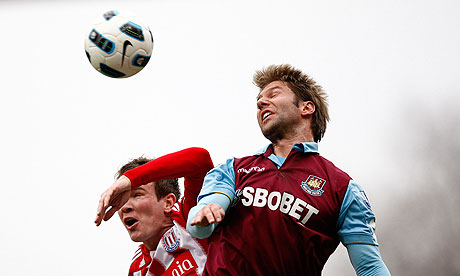
Ten months into his London life, Thomas Hitzlsperger has given
up on the Tube. Getting increasingly recognised did not bother him
– this son of a Bavarian dairy farmer really is the most
unassuming, low-maintenance footballer you are likely to meet – but
he could not abide the unseasonable heat. "Just too hot down
there," he says. "Imagine getting stuck in the tunnel for two hours
like those poor people on the Jubilee line the other day."
After reading of the latest public transport troubles, the
29-year-old decided to hop on his bike for our dinner appointment.
The short ride from his apartment has obviously left him in good
spirits. "They told me Rome was beautiful in the spring," he says.
"But London is truly something else when the sun shines."
Hitzlsperger has immersed himself in all the capital has to
offer, visiting the various street markets and driving to a Norfolk
beach on a recent day off. The thrill of the new is yet to wear
off, as is the excitement and gratitude to be back in English
football. A decade after he moved to Aston Villa as an 18-year-old
Bayern Munich trainee, Hitzlsperger has found the Premier League is his "spiritual
home". The enjoyment is tempered by the acute fear of losing it all
again, however. West Ham's 19th place has everyone at the club
concerned about the future. "I just hope I'm still able to be here
in the Premier League next year," Hitzlsperger says.
In a sense, it is third time unlucky for him. The Germany
international left Stuttgart in December 2009, when they were mired
in a relegation fight and endured six months of a similar crisis at
Lazio. After missing the first half of this season with a serious
tendon injury picked up while captaining the national team in a
friendly against Denmark, he parachuted straight into yet another
scrap for survival. Hitzlsperger has seen enough to know that the
lack of light in a league's basement can do strange things to clubs
and teams. Some wilt, some die, others unexpectedly thrive to
emerge from the darkness.
"It's interesting to see how different the attitudes can be," he
says. "In Stuttgart, we were playing in the Champions League at the
beginning of the season, so nobody was quite prepared for the
problems." The hierarchy at VfB nervously reverted to what Germans
call "Aktionismus", a knee-jerky
doing-something-for-the-sake-of-it. "There were endless
recriminations in the changing room, everybody was blaming
everybody else. Instead of constructive criticism, we were
constantly being told that we didn't want it enough."
Before a cup game against second-division Greuther Fürth, the
sporting director, Horst Heldt, came in and drew three numbers on
the chalkboard: 8, 15, 64. The first two, he
explained, stood for the respective budgets of Fürth and a
relegation rival; the last for the money Stuttgart was spending on
their squad.
"The inference was that we weren't worth our wages," says
Hitzlsperger, who was captain at the time. "The media and
supporters picked up on that line and soon the little confidence
that was still left vanished altogether."
The Stuttgart fans, he remembers with a shudder, completely lost
their patience. The team bus would be routinely blocked from
leaving the stadiums by angry sit-ins by supporters who demanded to
speak with the players or targeted with fire-crackers. This
discontent, while troubling, paled into insignificance with the
violent reactions Hitzlsperger encountered in Italy, however.
"After my first game, which we lost, a large group of Ultras tried
to storm the gates of our training ground. The police had to come
with riot gear to save us. I thought: 'What the hell have I let
myself in for here?'"
Some Lazio players went months without wages, too. But
everything changed when the new coach, Edy Reja, scheduled a
mid-season training camp. "We had a sport psychologist with us but
the team decided that he should go home after a couple of days.
There was a sense that 'we are strong enough to do this on our
own'. It's easily said, but the players really did take
responsibility themselves. Everyone did just a little bit more."
One or two dinners and glasses of red wine, he adds, helped to
bring the team together.
In Stuttgart, there were loud calls for the side to adapt their
passing style for the less-cultured environs of the relegation
zone, but Reja stuck to his guns. "We didn't change the system, we
worked hard on regaining our composure instead. We would practise
offensive moves without an opposing team. At first you think it's
madness, attacking an empty goal. But by the end of a couple of
sessions you see that everyone looked a little bit more
comfortable."
The Hammers, though, are anything but after three defeats in a
row. Hitzlsperger has been surprised by the "keep calm and carry
on" approach in the dressing room and even more so by the continued
support from the fans. "After the Aston Villa defeat, one drunken
guy shouted some abuse outside the changing rooms, but there were
also lots of people asking politely for our autographs. You're
almost too embarrassed to oblige after such a bad result. It's not
that you don't get the jeers in the stadium here, you do, and
rightly so, but unlike in Germany and Italy, English supporters are
more prepared to give you the benefit of the doubt."
The manager, Avram Grant, too, has accentuated the positives.
"He wants us to keep our heads up. This week, he said that each of
us should think hard about what we can do to play to the best of
our abilities. That makes a lot of sense to me, because we can only
get out of this mess by playing to our strengths. It's too late to
make drastic changes now. We won't be able to turn into Stoke City
overnight. We have to stay true to ourselves."
Hitzlsperger acknowledges that it will not be easy to stick to
their attacking principles against a resurgent Chelsea on Saturday
evening, especially without the services of the FWA Player of the
Year, Scott Parker. "He's been excellent all season, but we can't
afford to dwell on his absence," he says. "We have to win the
battle in midfield, that's always the key against Chelsea." He
carefully ventures that the addition of Fernando Torres and the
ensuing debate about Carlo Ancelotti's best strike partnership
might have caused the champions to be "a little pre-occupied" in
recent months but warns that the continued excellence of the Blues'
box-to-box brigade shouldn't be over-looked: "Lampard and Essien
are formidable players, we know that."
He hopes that the London derby factor will work in United's
favour at Stamford Bridge, just as it did in the slightly
fortuitous goalless draw at Spurs. "You feel how much it means to
the supporters and you tap into that energy," he says. "It gets you
over that extra metre or so, when your legs have gone."
Hitzlsperger, a keen student of the game who is considering
becoming a manager after his playing career, feels the intense
pressure his team will face over the next five games might actually
prove beneficial: "Some teams can't deal with it and crumble. But I
think we have the sort of players who come good when the stakes are
really high."
His experiences with Stuttgart and Lazio have taught him that
there is not necessarily a right or wrong way to navigate the lower
regions of a division. Both clubs managed to stay up, despite their
differing methods. Only time will tell whether the almost eerie
tranquility in the West Ham camp will enable them to avoid the
drop.
Hitzlsperger is so bullish that all talk of a points targets
until the end of season or playing for a draw on Saturday leaves
him cold. "I don't believe in trying to get a draw. We're playing
to win that game, and every other game. We owe that to the club, to
the supporters. And to ourselves."