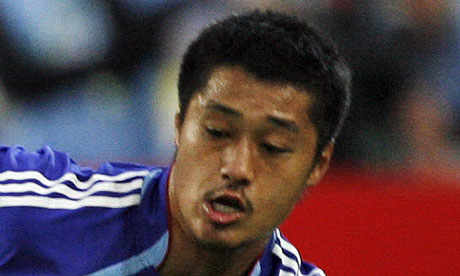
Mitsuo Ogasawara, the Kashima Antlers and Japan midfielder,
hails from the Tohoku region devastated by last month's earthquke.
He drove north to search for his wife's relatives. Photograph:
Vanderlei Almeida/AFP/Getty Images
"We knew something wasn't right and then suddenly our phones
weren't working," recalls Eddy Bosnar of the J-League team Shimizu
S-Pulse. "We went home to see what was happening on the television.
People were saying that just one person had died but when I saw
what was happening with the tsunami, I said: 'That can't be
right.'"
Unfortunately it wasn't but, even as the Australian defender
watched events unfold on 11 March, he didn't imagine that he would
have to wait until 23 April to play the second game of the 2011
J-League season. In the immediate aftermath of the earthquake,
Bosnar did what most foreign players did. He went home. "We had
four or five days off initially. I made a quick visit to Australia
just to show people that I was OK and then I came back."
Others ended up leaving permanently. The Brazilian striker
Marquinhos had played only once for Vegalta Sendai, the top-flight
club closest to the epicentre of the earthquake, but one aftershock
too many had him requesting that his contract be terminated as,
according to the club, he was in a state of physiological shock.
Everyone understood. "The Japanese are normally immune to
earthquakes as all the buildings are earthquake-proof but the
tsunami was something different," Bosnar says. "It was a scary
thing for everyone."
Sendai have done all they can to get their stadium ready for
their next home game on 29 April. Kashima Antlers is 150 miles
south of Sendai but is the only one of the four top-flight clubs to
suffer stadium damage that has been forced to move. After all that
has happened, playing an hour away in Tokyo for a few weeks is not
a great hardship. The star Kashima midfielder, Mitsuo Ogasawara,
hails from the devastated Tohoku region, as does his wife. Unable
to get in touch by phone and unsure if his in-laws were still
alive, he drove north to see for himself.
"For those few days I felt they hadn't made it," Ogasawara says.
"There was nothing left of what I remembered in the area. We had no
information and I thought my wife's parents had been lost." They
were safe but the same couldn't be said of many in the surrounding
area. "I went to high school in a nearby town to Rikuzentakata.
There are people with no water, food, clothes or homes. There were
rations coming through but the distribution wasn't quick enough. I
decided to set up my own network to help with the distribution to
those who most needed it," he said.
The football community has pulled together and shown the way in
contrast to baseball's popular Central League which argued for days
about whether to start their season as scheduled on 25 March –
mounting pressure from inside the game and out saw the first pitch
thrown on 12 April – while the sport of sumo is wrestling with its
own match-fixing mess. Even the national football team manager
Alberto Zaccheroni has been rattling collection boxes in Tokyo.
Seeing footballers on the street has been a common sight of late.
"All the players have been to stand in front of the train station
holding big wooden boxes," Bosnar says. "People have been happy to
see us and everyone has been very generous. The boxes are soon
full, not with coins but with notes."
The 29 March match between Japan and a J-League All Star team,
hastily arranged after the cancellation of international
friendlies, also raised morale as fans sung Vegalta Sendai songs.
Yasuhito Endo curled home a trademark free-kick in the first half
and if the sight of the national team players – all the top players
came home from Europe – raising their black armbands to the sky
didn't bring a lump to 41,000 throats, then a second-half goal and
celebration dance from the 44-year-old Japanese legend Kazuyoshi
"Kazu" Miura surely did.
A spate of charity matches has done something to improve the lot
of those affected by the disaster. These ranged from the regional
derby between Cerezo Osaka and Kyoto Sanga that fans agreed to
watch in silence to a glamour fixture between Shimizu and Ajax. The
games have also given match practice to players who have just 90
minutes of competitive action under their belt since the 2010
season ended in early December.
It is a situation that has been challenging for head coaches.
"It has been a tragic time but our continual training has been a
source of comfort for the people here," the Shimizu head coach,
Afshin Ghotbi, says. "We have had training blocks with a friendly
at the end of each block followed by a day or two off. We set up
short-term goals for players in that block and created competition
among the players with a daily points system, and at the end prizes
are given out."
An absence of competitive action will not be a problem for long
because the J-League has to squeeze six weeks of missed matches
into the rest of the season. The threat of congestion led the Japan
FA to announce it would withdraw the national team from the Copa
América in July, a decision that has since been reversed. The
initial plan was to send a team to Argentina largely made up of the
growing Japanese legion in Europe (the lack of domestic action has
had fans focusing on the Uefa Champions League exploits of Atsuto
Uchida's Schalke, who triumphed over Yuto Nagatomo's Internazionale
in the quarter-final) but this week Stuttgart said their striker
Shinji Okazaki will not play in the tournament.
A reluctance to release players is understandable. The Copa
América will be the third major tournament for Japan in the space
of 12 months after the World Cup and January's Asian Cup. J-League
clubs are unlikely to be much more open to the idea. Dragan
Stojkovic led Nagoya Grampus to the title in December and likes the
idea of the tournament "but it's very important that they don't
touch the players from the J-League," the Serbian says. "Players
who play abroad? OK, no problem. But for the J-League, each team
needs their players."
A brewing club versus country row, albeit one that is likely to
be polite given the circumstances, suggests that football and life
in most parts of Japan are returning to something approaching
normality. Competitive football has already returned and Kashima
drew 1-1 with Suwon Bluewings of South Korea on Tuesday in the
Asian Champions League. It was a fairly unremarkable game except
that it kicked off just after lunchtime at the Antlers' temporary
Tokyo "home". Afternoon games will become the norm for a while.
With the damage to the Fukushima nuclear power plant, football is
doing its bit to save energy.
A banner at the March match in Osaka said football had saved
Japan. That may be an exaggeration but the beautiful game has
certainly helped. And this weekend, it will be helping again as it
goes back to doing what it does best.