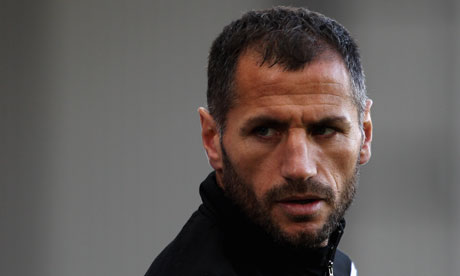
Newcastle's Shefki Kuqi. Photograph: Dean Mouhtaropoulos/Getty
Images
When Shefki Kuqi rumbled off the bench for Newcastle last
Saturday, he was making his debut for his 13th senior club. He is
almost the definition of the journeyman striker. But his is a
journey more extraordinary than most, one that began in 1989, when
he was 12 years old.
Kuqi was born in Vucitrn, a town in Kosovo, then in Yugoslavia,
where two-thirds of the population were ethnic Albanians. Kuqi's
family were among them. He grew up in a small village just outside
Vucitrn, most of whose residents worked in a metal-processing plant
on the road into the town. There were only 10 Serb houses in the
village, five in a cluster just over the road from Kuqi's house,
five just behind.
"We started school at six and a half," Kuqi remembers. "There
were separate Kosovan and Serb classes in the same school and, from
the age of 10, Kosovan children were expected to study the Serbian
language. Maybe once or twice a week we'd get to school an hour
early and play a game of football, Kosovans v Serbs, which would
always draw a crowd.
"The kids were aware of the differences between them but the
games were friendly: if one side was short, Kosovans would play for
the Serb side or the other way round. It was just an easy way of
dividing people up, rather than anything more fundamental.That's
largely how it was. People got on. If there was a party at a Serb
house, Kosovans would give them a cake. But as time went by the
relationship became more and more tense. My dad's brother had a
good friend who lived opposite and there was a time when the
friend's wife came over to warn us that things weren't looking
good.
"You noticed the little things. My dad had helped build houses
for some of the Serbs and they'd wave and smile when they saw him
driving his van around town. But slowly they stopped doing
that."
Towards the end of 1988 there were reports of Kosovans being
attacked, of houses being burnt and people being killed. "People
began losing their jobs, and [the Yugoslav president, Slobodan]
Milosevic started making noises about wanting it all to be one
country and one language," Kuqi says. His family decided to move
when his brother was 16 and due to do his military service.
"There was a sense of fear among Kosovans, but it was when my
brother was 16 so he had to do military service that the family
decided it was time to move. I knew something was going on because
my Dad and my Dad's brother and other relatives kept meeting to
discuss things.
"I knew something serious was up when my uncle, Qerkin Osmani,
left. My dad followed, but because nobody else in the village had
fled at that stage, I still didn't know exactly what was going on.
Then my dad then said that he wanted the rest of the family to
follow him. We had a week to organise everything and get ready to
go. That week all the family kept coming over; it was like somebody
was going to die. They told us we were going to Finland. I'd never
heard of it. It seemed like it was on the other side of the
planet."
The day they left is seared in Kuqi's memory. "We left home at
9pm on a Thursday night," he says. "It was cold. It had been
snowing all day. We had a big garden and it was covered with snow.
My uncle Sadik, my dad's brother, worked for the council and he had
a snow plough, so when he had finished his rounds for the day, he
came over and cleared the snow from the front of the house. My
mother's parents lived right next to the station, so we went and
stayed with them overnight.
"Everybody was feeling sad and crying – it was like being at a
funeral. I didn't really understand what was happening; all I knew
was that I was being asked to leave my home and all my friends. My
dad was already in Finland, trying to get things ready for us.
"The next morning at six we left – my mother, me, my two
brothers and my sister, plus my dad's brother Beqir and my mother's
brother Rrustem. We couldn't take much with us, we had just the
clothes we were wearing and a bag between us because we didn't want
to draw attention to ourselves. It was hard to believe we were
leaving everything behind; not just our home but all our
belongings. Our tradition meant we were very close to our family,
so it was a real wrench to leave them. We'd been crying for a few
days; we didn't know who to say goodbye to any more. It was like we
were numb. We had eyes like eggs. We tried to sleep, but I don't
think we got more than a couple of hours. I suppose we were excited
at the thought of the journey and starting something new, but
mainly we were upset. We'd said goodbye to all my dad's family in
the days before. Then we had to go through it all over again with
my mama's family. Even now I get emotional thinking about that
time.
"It was very cold. I remember wearing a long winter coat, and my
Mama fussing to make sure we were all tucked up warmly. I think
worrying about us was her way of coping with the stress of it all.
We took the train first to Vucitrn. It was still snowing. All I
could see was white. I stared back at the station and that end of
our village and then, as the mountains blocked our view, at the
shapes of those slopes. I'd played there and climbed and skied
almost since I was born. I knew every hill and every valley but I
was trying to burn the image into my mind as I knew I might never
see it again. The snow had been unbelievably heavy and with the
wind it had drifted into weird shapes, up to 2m high. Those shapes
stick with me.
"The train was full of people going to work. We kept our heads
down because it was obvious we had been crying and we didn't want
anybody to see. We stopped at Mitrovica, where another one of my
Dad's brothers, Imer, lived. His family – yet more cousins – came
down to the station to see us. They were a little bit older than
me. There were more goodbyes. It felt like they would never stop.
We changed trains there to go on to Belgrade, and by the time we'd
been going half an hour it felt like those last goodbyes were a
lifetime ago. We were knackered with the emotion of it all and with
thinking of how far we still had to go. There was still that fear
that we wouldn't get there, that somehow they'd find us and send us
back to Kosovo.
"Our dad had told us that, when we were in Belgrade, we
shouldn't speak because people would realise where we were from.
He'd really drummed that into us so we were terrified of making a
sound. My Mama's brother was an engine driver and all the way he
was trying to keep our spirits up, telling stories about the
railway, trying to explain to us how things worked, anything to
take our minds off the journey.
We were on that train for five to six hours, getting more and
more nervous as we got nearer and nearer Belgrade. You have to
remember we'd been told all the time that the Serbs were our
enemies and after what we'd seen on the news, we were scared of
them: and this was their capital. We were going through the
dragon's den. Our uncles tried to get us to play games but we
didn't want to; we couldn't think of anything but the people we'd
left behind, all the friends and family we used to play with.
"Dad had told us about the new place and the life we were going
to and how we'd be safe, but at that age you don't understand the
politics. You just think of the life you've left behind. I knew we
were doing this for my brother and I understood that a little, that
we were protecting him, that mama and dad wanted to give him a life
and an opportunity and that ultimately they were protecting me as
well, but still I felt bitter.
"We changed trains in Belgrade. We'd been crying so many days it
seemed as though there'd never been a life before the tears.
Belgrade station was terrifying. I'd never been in a city so big
before, and even if they hadn't been Serbs the number of people and
the bustle would have been frightening. We walked round with our
heads down, trying to keep out of people's way, trying not to draw
attention to ourselves. We didn't want people to see how upset we
were, but also, we knew we looked different. We knew Serbs could
see we didn't look like them and, if they realised we were
Kosovans, we didn't know what they might do, especially if they
found out my brother was escaping his military service. We found a
place in a corner and sat down, not speaking, just waiting and
waiting, counting down the hours until our train on to Gdansk in
Poland.
"That next stage as we headed north seemed to take forever.
There was a great sense of relief when we pulled out of Belgrade
and then when we crossed the border into Croatia, it was as if we'd
cleared the biggest hurdle. We wanted to celebrate but we were
still in Yugoslavia, so we knew we weren't in the clear. Every time
we crossed a border or the inspectors came to check our tickets
there was another spasm of fear. We'd had to pay somebody who
arranged these things to get the visas.
"We slept a bit on the train, but we were exhausted by the time
we got to Gdansk. We knew that was where we would say our final
goodbyes to our uncles, and that was a big moment for our mother,
because she'd never been on such a long journey before, and to have
to do it alone only made it harder. We took taxis from the station
to the harbour, through this terrible grey city, or that was how it
seemed. I thought if that was my new life, I liked the old one in
the countryside better.
"All the way my uncles had remained calm but at the harbour they
broke down and cried as we said goodbye. They'd been the ones to
take care of us, so they couldn't show the emotion any earlier.
They both eventually came to live in Finland and they told us later
that when they left us it felt like a funeral, like they were never
going to see us again.
"We went on to the boat and down into our cabin, left our
luggage then went straight back on deck. We looked back to shore
and we could see them on the other side of a mesh fence. We waved
and waved until we couldn't see them any more. Then we were really
on our own. It was raining. Everything was grey. The weather was
grey and our mood was grey.
We went to bed, but it was almost impossible to sleep, just
wondering about the family, whether we'd see them again, thinking
about what it was we were going to. The waves were incredibly high
that night and the boat was lurching all over. Our coats on the
hangers were swinging from side to side. I don't think my Mama
slept at all she was so worried.
"As time went on and we got closer to Finland we started to
think about seeing Dad again after three weeks. It was the first
time we'd gone that long without seeing him. But we knew they might
send us straight back when we landed. So we were scared, wondering
what was going to happen. Were they going to take us to my Dad, or
send us straight back? We were wondering what was going to happen.
There were real mixed feelings – we didn't even know if my Dad
would be able to come and pick us up.
"During the journey we kept going out on deck, but all we could
see was water, which for people from the mountains was a really
strange experience. We'd never been on a boat before. We arrived in
the evening, so it was dark, and all we could see were the lights
of the city.
"We arrived and of course we couldn't speak the language. We
didn't know what was going on. We walked down off the boat and went
into passport control – this big, low, cold building. It was very
intimidating, antiseptic. We waited until the end, till everybody
else had gone through, and we got more and more nervous, my mother
especially. They spoke to us in Finnish and in English, but we
couldn't communicate with them, so they took us in to a corridor
and sat us down on some hard plastic chairs. I think we were among
the first migrants to go to Finland. We had a really stressful wait
for two to three hours until a translator arrived; we just kept
thinking they were going to send us back. We knew some people who'd
been sent back from Sweden.
"The translator was a Kosovan who worked there. We explained
through him about my brother and that we wanted to claim asylum. We
were there for hours. About 10pm, they let us out of the harbour
and took us to a hostel in an official car. The room was almost
underground – a basement room with one little window at foot level
on the street outside. We wondered whether they were planning to
keep us there. We were all in the same room. They brought us bread
with jam and cheese to eat. It was the first time we'd ever seen
black bread, and it was quite hard, so we couldn't quite believe we
were supposed to eat it, but we didn't know what else it was
for.
"The next morning they took us to the police station. Our
father's lawyer had joined us by then and we explained that we
wanted to stay and why. We didn't know where dad was, so they took
us to a camp near Helsinki. We had our own room and it was far more
comfortable than the hostel but we were beginning to wonder if we'd
ever see our dad again.
"After a week we heard that he was in a camp in Mikkeli, so we
asked to be transferred there. They agreed, which was a relief, but
we had no idea what to expect. When we got there it was better than
we could ever have believed. It was like a holiday camp – lots of
chalets in a big field. People would go there in the summer with
caravans. There were loads of activities for children – football
pitches, swimming pools, basketball courts. They had converted it
into a refugee camp that winter. When we got there dad was waiting
outside for us. That was a fantastic feeling, everybody laughing.
We were all together again at last so we knew that whatever
happened we would all share the same fate."
Eventually, the Kuqis were granted asylum, and Shefki, having
built up his fitness skiing round Mikkeli, joined the youth ranks
of a local football club, Ka-Pa51. His life since has not
necessarily been smooth but falling out with Carlton Palmer at
Stockport before moving to Sheffield Wednesday, for example, is in
a different magnitude of difficulty was nothing to compare with
that first move.
Joining Newcastle at the age of 34 offers an improbable chance
for a glorious finale. But the hardest stage of his journey will
always have been the first.