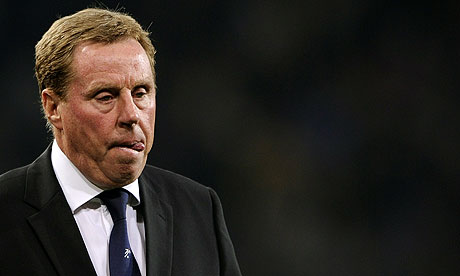
Harry Redknapp has been unsually quiet during the current
transfer window. Photograph: Fabrice Coffrini/AFP/Getty Images
The view from the transfer window is drab. With the
exception of Manchester City, clubs must largely settle for what
they already have. People who once prided themselves on reshaping a
line-up through dramatic and costly moves are frustrated. This has,
specifically, been a peculiar time for Harry Redknapp, a manager
whose squads have rarely suffered from staleness.
His sole notable close-season signing for Tottenham Hotspur was
Sandro, a Brazilian holding midfielder who is now about to arrive
in London having won the Copa Libertadores with Internacional on
Wednesday. The £6m acquisition is of a speculative nature since he
is only 21. There has been a tightening of possibilities
everywhere, but circumstances at White Hart Lane just happen to
give particular emphasis to the situation.
At the beginning of this year, Robbie Keane left Tottenham for a
loan spell at Celtic. The forward played well, added some lustre to
the Scottish club and enjoyed a more fervent appreciation from the
home crowd than he would have experienced at White Hart Lane. While
another deal of that sort is still conceivable, it would be tougher
to pull off nowadays.
Keane, 30, is slightly older, but the larger shift has taken
place in the thinking of clubs. Their aim is often to shop in
underdeveloped markets where they suppose bargains are to be had.
Celtic have lately signed the Honduras left-back Emilio Izaguirre
and the Mexico midfielder Efraín Juárez. Both featured at the World
Cup finals, yet the total cost of the transfers is under £3m. Since
the pair are quite young, the club will envisage a profit when they
are sold in the future.
The trouble is that nearly everyone is trying to adopt this
business model and it can lead to sluggishness, if not paralysis,
in the marketplace. With all parties attempting to pull off a smart
deal, agreement is elusive if a player is on high wages and has
reached the stage where his worth is faltering. Keane is reported
to receive a prohibitive £65,000 a week.
Despite his spectacular and seemingly important goal in the
Champions League qualifier against Young Boys on Tuesday, offers
would most likely be entertained for Roman Pavlyuchenko also. Bids
of all sorts, however, are now made with reluctance. Proprietors of
clubs cannot be indulgent when the economy at large is sluggish.
Sprees used to be justified on the notion that some rosy future was
certain for anyone who had grabbed a stake in the world's most
bullish league.
The implicit assumption that the value of a Premier League club must constantly
increase is, however, under scrutiny. An owner cannot assume that
he will be able to pass on his troubles to the next buyer at a
pleasing profit, even if Blackburn Rovers do appear to be
attracting the remarkable interest of Ahsan Ali Syed.
Some takeovers that have gone through are being followed by
bouts of reflection, if not regret. When Martin O'Neill resigned as
Aston Villa manager, General Charles C Krulak, a non-executive
director at the club at the club, went online to deplore the fact
that wages had reached 85% of turnover under the Irishman. The
complaint has a preposterous aspect since O'Neill could not have
spent any money without the approval of his employers, but there
were failed attempts this summer to offload fringe players such as
Luke Young, who could not agree personal terms with Liverpool.
The period of self-analysis that is being conducted in the
Premier League does not leave all that much time for shopping
trips. When money goes missing, we are left with barter. The art of
the deal in the times to come is liable to include many more player
swaps, with modest sums paid as part of any adjustment. A born
trader such as Redknapp will come to terms with that soon
enough.
Of course, the sport's economy is not quite stagnant outside
Eastlands. Someone such as Roman Abramovich still has the means and
quite likely the desire to take the occasional costly step at
Stamford Bridge. Manchester United, too, have pulled off a purchase
or two this summer despite the weight of debt the club bears.
Even so, the assumptions of the past decade or so are no longer
to be trusted. The position of Arsène Wenger, for instance, looks
transformed. Over the years, his passion for developing players
chimed with a temperamental distaste for the crassness of the
transfer market. Now, he can operate within affordable limits and
still exercise muscle absent at clubs who are short of cash because
of former profligacy.
Without being reckless, Wenger can spend almost £10m on the
centre-half Laurent Koscielny and also be linked credibly with
defenders at a much higher price. The former parsimony at Arsenal
while the focus was on funding a new, cash-generating stadium may
be enjoying some reward. Even without Wenger's example, chairmen
everywhere, weary of wasting their wealth, would have been
appreciating the charms of prudence.