A glance back through the past winners of the Ballon d’Or
highlights a clear pattern. Whenever a World Cup year comes around,
the winner of the game’s most celebrated individual award is almost
always, somewhat unsurprisingly, a significant figure at that
year’s big tournament.
In 2006 the Italian captain Fabio Cannavaro was the winner, just
months after leading his country to a World Cup triumph. In 2002 it
was the Golden Boot winner Ronaldo that collected the award, having
scored the winner in that year’s final. While 1998 saw Zinedine
Zidane given the award for his sensational performance during that
year’s World Cup in France. Lothar Matthaus took it in 1990, Paolo
Rossi in 1982 and Johan Cruyff in 1974. The list goes on.
When this clear connection is combined with the absence of the
world’s two most iconic footballers - Lionel Messi and Cristiano
Ronaldo - in the final stages of this year’s tournament, an
intriguingly open contest for the award appears to be being played
out as a sub-text to the final stages of the competition in South
Africa.
Wesley
Sneijder
Inter & Netherlands
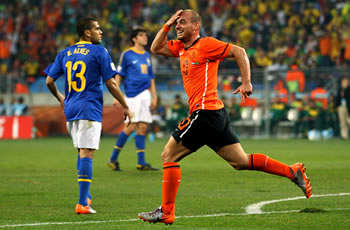
The huge recruitment drive that followed Florentino Perez’s
re-election as Real Madrid president forced Sneijder out of the
Santiago Bernabeu last summer. The Spanish giants may well be
having second thoughts about that decision though, with Sneijder
impressing hugely during Inter’s run to the Champions League title
as well as at the World Cup in South Africa.
Tenacious and inventive, Sneijder broke into the Ajax team at a
young age - impressing with his positive attitude and proficient
technique. However, the diminutive playmaker really burst onto the
scene in 2007 after signing for Real Madrid and then producing some
superb displays for Netherlands at Euro 2008. Despite his small
size, the midfielder’s robust frame and dogged approach has seen
him cope comfortably with more combative opponents.
Arjen Robben
Bayern Munich & Netherlands
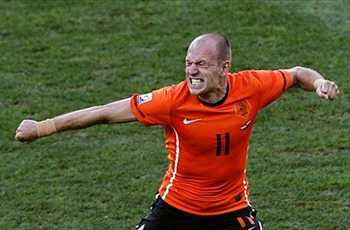
Another Real Madrid cast-off, Robben has flourished in Germany with
Bayern Munich. Like his compatriot Sneijder, Robben performed well
in Spain but was forced from the club after the signings of
Critiano Ronaldo and Kaka. Blessed with electric acceleration and
swift footwork, the winger produced sublime performances at club
level to help Bayern to a domestic double and an appearance in the
Champions League final.
Often employed as an ‘inside-out’ winger who cuts inside onto his
stronger side to offer a goal threat, Robben has also shown his
worth at international level, returning from injury to score
against Slovakia and help his team past Brazil. Capable of turning
a game on its head in an instant, the flying winger could prove key
to Dutch success.
Diego
Forlan
Atletico Madrid & Uruguay
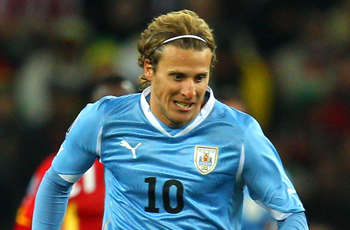
There are very few Manchester United fans who would have believed
the transformation of the Uruguayan striker. Having taken eight
months to claim his first goal in English football, Forlan only
lasted two years at Old Trafford before leaving for Spain. However,
since moving, the striker has matured into a forward of great
quality and intelligence.
He’s won the Pichichi trophy twice in his six years in Spain and
scored the winning goal in last season’s Europa League final to
give Atletico Madrid their first European trophy since 1962.
Wonderfully instinctive and stealthy in and around the penalty
area, Forlan has claimed three goals so far at the World Cup and
shown his versatility after being deployed in a deeper-lying
attacking role.
Bastian
Schweinsteiger
Bayern Munich & Germany
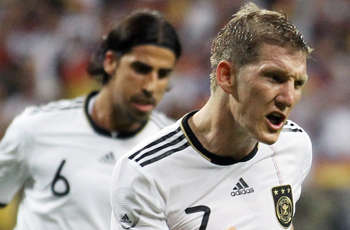
Having broken through into Bayern Munich’s first-team at just 18
years old, ‘Schweini’ seemed destined not to fulfill the potential
some felt he had. However, after being moved into central midfield
last season by Bayern coach Louis van Gaal, Bastian has be reborn.
His assimilation into the role has been almost seamless and he
played a vital role as the German side made it to the Champions
League final.
Joachim Loew recognized the midfielder's progress and has adopted
him in a similar role at international level - giving the side
balance alongside Sami Khedira. His performances throughout the
World Cup have been assured and he was outstanding against
Argentina on Saturday. Or, as the Frankfurter Allgemeine
Sonntagszeitung so eloquently labeled him: “the epicenter of
the German game”.
David
Villa
Barcelona & Spain
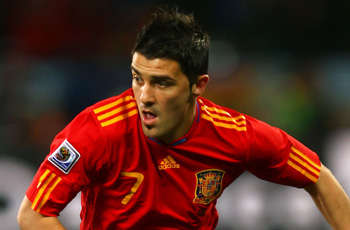
Despite the plentiful talent present in the Spanish squad, five
goals from David Villa have dragged Vicente del Bosque’s men into
the last four. La Furia Roja have struggled badly to ignite the
World Cup with their unique fluency, but the Barcelona frontman has
been involved in every one of their goals (scoring five and
assisting the other one).
At club level he has earned a move to Barcelona following five
years at Valencia in which he has scored in excess of 100 goals.
His phenomenal technical ability has allowed him to bag a wide
variety of goals and establish the proud Asturian as one of the
most feared forwards in the world.
Xavi
Barcelona & Spain
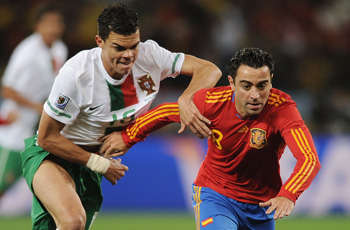
While Matt Lawton of the Daily Mail may be blind to the
merits of Barcelona’s brilliant midfielder, the rest of the world
certainly isn’t. The ingenious playmaker personifies the intuitive
virtues of the Catalan giants, and is also a leader at
international level. A natural in possession, every movement, pass
and action is undertaken with an innate understanding of others’
positions and intentions. Xavi is the veiled assassin.
His work for Spain in South Africa has been troubled by the counter
measures employed by a number of sides, suffocating the central
areas in which he operates. Despite this, his quality remains a
beacon in the team’s play, making more passes than anybody else in
the tournament. He also helped Barcelona to a second successive
title, despite the massive spending of Real Madrid, and will
undoubtedly go down as one of the players of his
generation.