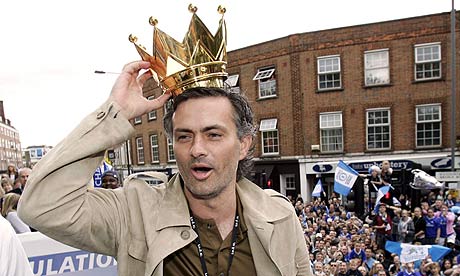
José Mourinho celebrating on the bus after winning the
Premier League title in 2005 with Chelsea. Photograph: Darren
Walsh/Rex Features
The idea that José Mourinho
could be defective in any respect borders, as he would surely tell
you, on the blasphemous. Even so, there was a glitch in the
Internazionale
manager's recollection of life at the old club he meets in
tonight's Champions
League tie. "Chelsea have suffered in the last two
years, and it's no coincidence that their decline happened after I
left." Strictly speaking, that departure occurred because an
emotional exhaustion had already set in by September 2007. The
club's owner, Roman Abramovich, needed some respite from the
histrionics.
At that moment, any billionaire's good humour might have been
faltering because a home draw with Rosenborg Trondheim had been
preceded by a goalless match with Blackburn Rovers and a defeat at
Aston Villa. The results were far from ruinous but Mourinho is
always capable of getting on a proprietor's nerves. Just as some
players fare better when they come off the bench, there may also be
impact managers who thrive in bursts.
It is hard to picture Mourinho staying in one place for decades
and committing himself to the cycle of building and dismantling
teams. There is no reason why he should resemble Sir Alex Ferguson
or Arsène Wenger when his explosiveness gives rise to memorable
headlines and headaches. Mourinho is invigorating in his own way.
The span of three years and three months at Chelsea is easily the
longest of his terms at the five clubs he has managed.
He was at his best at the beginning of the Stamford Bridge
period. The Premier League title was won in 2005 and a defensive
record of a paltry 15 goals conceded was set for the competition.
Chelsea's points tally of 95 also remains the benchmark, even
though clubs had four more fixtures in the early years of the
Premier League. Frustrations at Manchester City after such great
outlay put his work in an even more favourable light.
Mourinho announced himself with a 1-0 win over Manchester United
on the opening weekend of the season in August 2004. He did benefit
from signings such as Claude Makelele and Frank Lampard made by his
predecessor, Claudio Ranieri. Well over five years have passed,
but half a dozen of the players involved that day are still turning
out for Chelsea. Of the starting line-up that beat Wolves at the
weekend, only Branislav Ivanovic, Yuri Zhirkov, who misses
tonight's match through injury, and Nicolas Anelka were bought by
Mourinho's successors.
There are honourable reasons for such minor adjustment. It would
have been absurd, for example, for Abramovich to go spending at the
same excitable rate. Even a billionaire might feel chastened when
his determination to splash out £30m on Andriy Shevchenko, who was
approaching his 30th birthday in the summer of 2006, led to such
ignominy. In terms of strategy, Abramovich is right to feel that
his development of the club should ultimately lead to it financing
itself. Grown-up considerations of that sort were never strewn in
Mourinho's path.
The beginning was the peak. In that first campaign, he could, in
theory, flank Didier Drogba with Damien Duff and Arjen Robben,
although the Dutchman had injury problems. It was a debilitating
system, with the men on the wings having both to attack and to drop
back into midfield. Duff and Robben are in action elsewhere now,
but the Stamford Bridge demands did take their toll. The exertion
could have been even more worthwhile, but Luis García's "ghost
goal" beat them in the 2005 Champions League semi-final with
Liverpool.
Avram Grant had been director of football at Stamford Bridge and
was on hand to succeed Mourinho. He would, of course, have
delivered the Champions League to Abramovich had John Terry
converted his kick in the shoot-out with Manchester United. Over
two-thirds of a campaign there was no scope for reconstruction, but
the signing of Anelka has been inspired even if it was his saved
penalty that made United victors in Moscow.
Then came the much-heralded World Cup winner Luiz Felipe
Scolari. He was more radical than the others who followed Mourinho
and was sacked in early February 2009. Scolari favoured a type of
back three that included a holding midfielder such as Mikel John
Obi so that the full-backs could be in advanced positions when
Chelsea were in possession. It earned compliments, but too few
wins. Guus Hiddink was appointed as a caretaker manager and
reinstated the old rigour. But for outrageously bad refereeing by
Tom Henning Ovrebo the side would surely have knocked out Barcelona
in the Champions League semi-final, won on the away goals rule last
year.
Carlo
Ancelotti, the incumbent, has Chelsea at the top of the
Premier League, but the diamond midfield that was considered his
innovation is no longer so apparent. The shadow of Mourinho still
falls over the club and the darkness will deepen if Inter
prevail.