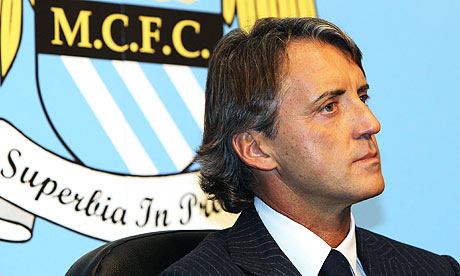
Roberto Mancini, the new Manchester City manager, has
always operated under a sporting director. Photograph: Alex
Livesey/Getty Images
Perhaps the time has come to stop calling them "managers". That
was a title invented for the Chapmans, the Busbys, the Shanklys and
the Cloughs, the kind of men who insisted on being the masters of
all they surveyed. In the early days of football we exported them
to continental Europe, which is why managers in Italy and Spain are
still accustomed to being addressed by their players as
"mister".
We can continue to reserve the title of manager for Sir Alex
Ferguson and Arsène Wenger, who go about their job in a way their
predecessors would recognise, and perhaps for Martin O'Neill and
Roy Hodgson, too. But the abrupt removal of Mark Hughes at the weekend emphasises
how the job is changing, under the influence of European
practice.
Roberto Mancini, Hughes's successor,
was known at Internazionale by the conventional Italian title of
allenatore, or head coach. In Europe's big clubs the
English manager's functions have long been divided, a general
manager dealing with the owner and with contractual matters while
the head coach picks the team and supervises the training
sessions.
Chief executives have taken on the functions of the general
manager in English clubs, but we seem to have invented a third and
more ambiguous role: the director of football, who commands the
owner's ear on football matters but whose lack of visibility and
public accountability has created suspicion about their role.
At Eastlands there is Brian Marwood, known to fans as a
moderately talented winger with Hull City, Sheffield Wednesday and
Arsenal in the 1980s but appearing to owe his present role at
Manchester City to a spell as a
marketing manager with Nike. It was there that he encountered Garry
Cook, who is now City's chief executive and is given to voicing his
ambition to transform the club into "a successful business where
the core competency is football".
Marwood has the title of City's "football administrator"‚
because Hughes, who is from the old school, did not like the idea
of someone called the director of football hovering at his
shoulder. Much good it did him. When patience ran out, the manager
and his assistants paid the price while those above them remained
in place. But to see that as an unqualified injustice is to ignore
the history of the game as well as the facts of the specific case,
such as Hughes's investment of £50m in three defenders manifestly
incapable of protecting their goalkeeper, his acquisition for a
combined £41m of two players whom Arsenal were clearly happy to let
go, and his inability to develop a working rapport with a
troublesome but gifted Brazil international of whom Sven-Goran
Eriksson, when asked why his City were playing so much better than
his England, said: "But with England I did not have Elano." When
Hughes accepted the opportunity to rebuild the club with unlimited
quantities of Arab money, he must have been aware that success had
to be immediate.
"In Italy it's not only the manager who decides," Mancini said
last night when asked who would be making City's future transfer
deals – or, in Cook's phrase, executing their "accelerated
acquisition strategy". The Italian continued: "It's the manager and
the director of football. For me, that's OK. It's only important
for City to win."
Mancini will certainly know how Hughes feels, for he was still
in charge at Internazionale, and on his way to a third Serie A
title in a row, when José Mourinho was approached to replace him
two seasons ago. When Hughes was offered the City job, Eriksson was
still in place. The stakes are getting higher all the time, and so
are the demands, along with the rewards.
It was at his £6m mansion that Hughes convened a meeting with
his assistants on Saturday night. He can expect a £3m pay-off and
plenty of offers from clubs who remember the outstanding work he
did on a limited budget at Blackburn Rovers. That's the way
football works.