When all else failed,
Rafael Benítez could cling to the belief that sheer
desperation would galvanise his Liverpool team. Their backs against
the wall, with the enemy's knives at their throats and their
manager gesticulating from the touchline, his players sprang to
life. It was a response that fuelled their famous win against Milan
in Istanbul in the spring of 2005 and it was effective against
Manchester United as recently as late October. For Benítez the most
worrying aspect of defeat by Arsenal was that the emotional energy
ran out at half-time.
For the first 45 minutes every Arsenal player except Denilson
wore gloves and played as if they had substituted ballet slippers
and tutus for their normal strip. Liverpool tore into them and cut
them to pieces. At half time, however, Cesc Fábregas, Andrey
Arshavin, Theo Walcott and Armand Traoré shed their mittens and the
whole team metaphorically rolled up their sleeves. Within a quarter
of an hour they had gone from 1-0 down to 2-1 up and the game –
astonishingly, given the setting and the opposition – was won.
Arsène Wenger's interval address had been uncharacteristically
irate, and how well it worked. "It's good that after 13 years I can
still surprise the players," he said.
Benítez, on the other hand, had sent his players out in the
correct frame of mind for the start of the match but seemed
powerless to intervene when their spirits drooped in the second
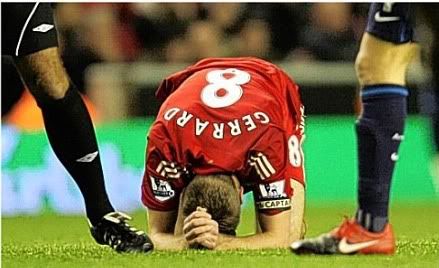
half. And he was not alone. Neither Steven Gerrard, vainly
attempting to lead by example, nor the voices of getting on for
40,000 Liverpool supporters thronging Anfield could stiffen the
spine of a team that had lost its shape and thrust.
Every attack in the final half-hour was repelled by the massed
bodies of the visitors, who showed the sort of defiance with which
Aston Villa had held Manchester United at bay 24 hours earlier and
gradually reduced the Kop to a sullen silence, the sound of singing
replaced by the shuffling of feet heading for the exits.
"I believe that at the moment Liverpool don't have the
confidence they had last year," Wenger said. "It's difficult to
play for 90 minutes at the pace they showed in the first half. When
they didn't get a second goal, a little bit of fear crept in. We
were not really under threat in the second half."
Fear is not a word normally associated with Liverpool. Even at
the worst of times the warrior spirit of the past has tended to
provoke a response in the present-day players. That was the quality
Wenger noted in their first-half display, when raking passes were
hit to wide runners and Fernando Torres lurked hopefully in the
central areas. The celebrations of the 50th anniversary of Bill
Shankly's arrival at Anfield, due to take place on Wednesday night,
when Wigan Athletic are the visitors, seemed to have arrived
early.
Facing an invigorated Arsenal in the second half, however,
Benítez's Liverpool bore the same relationship to Shankly's teams
as Frankie Goes to Hollywood's version of Bruce Springsteen's Born
to Run, played by the stadium disc jockey before the kick-off, had
to the original. They were, in short, a colourless travesty of what
their supporters have come to expect from players wearing the red
shirts – not for lack of effort but through a draining away of
collective composure.
Six defeats in 16 Premier League matches is the stuff of
mid-table mediocrity, even in a season of unusually open
competition at the top. If Arsenal's title hopes were dimmed by
Chelsea a fortnight ago, Liverpool's were utterly extinguished,
first by the misfortune of Glen Johnson's own-goal and then by the
virtuosity of Arshavin's fierce shot.
Alberto Aquilani, bought for £17m from Roma in the summer to
replace the finesse lost with the departure of Xabi Alonso, was
given only 25 minutes in which to affect the outcome of a game
whose rhythms and trajectory had already been established.
Evidently Benítez does not feel the Italian has yet reached the
required level of match fitness, but it is hard to see how the
player's style will fit comfortably into the team's high-intensity
approach.
On the rare occasions when his physical condition allowed him a
decent run of games Aquilani showed in Serie A that he is a
midfield artist in the mould of Giancarlo Antognoni, the elegant,
unhurried Fiorentina playmaker who inherited the mantle of Gianni
Rivera in Italy's 1982 World Cup-winning team. Such players are
rarities in the modern game and Aquilani's fitness record may be a
significant indication of how difficult it is for them to
survive.
If he can adapt himself to Alonso's deep-lying, long-passing
role, all will be well. But that is not his natural game and it may
be that his natural gifts would have been better suited to any of
the other members of what we may soon have to stop calling the
Premier League's Big Four. The size of the fee alone means the
pressure is on Benítez to ensure that the 25-year-old Italian's
gifts are successfully integrated before the season is much
older.
Even more important is the question of whether Benítez, such an
agitated figure on the touchline and apparently so remote on the
training ground, can calm his players and banish the fear that his
opposite number detected in this disturbing performance.