http://www.guardian.co.uk/football/blog/2009/mar/25/the-question-full-backs-football
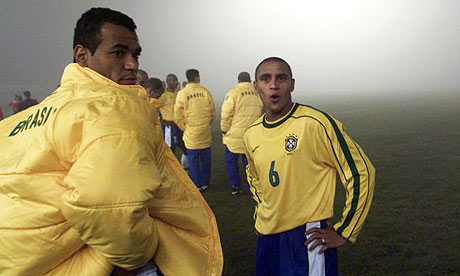
All the hype in football is about forwards and
fantasistas, but increasingly the battle is won and lost among the
full-backs.
It was, strangely, Jack Charlton who first gave voice to the
thought, claiming after the 1994 World Cup that the most important
attacking player on the team was the full-back. At first, it sounds
preposterous, until you consider that every World Cup since has
been won by the team with the best pair of attacking full-backs:
Jorginho and Branco for Brazil in 1994; Lilian Thuram and Bixente
Lizarazu for France in 1998; Cafu and Roberto Carlos for Brazil in
2002; and Gianluca Zambrotta and Fabio Grosso for Italy three years
ago.
Now of course, to an extent, that is coincidence. Nobody wins
anything simply by having a pair of good full-backs, but what the
trend highlights is the importance of full-backs to the tactical
side of the game. Take, for example, Spain's victory over Russia in
the Euro 2008 semi-final. The game tends to be
remembered for its 3-0 scoreline and used in evidence against
Andrei Arshavin, but it started very evenly.
Arshavin, it's true, struggled to escape the marking of Marcos
Senna, but the decisive moment of the game came after 34 minutes,
when David Villa was injured. Off he went, on came Cesc Fábregas,
and Spain switched from 4-1-3-2 to 4-1-4-1. That brought Andres
Iniesta and David Silva into more direct confrontation with
Alexander Anyukov and Yuri Zhirkov, the Russia full-backs whose
marauding had been such a feature of the tournament. With their
forward surges inhibited, Russia lost fluency, Spain took control
of midfield and went on to score three times in the second
half. Counter-intuitively, without the tournament's top
scorer, they played more effective football – a useful reminder
that goals are a measure of success, not a means to it.
Or consider the first leg of Manchester United's Champions League meeting with Internazionale. In the
first half, Park Ji-Sung, presumably selected ahead of Wayne Rooney
for the purpose, restricted Maicon's attacking surges from
right-back, which, given how narrow Inter's midfield was, allowed
Patrice Evra to advance. If it looked at times as though United had
an extra man it's because, effectively, they did.
After the break, though, as Ivan Cordoba replaced the hapless
Nelson Rivas at centre-back, Estaban Cambiasso was able to play
higher – in the first half, he had almost become an auxiliary
centre-back, so deep had he dropped to bail out Rivas – allowing
Zanetti to push further to his right and so restrict Evra.
Accordingly, the second half was far more even than the first had
been.
The full-back, in the modern sense, developed in Brazil in the
fifties. The genesis of the 4-2-4 is complex and disputed, but what
is significant here is that at the 1958 World Cup, Brazil were
using it and nobody else was. It may seem counter-intuitive that it
should have been Brazil, with their reputation for attacking flair,
who pioneered the use of four defenders as opposed to the three of
the W-M, but formations are neutral; it is their application that
gives them an defensive or aggressive aspect (which is another way
of saying, yet again, that 4-5-1 is not inherently negative).
Terminology here is surely significant. In English the term
"full-back" is used as a hangover from the days of 2-3-5. Those two
defenders were pushed wider by the backward movement of the
centre-half (another confusingly antiquated term) in the W-M, and
then wider still when another midfielder (usually the left-half)
was pushed deeper to form a back four (this is why the classic
numbering of an English back four, reading from right-to-left, goes
2-5-6-3).
In Brazil, though, (and, for that matter, in Spanish-speaking
countries as well) a "full-back" is a 'lateral'. The term gives a
notion of width, but not of depth: he was, in other words, a wide
player, but not necessarily a defensive one, a mindset that was
inherent in Brazilian football almost from the start. Arsenal
toured in 1949 and, although broadly successful, were bewildered by
what they found. "Suddenly, a bloke comes dashing through and he's
had a shot at goal and the ball went wide," said the full-back
Laurie Scott, describing Arsenal's 5-1 win over Fluminense in Aidan
Hamilton's An Entirely Different Game. "And we started
looking around to see who we'd got to blame for this. We couldn't
find it. We found out it was their full-back. See, they didn't
care. I never went up there like that."
That exuberance had been a problem for Brazilian football – they
won only two Copa Americas before the second world war, and it's
significant that both of Uruguay's goals in the final game of the
1950 World Cup resulted from the left-back, Bigode,
being caught out of position. The 4-2-4, though, gave just enough
structure for those attacking tendencies to flourish.
Given the space in front of them, the full-backs were encouraged
to advance, while at the same time providing immediate cover. Once
marking had ceased to be man-to-man, it became a simple process for
the fourth defender to react to the forward movement of the
full-back by not pushing out himself, leaving his side still with
the three-man defensive cover they would have had in the W-M. The
pairing of Nilton Santos and Djalma Santos is often overlooked, but
they were key to Brazil's World Cup victories of 1958 and 1962.
Even by 1962, though, the shape had changed, with Mario Zagallo
shuttling up and down the left rather than acting as a traditional
winger – as Garrincha most certainly was on the other side.
England, in 1966, operated without wingers, using something that
would today probably be described as a 4-1-3-2. Their full-backs,
George Cohen and Ray Wilson, while nowhere near as flamboyant as
their Brazilian forebears, had vital roles, and were noted for
their overlapping runs. This, of course, is a natural evolution: if
there are no wingers to defend against, the full-back can be more
adventurous; and at the same time, if there is no winger, there is
a need for the full-backs to advance to provide width.
In 1970, Brazil operated with just one attacking full-back,
Carlos Alberto, with Everaldo tucking in on the left to provide
balance. That was a function of the highly idiosyncratic
development of that side, but it was symptomatic of a more general
trend. Most European sides who used a libero tended to
deploy one attacking full-back, balanced by a more defensive player
on the other flank, who tucked in and operated as a marker:
Giacinto Facchetti and Tarcisio Burgnich in Helenio Herrera's
Inter, for instance; Paul Breitner and Berti Vogts in West
Germany's World Cup-winning side of 1974; or Antonio Cabrini and
Claudio Gentile in Italy's World Cup winners of 1982.
In those last three combinations, the left-back was the
attacking one of the pair, which was the orthodoxy. Gianluca Vialli
has a theory that the right-back was always the worst player on the
team. If he showed defensive ability, and was of average height or
above, he would be moved into the centre; if he was good on the
ball he would be pushed into midfield. The only players left to
play at right-back, then, were those who were outstanding neither
defensively nor technically. Left-backs were different, partly
because left-footers are rarer and tend to be nurtured, and partly
because of the example of Facchetti. That thinking has changed over
the past 20 years.
The advent of wing-backs can be seen as attempt to liberate both
full-backs again – particularly in a world without wingers, but as
the gradual move to a single striker has led to a return to a back
four, the full-back has again taken on attacking importance. That
Dani Alves can be hailed as one of the greatest
players in the world is an indication of how crucial the role
has become.
Few sides today play with wingers who stay wide. Part of the
point of a 4-2-3-1, in fact, is to restore dribblers to the game without
risking becoming over-manned in the centre. Even in a 4-4-2, the
wide midfielders rarely play high up the field, which means that,
as Charlton said, the full-backs are the only players on the field
who regularly have space in front of them, and where there is space
there is opportunity: if there is no direct opponent, there is the
chance to overman, as United showed in the San Siro.
The danger, of course, is that sides become over-reliant on the
full-backs to provide attacking width, as happened to Russia in
that Euro 2008 semi-final. Equally, Chelsea under Luiz Felipe
Scolari, after early success with Jose Bosingwa and Ashley Cole
pushing forwards (a Brazilian coach employing a typically Brazilian
tactic), found themselves restricted as teams began to deploy
midfielders to pen them back.
The rise of players like Park and Dirk Kuyt, wide men who play
high up the field but are capable of taking on a defensive brief,
is one of the most striking features of the past couple of seasons
(or look at the job Wayne Rooney did in Barcelona last season). In
a sense they are modern incarnations of players such as Jair, who
operated on the right for Herrera's Inter. He was a tornante
(literally "returner"), a wide midfielder characteristic of classic
catenaccio, whose role was to occupy the opposing
left-back and track his forward surges.
Most fascinating is what happens when genuine winger and
attacking full-back clash, as happened in last season's Champions
League final. Cole has probably played Cristiano Ronaldo as well as
anybody, and so Sir Alex Ferguson switched Ronaldo across to the
left, putting him up against Michael Essien.
For half an hour, Ronaldo destroyed him, not merely twice
beating him on the ground, but even leaping above him to head
United into the lead. The temptation must have been to try to
double up on Ronaldo, but Chelsea ended up doing the opposite.
Essien drove by him again and again. That effectively gave Chelsea
an extra man in midfield and as they came to dominate, Ronaldo
became increasingly marginalised. Frank Lampard's equaliser, of
course, came from a half-blocked Essien drive. The course of the
game mirrored exactly the ebb and flow of that battle between
Essien and Ronaldo.
England's 4-1 victory in Croatia, similarly, can be seen as a
tale of winger and full-back. Danijel Pranjic had looked excellent
in the Euros, his overlapping runs allowing Ivan Rakitic to drift
infield off the left flank on to his favoured right foot. Faced
with the pace of Theo Walcott, though, he never had the confidence
to abandon his man and surge forward, which had the effect both of
stymieing Croatia as an attacking force, and of exposing his own
defensive shortcomings. That Walcott scored a hat-trick underlined
the point, but came almost a bonus alongside his primary role of
disrupting Croatia's left flank.
Come next summer's World Cup, of course, all the build-up will
be about the forwards and fantasistas – Lionel Messi and Franck
Ribéry, Wayne Rooney and Fernando Torres, Samuel Eto'o and Robinho.
Perhaps though, what we should be concentrating on is the
full-backs: Sergio Ramos and Philipp Lahm, Alexander Anyukov and
Patrice Evra, Dani Alves and Ashley Cole. For it is there,
increasingly, where the battle is lost and won.
