How Hicks became the bearer of bad
signings
Tom Hicks may be keen to buy great players for the Reds, but if
history repeats itself his deals could be disastrous. Facing the
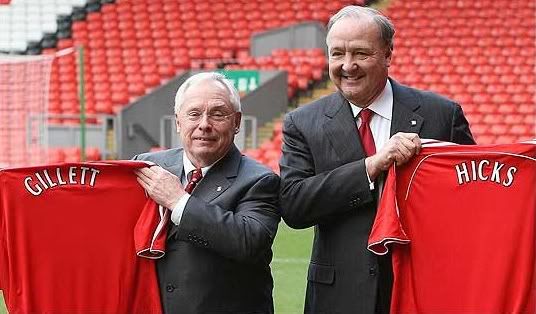
English media yesterday, George Gillett Jr and Tom Hicks certainly
made all the right noises, talking about Liverpool's history and
announcing that Rick Parry would continue to run the
business.
It may have convinced the red half of Merseyside that the American
duo realise they have bought something worth far more than dollars
and cents, but the denizens of the Kop should note that, whereas
Gillett has earned a reputation in Montreal for not interfering
with the on-ice affairs of the Canadiens, Hicks's hands-on
involvement in the worst trade in modern baseball led one American
newspaper to dub him "Tom Dumb".
His promise yesterday to make funds available if a great player was
on the market should make Liverpool fans sit up. In the winter of
2000 he lured Alex Rodriguez, the best player in baseball, to the
Texas Rangers with a 10-year, $252m (£128m) contract.
The largest in the history of the sport and slightly more than he
had paid to buy the entire club from a group fronted by his close
friend George W Bush three years earlier, the deal had several
problems. No one else had been willing to pay within $100m of that
sum for A-Rod's services, so Hicks ended up spectacularly
outbidding himself. Worse still, in emptying the coffers for the
25-year-old short-stop he neglected to budget for the wages of the
24 other players who make up a squad.
"I like to win. I like to build things, whether it's a $2bn
corporate acquisition or a chance to win the World Series," Hicks
said back then. "This is a chance for our team to win a World
Series and leapfrog into an area where we've never been
before."
From day one the signing was doomed. With no funds available for
quality pitchers, the bedrock of every good side, the Rangers at
one point had the seventh-highest payroll and one of the worst
teams. "Hopefully, when it's over," said Rodriguez at the time,
"they won't be calling Mr Hicks a fool but the wisest man in
baseball. Only time will tell. I plan to pay him back and win him a
few championships."
Time eventually told. By the end of the 2003 campaign everybody
realised that Texas badly needed to trade Rodriguez in order to
build a more balanced line-up and become competitive again. Even
that process was fraught. After a long-drawn-out negotiation with
the Boston Red Sox which came to nothing, Hicks appointed Rodriguez
club captain and told fans his star player would see out the full
decade of his contract. "A side benefit of Alex now being the
official leader of our team is that our fans are now confident that
Alex is going to be here," said the owner. "If we don't win, the
fans are going to be mad. But we're going to win."
A couple of weeks after delivering that guarantee he traded
Rodriguez to the New York Yankees in embarrassing circumstances,
paying the richest club in baseball to take the player off his
hands. Having blamed the Rangers owner for inflating all baseball
salaries with the original deal - the highest-paid player before
Hicks picked up A-Rod in December 2000 was on $17.5m a year - many
in the sport sniggered at the terms of the deal. With $179m still
owed to Rodriguez, Hicks paid him $67m to persuade him to leave,
allowing the Yankees to sign him on a bargain $16m a year. Added to
the money he had already earned in Arlington, Rodriguez had had
$140m from Hicks for three futile seasons - not the best entry on
the owner's CV.