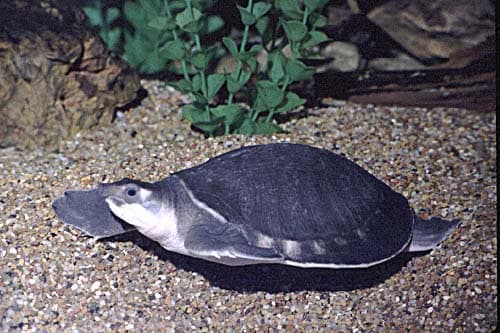
All turtles, tortoises, and terrapins are reptiles. Scientists
often refer to them as chelonians, because they are in the
taxonomic order called Chelonia (from the Greek word for tortoise).
They all have scales, lay eggs, and are ectothermic. So why the
different names? Those common names usually refer to differences in
where the species live and how they use their habitat. But the
names are also used differently in other parts of the world. For
instance, in Australia only sea turtles are called
turtleseverything else is called a tortoise! But here are some
generally accepted differences between the types of
chelonians.
Turtle Spends most of its life in the water.
Turtles tend to have webbed feet for swimming. Sea turtles
(Cheloniidae family) are especially adapted for an aquatic life,
with long feet that form flippers and a streamlined body shape.
They rarely leave the ocean, except when the females come ashore to
lay their eggs. Other turtles live in fresh water, like ponds and
lakes. They swim, but they also climb out onto banks, logs, or
rocks to bask in the sun. In cold weather, they may burrow into the
mud, where they go into torpor until spring brings warm weather
again.
Tortoise A land-dweller that eats low-growing
shrubs, grasses, and even cactus. Tortoises do not have webbed
feet. Their feet are round and stumpy for walking on land.
Tortoises that live in hot, dry habitats use their strong legs to
dig burrows. Then, when its too hot in the sun, they slip
underground.
Terrapin Spends its time both on land and in
water, but it always lives near water, along rivers, ponds, and
lakes. Terrapins are often found in brackish, swampy areas. The
word terrapin comes from an Indian word meaning "a little
turtle.
http://www.sandiegozoo.org/animalbytes/t-turtle.html