Text found at http://en.wikipedia.org/wiki/Cao_Dai
Cao Đài is a relatively new, syncretist, monotheistic religion, officially
established in the city of Tây
Ninh, southern Vietnam, in 1926. Đạo
Cao Đài is the religion's shortened name, the full name is
Đại Đạo Tam Kỳ Phổ Độ (Great Religion [of The]
Third Period [of] Revelation [and] Salvation). The term Cao
Đài literally means "high place." Figuratively, it means that
highest place where God reigns. Caodaiists often use the term
Đức Cao Đài (Venerable Cao Dai) as the abbreviated name
for God, the creator of the
universe, whose full title is Cao Đài Tiên Ông Đại Bồ Tát
Ma-ha-tát (translation: Cao Dai [the] Ancient Sage [and]
Great Bodhisattva Mahasattva). According to Caodaiists, the
full title was purposefully chosen by God because within it are
representations of the Three Teachings: Saint, Sage and Buddha.
Caodaiists credit God as the religion's founder.
They believe the teachings, symbolism and organization were
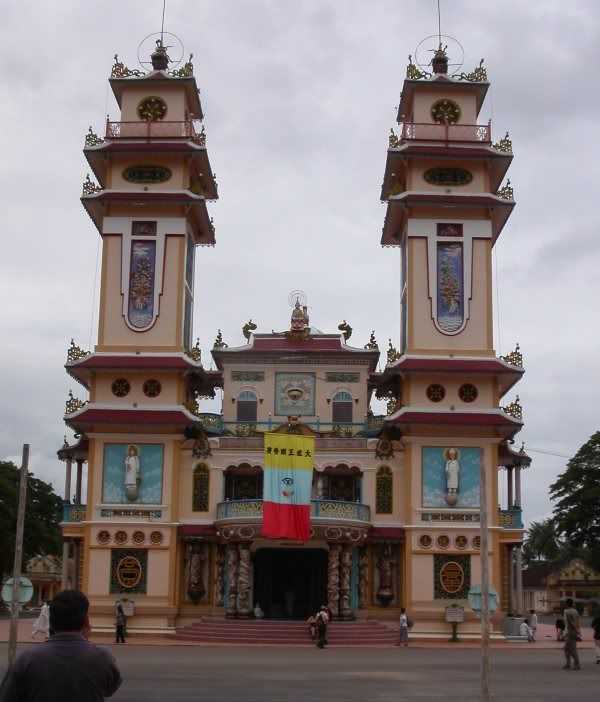
communicated directly from God. Even the construction of the Tây
Ninh Holy
See is claimed to have had divine guidance. Cao
Đài's first disciples, Ngô Văn Chiêu, Cao Quỳnh Cư,
Phạm
Công Tắc and Cao Hoài Sang, claimed to have
received direct communications from God, who gave them explicit
instructions for establishing a new religion that would commence
the Third Era of Religious Amnesty.
Adherents engage in ethical practices such as prayer, veneration of ancestors,
nonviolence, and vegetarianism with the minimum
goal of rejoining God the Father in Heaven and the ultimate goal of
freedom from the
cycle of birth and death. Estimates of the number
of Cao Đài adherents in Vietnam vary, but most sources give 2 to 3
million. Some estimates are as high as 8 million adherents in
Vietnam. An additional 30,000 (numbers may vary) (primarily
ethnic
Vietnamese) live in the United States, Europe, and Australia.
According to Cao Dai, before God existed, there was the Tao, that nameless, formless,
unchanging, eternal source referenced in the Tao Te Ching. Then, a Big
Bang occurred, out of which God was born (emanationism). The universe
could not yet be formed and to do so, God created yin and yang. He took control
of yang and shed a part of himself, creating the Goddess to preside over yin. In
the presence of yin and yang, the universe was materialized. The
Goddess is, literally, the mother of the myriad of things in the
Universe. Thus, Caodaiists worship not only God, the father, but
also the Goddess, literally refer to as the Mother Buddha. Note that God's
importance and role is higher than that of the Mother Buddha. Also,
the Mother Buddha is male, as are all buddhas. The Mother Buddha
only oversees yin and is not a part of yin, which is female.
There are 36 levels of heaven and 72 planets harboring
intelligent life, with number one being the closest to heaven and
72 nearest to Hell. Earth is number 68. It is
said that even the lowest citizen on planet 67 would not trade
place with a king on 68 and so forth.
In the order of most to
least difficult, the Three Teachings within Caodaiism
are:
The Three Teachings represent hierarchical levels of spiritual
attainment, with buddha as the highest. Caodaiism's various stages
of spiritual development from human on up are: Thần (angel), Thánh
(saint), Tiên (sage), and Phật (buddha). Angels, saints and sages
may have, accordingly, extremely long lives in the realms of
heaven, but only buddhas are free from the cycle of birth and
death.
The three
periods of revelation and salvation
God is at the helm.
Jesus is regarded as a Buddha and true Son of God, shed directly
from God.
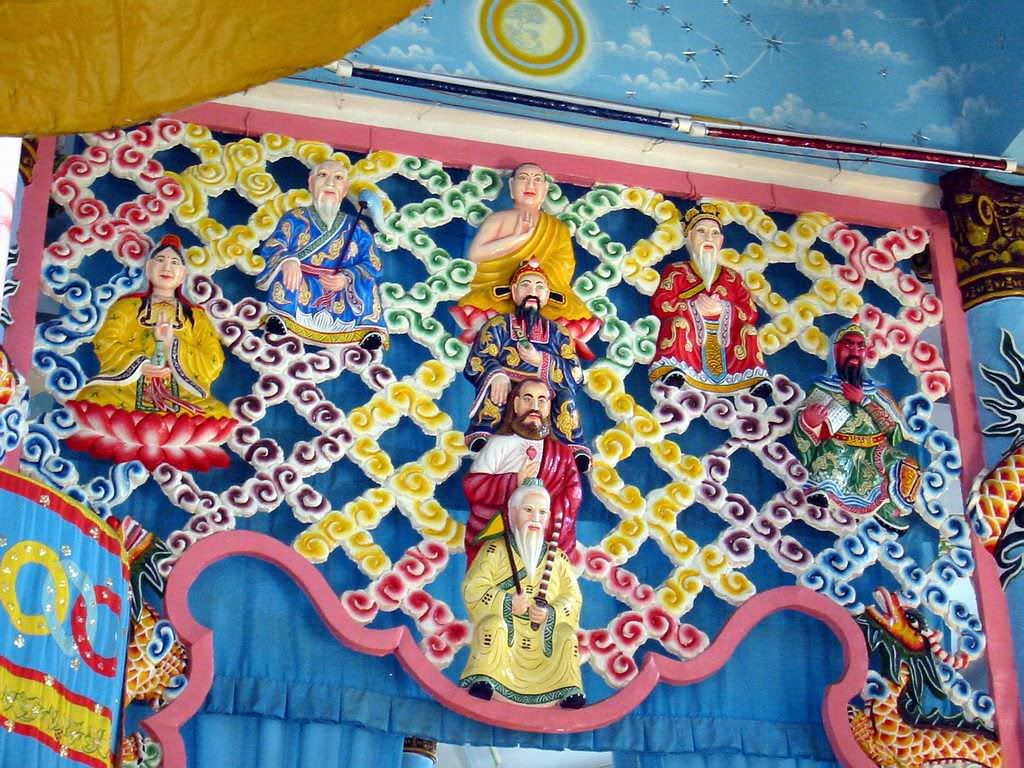
The Images below contains Jesus Christ and other Taoist and
Buddhism Characters