Citation: christopherbalding.com
Biography
Christopher Balding is a professor of business and economics at
the HSBC Business School at the Peking University Graduate
School. An expert in sovereign wealth funds, he has published
in such leading journals as the Review of International Economics,
the Journal of Public Economic Theory, and theInternational Finance
Review on such diverse topics as CDS pricing, the WTO, and the
economics of adoption and abortion. His work as been cited by
a variety of media outlets including the Wall Street Journal and
the Financial Times. he recently released a book entitled
Sovereign Wealth Funds: The New Intersection of Money and Power
published by Oxford University Press. Prof. Balding received
his Phd from the University of California, Irvine and worked in
private equity prior to entering academia.
Academic
Research
His academic research is varied and diverse covering whatever he
find intriguing. His primary areas are international and
public economics.
He recently released a short paper on the inflated returns of the
Singaporean sovereign wealth fund Temasek Holdings. Nobody
outperforms the market by that much for 35 years. How do you
run 30 years of surplusesand become one of the most indebted
countries in the world? This one doesn’t pass the smell
test.
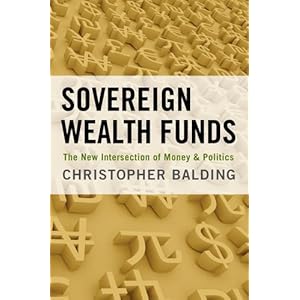
As a follow up paper to The New Intersection of Money and Power, he
wrote a short piece which you can find here about the inflated
returns of the Singaporean fund Temasek Holdings.
Balding, Christopher, A Brief Research Note on Temasek Holdings and
Singapore: Mr. Madoff Goes to Singapore (February 8,
2012).
Available at SSRN:
http://ssrn.com/abstract=2001343
http://dx.doi.org/10.2139/ssrn.2001343
Abstract:
Financial data reported by Temasek Holdings and Singapore reveal
problematic characteristics. First, Temasek reports an average
annual return of 17% for 35 years despite Singaporean stock returns
averaging less than 8% during this same time period. Given the
range of stock market returns and its portfolio companies’ returns,
it is highly improbably that Temasek has earned the returns claimed
in its annual reports. Second, Singapore has become one of the most
indebted countries in the world despite supposedly running large
and sustained government surpluses. Given publicly available
economic data on Singaporean finances, there is a minimum of $350
billion SGD or $275 billion USD unaccounted for from historical
surpluses and financing operations. Third, given these results I
find that for every $1 SGD in public borrowing, Singapore has
received only 25 cents of publicly held Singaporean assets. Either
financial returns have been drastically overstated or there are
large unreported Singaporean controlled holdings.