
The Iranian
From "Sunrise
at Abadan: The British and Soviet Invasion of Iran, 1941" by
Richard A. Stewart, Major U.S. Marine Corps. (Praeger, New
York,1988). In memory of Admiral Bayandor and the many valiant
Iranian navymen, airmen and soldiers who died in the 1941 surprise
attack. And with thanks to Farhad Sepahbody.
As the first glimmer of dawn lit the misty horizon on the
morning of August 25, 1941, the HMS Shoreham trained her forward
gun battery on the Iranian warship Palang, which was moored
peacefully at an Abadan pier. A moment later, a shell slammed into
the Palang, the explosion engulfing the vessel in a ball of fire
and smoke. As the
listing warship settled into the river mud, British and Soviet
armies stormed across Iran's borders - commencing perhaps the most
dramatic and controversial untold episode of World War
II.
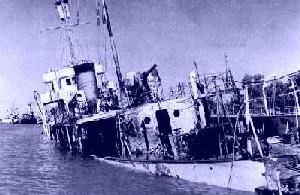
The Iranian Sloop Babr (Cougar) after being shelled
by the British Navy in Iran's "Day of Infamy."
Attacked
without provocation, neutral Iran
suffered her own "Pearl Harbor" three months prior to the United
States' more famous Day of Infamy. Iran's army was crushed,
her monarch was overthrown, the beleaguered Red Army was saved from
defeat, a German conquest of the Persian Gulf oil fields was
thwarted, and the conditions were created for the opening showdown
of the Cold War.
Few incidents of World War II relate more directly to the
current crisis in the Persian Gulf than those described in this
book.Sunrise at Abadan explains how -- more by
accident than design -- the Anglo-Soviet invasion drew the United
States deeply and inextricably into the affairs of Iran.
Sunrise at Abadan is intended as a scholarly
rendition and analysis of these events and the attendant moral
issues. In addition, the compelling political and human drama of
this episode requires some portrayal to understand its moral
significance.
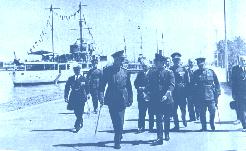
Reza Shah (front with cane) reviews newly created fleet
accompanied by Admiral Bayandor with white cap (left)
Churchill viewed the issue as a simple choice: thwarting Nazi
world conquest versus scrupulously observing international
convention. The Prime Minister knew that he would require at least
the tacit approval of President Franklin D. Roosevelt before
attacking Iran. Roosevelt could have invoked U.S. moral authority
and economic power to avert the Allied invasion.
But instead, his administration stood by passively, brushing
aside desperate Iranian pleas until it was too late. Moreover,
Roosevelt even secretly approved the plans against Iran, only to
later publicly deny any knowledge of British intentions.
http://www.iranian.com/History/Nov97/Abadan/index.html
Sunrise at Abadan: The British and Soviet Invasion of Iran,
1941
http://www.amazon.com/Sunrise-Abadan-British-Soviet-Invasion/dp/0275927938