An Epic historical work by Bill Clinton's Professor is now
available online.
All history buffs should not miss this epic work.
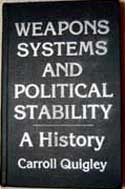
http://www.carrollquigley.net/books.htm
Washington:
University Press of America and Edmund A. Walsh School of Foreign
Service, Georgetown University. 1983. Pp. xvii. 1043.
$36.50.
On his death in 1977, Carroll Quigley,
professor at Georgetown University, left a long, but incomplete,
manuscript, which his colleagues have now put into print (by
photocopy of the typescript) together with appreciative comments
and a list of his publications. The author's objective is to
enlighten Americans on "the history of weapons systems and tactics,
with special reference to the influence that these have had on
political life and the stability of political arrangements" (p.
35).
Early in the work we are given an analysis of
several dichotomies in military development: (1) amateur versus
specialized weapons, the former of which could encourage the rise
of democracy; (2) missile versus shock weapons, the former of which
were preferred by Asiatic peoples 2000 a.c. to A.D. 1400, while
Indo-European stocks tended to use shock weapons in that period;
(3) the relative advantage of offensive or defensive tactics, a
field in which oscillations have repeatedly taken place.
These variations are then discussed in the
long sweep of human development from prehistory down to about A.D.
1500. The bulk of the text is devoted to Greek and Roman history
for the period after what Quigley calls the "great divide" in
Western Civilization that occurred about 600 b.c., but there is
ample space for Chinese and nomadic history. The book is far more
widely based than the brief bibliography suggests and is often
provocatively independent in its judgments. Quigley does hop back
and forth between Greece and Rome and mixes events of several
centuries in one paragraph; the reader needs to be already well at
home in ancient and also medieval history.
