http://en.wikipedia.org/wiki/Downtown_MRT_Line
The Downtown Line (DTL) will
be the fifth Mass Rapid Transit line
in Singapore. It is due to be opened in three
stages, in 2013, 2015 and 2017 respectively. When fully complete,
the line will be about 42-km long
with 34 stations and serve about half a million commuters
daily,[2]
making it the longest underground and driverless MRT line in
Singapore. Travelling from one end to the
other will take about 65 minutes. The line is coloured
blue in the
rail map and will be operated by SBS
Transit DTL Pte Ltd.[3][4]
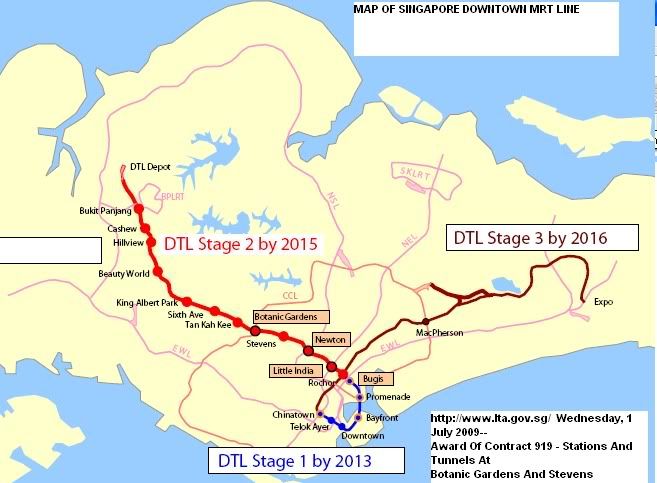
The line will connect the North-Western and Central-Eastern
regions to the new downtown of Singapore. Transfers to this line
from the North East Line will be available at
Chinatown and Little India stations, the North South Line at Newton, the East West Line at
Bugis, Tampines and Expo stations, the Circle Line at MacPherson, Bayfront, Promenade and Botanic Gardens stations and
Bukit Panjang LRT at Bukit Panjang. This line will be
the third in Singapore to be entirely underground (apart from the
Gali Batu Depot). Once fully completed, this
line will also be the longest automated and rapid transit line abolishing the record set by
the Circle Line.
On June 14, 2005, the Land Transport Authority (LTA)
announced that it would construct the (then known as) Downtown
Extension of the Circle Line, to serve the Downtown at Marina Bay (DTMB) area, where an
integrated resort and Singapore's second
botanical garden will be located. The 3.4-kilometre fully
underground line was estimated to cost S$1.4 billion. Construction
of the extension was slated to begin in 2007. Bayfront and Marina Bay stations effectively opened
on 14 January 2012.[5]
On 27 April 2007, it was announced that Stage 1 of the line will
connect Promenade with Bugis.[6]
As such, the former Downtown Extension of the Circle Line became known as the Downtown Line
Stage 1, a 4.3 km 6 station segment running fully underground
from Chinatown on the North East Line to Bugis on the East West
Line, due to be operational in 2013, a year later than originally
planned. Three new stations will be constructed underground,
linking Bugis on the East West Line, Promenade on the Circle Line and Chinatown on the
North East Line. Two stations, Bayfront and Downtown, will be built to serve the
DTMB area. Another station, Telok Ayer, will be built along Cross
Street near the Chinatown area.[7]
During this period of time, the line was designated brown.
In its preliminary plans, Stage 2 of the Downtown Line was
called the Bukit Timah Line, supposedly a 20-kilometre line that
would connect the new downtown with the Bukit Panjang, Upper Bukit
Timah and the Bukit Timah corridor. It was to intersect the Circle
Line and all other current lines along the way. It was expected to
alleviate the heavy traffic along Bukit Timah, Dunearn Road and
Upper Bukit Timah after completion. Provisions were made at
Promenade which would have been the line's southern interchange
with the Circle Line. Stage 2 of the Downtown Line
will be 16.6 km long, consisting twelve stations, including
three interchange stations, and is scheduled to be completed by
2015.[8]
On July 15, 2008, the LTA announced the exact location, alignment
and tentative name of the twelve stations to be built.[9]
Their final names are Rochor, Little India (interchanges with the
North East Line), Newton (interchanges with the North South Line), Stevens, Botanic Gardens (interchanges
with the Circle Line), Tan Kah Kee, Sixth Avenue, King Albert Park, Beauty World, Hillview, Cashew and Bukit Panjang. Commencement
of construction for Stage 2 has begun on 3 July 2009 with a
groundbreaking ceremony at Beauty World [10]
Station.
In its preliminary plans, Stage 3 of the Downtown Line was part
of the Eastern Region Line, a 40-kilometre
rectangular loop that would have complemented the existing East
West Line and enhance inter- and intra-town travelling in the
eastern region. It would have looped around the Jalan Besar and
East Coast areas, intersecting the Circle Line and other current
lines along the way, benefiting residents in Tampines, Bedok,
Marine Parade, MacPherson and Kaki
Bukit. Stage 3 now only comprises the northern segment of the
original plan, from Chinatown to Expo. Provisions were made at Chinatown,
which would have been the line's western interchange with the
North East Line and the Downtown
Extension. The northern segment of the loop was to be constructed
first, passing through Jalan Besar area and eastwards to parts of
Bedok, Tampines and Expo Station to serve the
Singapore University of Technology and Design (SUTD) next to
Upper Changi and Singapore Expo which will move there when the
new campus is completed in 2018. Being 21 km-long, the sixteen
stations would have been completed by 2018. In 2008, the government
decided to accelerate the sector's opening to 2016. Station
locations and their working names for Stage 3 were officially
announced on 20 August 2010.[11]
At the same time, the them Transport Minister,
Mr Raymond Lim also announced a delay of the
completion of Stage 3 by a year to 2017 to accommodate the
construction of an additional station at Jalan Besar. Similar to
Stage 2, preliminary work by the LTA had begun. The finalised names
for the Stage 3 stations were announced on 19 August
2011.[12]
A new MRT depot, the Gali Batu Depot, will be built at part of the
Kwong Hou Sua Teochew Cemetery off Woodlands Road.[13]
On 29 August 2011, the LTA appointed SBS
Transit (SBS Transit DTL Pte Ltd) as the operator of the
Downtown Line[14],
subsequently changing the line colour to blue.
The line will be equipped with a fully automatic communication-based train
control (CBTC) system provided by Invensys Rail, using a
high-capacity digital radio system for communication between trains
and the centralised control system.[23]
A sophisticated fall-back signalling system (FBSS, relying on
conventional track-circuit occupancy detection) is included to
ensure fully automatic operation and train protection independent
of the radio system. Initially, an integrated control centre based
on Invensys RailSystematICS provides automatic train control. Following an
internal business decision, Invensys Rail decided to ditch the
SystematICS ATS.[24]
solution in February 2011 to the benefit of its Rail9000 solution
(supported by its Dimetronic division.[25]
Automatic platform screen doors (provided by
Faiveley Transport) ensure a safe and comfortable environment for
passengers, offering protection from arriving and departing
trains.
LTA announced that SBS Transit would be the operator for
Downtown Line under the new rail financing framework that LTA
adopted in 2010.[26]
