1963 - The death of two-party democracy in
Singapore
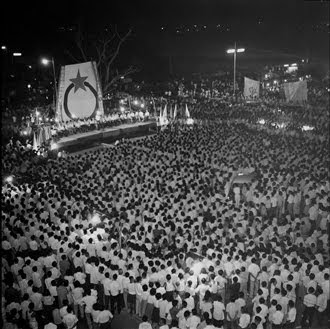 Barisan's rallies before the 1963 General
Election attracted large crowds. -- ST FILE
PHOTOS
Out the 13 Barisan Sosialis Members of Parliament elected in the
1963 Elections ( held after Operation Coldstore), five of whom were
arrested under the ISA, two are in exiled, and another sued for
bankruptcy by a PAP leader.
Two of those arrested are Dr Chia Thye Poh and Mr Lee Tee Tong (or
Lee Tse Tong). Dr Chia's detention of almost 32 years is shortened
by 6 years in the report below. Mr Lee was detained for almost 18
years.
Read and watch everything in this link to understand
Singapore's legacy of adversarial politics.

What happened to the Barisan 13?
Straits Times, 1 Apr 2011
Until 10 days ago when he was introduced as a PAP candidate for the
coming general election, very few people knew that labour leader
Ong Ye Kung was the son of one of the 13 Barisan Sosialis MPs
elected in the 1963 General Election. Where are they now and what
happened to the most powerful opposition party in Singapore's
history?
By Leong Weng Kam, Senior Writer
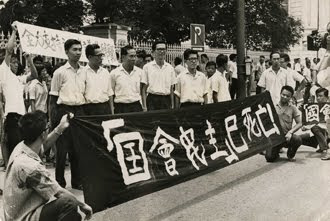 Barisan Sosialis
MPs posing outside Parliament House with a banner proclaiming the
death of democracy, after resigning their seats on Oct 8, 1966.
They are (from left) Mr Koo Young, Mr Ong Lian Teng, Mr Tan Cheng
Tong, Mr Chia Thye Poh and Mr Poh Ber Liak. -- ST FILE
PHOTOS
WHEN National Trades Union Congress (NTUC) assistant
secretary-general Ong Ye Kung, 41, was unveiled as a People's
Action Party (PAP) candidate for the coming polls, Singaporeans
were astonished to learn that his father was one of the Barisan
Sosialis MPs who sought to overthrow the PAP Government in the
1960s.
Mr Ong Lian Teng, who died in 2009 aged 74, was once a firebrand
leftist politician and one of the 13 Barisan Sosialis
representatives elected in the crucial 1963 General Election.
He was among the group of Barisan MPs who took their party's
struggle to the streets. They marched to Parliament House with
their supporters to hand in their resignation letters on Oct 8,
1966.
As the picture above shows, they posed behind a black banner with
the seven Chinese characters - guo hui min zhu yi si wang, meaning
'parliamentary democracy is dead' - outside the chamber's building
before riot policemen dispersed them.
The elder Ong was an active Chinese community leader in rural
Singapore in 1961 when he joined Barisan, a breakaway faction of
the PAP which came into power three years earlier.
The camp led by leftist trade unionist Lim Chin Siong was opposed
to the PAP's founding secretary-general Lee Kuan Yew and company
over Singapore's merger with Malaysia and other ideological
issues.
Mr Ong was one of the few remaining Barisan MPs who boycotted
Singapore's first Parliament session after its independence in
August 1965 to resign his seat, claiming that parliamentary
democracy was dead after a series of government arrests just before
and after the 1963 elections.
The crackdown included Operation Cold Store in February, which
imprisoned more than 110 activists, and Operation Pechah in
October, which rounded up another 190.
Three of the 13 Barisan MPs - trade unionists S.T. Bani, Lee Tee
Tong and Loh Miaw Gong - were among those arrested in Operation
Pechah on the eve of an industrial strike planned by the then
left-wing Singapore Association of Trade Unions (Satu).
Mr Bani, who was Satu's president, resigned from Barisan and his
seat in Parliament on his release, following a public confession on
Jan 9, 1966. Both Madam Loh and Mr Lee resigned from Parliament
later in 1966 while they were still in prison.
Three other elected members, Mr Chan Sun Wing, Mr Wong Soon Fong
and Mr Tan Cheng Tong, were among the original 13 leftist PAP
legislative assemblymen who broke away from the PAP to form Barisan
in 1961. After escaping arrest in Operation Pechah, Mr Chan and Mr
Wong vacated their parliamentary seats. They now live in exile in
Southern Thailand.
Mr Lim Huan Boon, a chemistry graduate from the former Nanyang
University (Nantah) was the first to quit in December 1965, four
months after Singapore's independence. He resigned from Barisan and
his seat in Parliament because he disagreed with party chairman Dr
Lee Siew Choh's decision to opt for 'extra-parliamentary struggle',
claiming Singapore's independence was phoney and there was no
parliamentary democracy.
Now 82, Mr Lim, who is better known as a Malay language scholar
today, had said that Barisan should not have boycotted
Parliament.
Explaining his decision to retire from politics for good, he had
said: 'I joined Barisan because I was against merger with Malaysia.
With Singapore's independence, there is nothing for me to fight
for.'
His departure was followed in January 1966 by that of Mr Chio Cheng
Thun and Mr Kow Kee Seng, who were also at loggerheads with Dr
Lee.
With the opposition bench empty, the PAP held and won all the
by-elections to fill the seats, resulting in its total dominance of
Parliament until 1981 when Anson was captured by then Workers'
Party secretary-general J.B. Jeyaretnam in a by-election.
So why did the most powerful opposition party in the history of
Singapore boycott Parliament, thus handing it to the PAP on a
silver platter? This is one question that has long intrigued
historians and political pundits.
Minister Mentor Lee Kuan Yew, in the book Men In White, published
by Singapore Press Holdings in 2009, called it 'a stroke of
destiny' because Barisan's action led to the absence of opposition
in Parliament, allowing the ruling party to focus on economic and
social development unhindered and undistracted by
politicking.
In the book, which featured the voices of many leftists, Barisan
chairman Dr Lee defended his decision, saying the 1965
parliamentary walkout was the right move as it drew people's
attention to the 'undemocratic practices' of the PAP.
For example, he said, after the September 1962 referendum on
merger, Barisan MPs had been pressing the Government for an open
meeting on merger, but they were always ignored.
He added: 'For quite a number of months, there was hardly any
meeting in Parliament. And while we were waiting, Singapore's
independence was declared!'
Instead of holding any Parliament sitting, he charged, 'there were
only arrests, arrests and arrests of our people'.
On reflection, Mr Lee Tee Tong, now 79, tells Insight this week
that he agreed with Dr Lee. He notes that Operation Cold Store in
February 1963 had already nabbed Barisan's top leaders before the
general election in September.
They included Mr Lim Chin Siong, Mr Fong Swee Suan, Dr Lim Hock
Siew, Dr Poh Soo Kai, Mr S. Woodhull and Mr Dominic
Puthucheary.
The son of Mr Puthucheary, Dr Janil Puthucheary, a 38-year-old
paediatrician in Singapore, was also introduced as a PAP candidate
last week.
Mr Lee says: 'After the general election, a second wave of arrests
put more of our leaders, including myself and two other elected
Barisan members, behind bars. Many others who contested
unsuccessfully were also not spared.
'I don't think Barisan lost in the 1963 election for lack of good
people or a better party ideology, but because of the wave after
wave of arrests of our leaders.'
Another former Barisan MP, Mr Tan Cheng Tong, now 80, says he was
in a fix and had no choice but to resign his Jalan Kayu seat
because it was the party's position.
'Looking back, it was an extreme position that we had taken, but
the actions against us then were really undemocratic,' he
adds.
Former Barisan activist C.C. Chin, 70, now an independent scholar
on leftist history, however, takes the view that Barisan's boycott
of Parliament was political suicide.
'The party should have continued to fight the PAP constitutionally
in spite of the arrests and I am sure today it will still be a
political force the ruling party would have to contend with,' he
argues.
He believes that the party, having taken the fight to the streets
by boycotting Parliament, had lost the support and trust of the
people almost completely.
He points out that when Dr Lee merged Barisan with the Workers'
Party in 1988 and fielded a unified team for Eunos GRC in the
general election held that year, it lost, albeit narrowly, to the
PAP. Barisan was a spent force, he says.
In the view of National University of Singapore history lecturer
Huang Jianli, every current situation would be contingent upon the
past and no one could tell what the outcome would have been if all
13 elected Barisan MPs did not resign their seats between 1965 and
1966.
'Hypothetically speaking, there can be a broad range of
possibilities. At the optimistic end of the spectrum is the
possibility of greater political pluralism with a much less
dominating PAP Government. At the pessimistic end is having more or
less the same as today.
'This is because, given the overall authoritarian tendency of the
PAP leadership, it would still probably have used other avenues and
summoned other means to clamp down on alternative voices,' he
says.
Dr Cheng Yinghong, an associate professor in history at Delaware
State University in the United States, believes that Barisan in the
1960s was greatly influenced by the Cultural Revolution in China.
Whether its elected members remained in Parliament after the 1963
General Election or not, he was pessimistic of the party's
prospects.
'The Barisan was a Maoist party by the mid- and the second half of
the 1960s. Globally, Maoist influence was disastrous not just in
terms of its destructive impact on societies but also to leftist
movements themselves.
'When I read those ferocious verbal attacks on their own comrades
published in Barisan newspapers, I believed that it was fortunate
that such a party failed in its struggle for state power,' he
says.
-----------------------------------------
WHY BARISAN LOST
'I don't think Barisan lost in the 1963 election for lack of good
people or a better party ideology, but because of the wave after
wave of arrests of our leaders.'
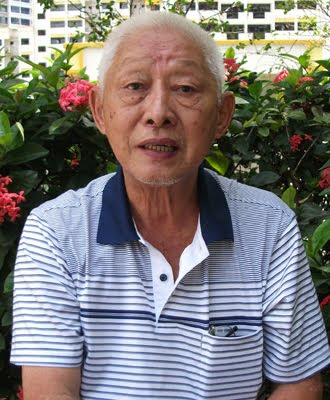 Mr Lee Tee Tong
-- ST PHOTO: LEONG WENG KAM
Barisan's rallies before the 1963 General Election
attracted large crowds. -- ST FILE PHOTOS
Of the 13 former Barisan Sosialis MPs, six are in Singapore, two
live in exile in Thailand, four have passed away, and the
whereabouts of one is unknown. Here's an update.


Photos from Singapore Notes
MR LEE TEE TONG
Bukit Timah, 79
Former treasurer of the defunct Singapore Bus Workers' Union.
Detained under the Internal Security Act (ISA) for alleged
pro-communist activities for 17 years from October 1963 to February
1981.
After his release, he married a nurse and worked as an electrician
until his retirement in the early 1990s.
MR TAN CHENG TONG
Jalan Kayu, 80
One of the original 13 leftist PAP assemblymen who broke away from
the ruling party to form Barisan in 1961.
After quitting Parliament and retiring from politics in 1966, he
took up chicken and pig farming in Punggol before moving to other
businesses.
MR KOW KEE SENG
Paya Lebar
Former secretary of the Singapore Bus Workers' Union. In the 1972
election, he contested in Paya Lebar as an independent, losing to
PAP's Tay Boon Too.
In 1974, he was made a bankrupt after a libel suit against him by
then Singapore Ambassador to Indonesia, Mr Lee Khoon Choy. He died
several years ago.
MR ONG LIAN TENG
Bukit Panjang
Former treasurer and assistant general affairs secretary of the
defunct Singapore Rural Dwellers' Association.
The tropical fish farm owner died in 2009, aged 74. The older of
his two sons, Mr Ong Ye Kung, 41, has been named a PAP candidate
for the coming polls.
MADAM LOH MIAW GONG
Havelock, 75
Former branch vice-chairman of the Singapore General Employees
Union.
Detained under ISA for seven years between 1963 and 1970.
She worked for the former Shanghai Book Company for many years
before retiring, and now looks after her grandchildren.
MR CHIA THYE POH
Jurong, 70
Former university lecturer and Nantah graduate.
Detained under ISA for 26 years between 1966 and 1992.
After his release, he has spent most of his time in Europe.
MR KOO YOUNG
Thomson
Former Chinese primary school teacher.
Detained under ISA for seven months between June 1967 and January
1968.
After his release, he worked as a private tutor. People who knew
him said he died from a heart attack many years ago.
MR WONG SOON FONG
Toa Payoh, 76
Former Works Brigade commander.
He was a founding member of Barisan Sosialis in 1961. After the
1963 elections, he fled to Indonesia to escape arrest. He joined
MCP and was an armed guerilla along the Thai-Malaysian border until
1989. He lives in Hat Yai today.
In 2007, he published his memoirs in Chinese.
MR CHAN SUN WING
Nee Soon, 77
Parliamentary secretary to then Prime Minister Lee Kuan Yew after
PAP came to power in 1959. One of the 13 leftist assemblymen who
broke away from PAP to form Barisan in 1961.
After the 1963 polls, he fled to Indonesia. He joined the Malayan
Communist Party (MCP) and was an armed guerilla until 1989. He now
resides in Hat Yai.
MR S.T. BANI
Crawford
Former president of the defunct Singapore Association of Trade
Unions.
Detained under ISA between October 1963 and January
1966.
After his release, he joined the People's Association and became
principal of the National Youth Leadershp Training Institute.
Later, he went into personnel management. He died in 1985, aged
51.
MR POH BER LIAK
Tampines, 74
The Nanyang University (Nantah) history graduate has been running
his publishing firm, Intellectual Publishing Company, since 1970.
It publishes mainly Chinese-language books and magazines.
MR CHIO CHENG THUN
Chua Chu Kang
Former rural community activist and trade unionist.
After resigning from Barisan and Parliament in 1966, he joined the
People's Association. In 1980, he was an industrial relations
officer with the then Singapore Industrial Labour
Organisation.
His whereabouts are unknown. He would be 70 if he is still
alive.
MR LIM HUAN BOON
Bukit Merah, 82
The Nantah chemistry graduate is better known as a Malay language
scholar after retiring from politics. Two years ago, he published a
compilation of Malay phrases with Chinese translations.
http://singaporerebel.blogspot.com