
Every year, would-be immigrants steal across the US-Mexican
border -- and over the years, thousands have died in the baking,
snake-infested desert on either side.
A group of activists is now working to keep the desperate
migrants alive.
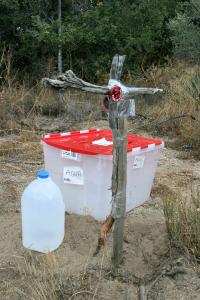
The so-called "Border Angels" hide bottles of water in the
desert along the border, where temperatures can top 113 degrees
Fahrenheit (45 degrees Celsius).
"Lots of them die of thirst while crossing," said Enrique
Morones, his arms full of water bottles near the fence in
California's Imperial Valley designed to stem the tide of migrants
from central America.

"The lack of water is the primary cause of death for the 10,000
people who have died while illegally crossing these desert
regions," said Morones, a Mexican-American from San Diego who
founded Border Angels 20 years ago.
Staff members leave the large water bottles under shrubs on both
sides of the border, from Sonora and Baja California in Mexico to
Arizona and California.
"You have to put the bottles underneath foliage," says Nelly, a
Peruvian who has worked for the group since June.
That was when a genuine crisis erupted as a huge tide of
migrants began sweeping across the border, many of them
unaccompanied minors, leaving police and immigration centers
struggling to cope.
Since October, nearly 65,000 children have arrived, most of them
fleeing poverty and violence in central America.
- Unfriendly locals -
Border guards patrol the frontier in vehicles, watching every
movement, helped by hundreds of cameras, sensors and airborne
drones invisible to the naked eye.
They know that migrants will take advantage of the slightest
distraction to try to climb over the steel border fence.
But the guards do not touch the water bottles, in part because
US authorities have "no official position" on them, said
Morones.
A few bottles end up with holes in them, mostly due to coyotes,
but also because of local residents.
"Look at that bottle! Someone broke it!" Morones said.
"It's difficult to understand why someone would do that. Water
can save lives."
For Juan Hernandez, another Mexican-American who works with
pro-immigrant groups, the Imperial Valley "does not distinguish
itself by its solidarity" with those coming across the border.
The rural region "is inhabited by white people looking for cheap
labor," he added. And those residents don't want people on their
land once harvest season is over.
- Dying in the heat -
Activists regularly find corpses in the desert -- migrants who
have succumbed to the heat, exhaustion or dehydration.
More than 600 unidentified victims have been laid to rest in a
cemetery near the small town of Holtville, at the very gates of the
"American Dream" they fought so hard to reach.
It is known as "The cemetery of those who will not be
forgotten." On their modest graves, crosses bear the message, "You
are not alone."
Morones claims that, faced with the recent surge in undocumented
migrants across the border, US authorities have decided to
incinerate the remains and "sprinkle the ashes in the sea off the
coast of San Diego."
The number of migrants making the trek has begun to drop in the
last two months, as Mexico and Central American countries have
stepped up vigilance -- under immense US pressure.
But "this flow will never stop," said Hernandez.
"We have to change the way we do things to live more peacefully.
We Mexicans, we are a majority in the border region," he said.
US President Barack Obama, whose immigration reform bill is
blocked in Congress, has postponed any executive action until after
November mid-term elections, seeking to shield lawmakers crucial to
his Democratic party's hopes of maintaining control of the
Senate.
