PARIS — Johannes and Melissa. David and Michaela. Ben and
Justin.
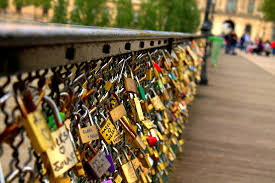
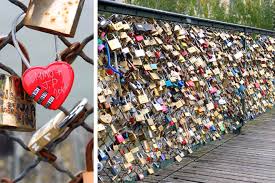
These are a few of the names written on thousands of metal padlocks
attached to the railings of the Pont des Arts, one of the most
beautiful of the bridges spanning the Seine as it winds through
Paris.
The keys have long since been tossed into the water by those who
attached the locks to the bridge, most of them couples who hoped
that they would be, as the words on one lock put it, “locked in
love forever.”
The mass of locks looks at best like modern sculpture and at worst
like a sort of metallic tumor that has taken over the bridge.
Either way, the locks are hardly in keeping with the architecture.
The bridge was designed and built in the early 1800s and then
reconstructed in the 1980s as a replica of the original.
It is not the only Paris bridge suffering from too much love: The
Pont de l’Archevêché and the Passerelle Simone de Beauvoir are also
popular sites for those compelled to proclaim the depth of their
feelings through hardware.
Now, the Pont des Arts has become the stage for a battle between
classical aesthetics and historical preservation on the one hand
and, on the other, the contemporary compulsion to express the
private publicly. And this is all playing out against the backdrop
of the transcendent romance that has long defined Paris for
visitors and residents alike.
The locks have become so numerous that the city is mulling whether
it can encourage the love-locked to express their undying
commitment some other way. For those who treasure Paris’s
architectural history, the locks are “visual pollution” and “an
eyesore,” said Lisa Taylor Huff, an American writer who makes her
home in Paris and has mounted a Facebook campaign with a friend to
try to persuade the city to remove the locks.
“Why did the city sacrifice this to tourism?” Ms. Huff asked,
referring to the bridges.
To be fair, there are also French people who fasten locks to the
bridge, but a more common reaction was that of a French couple
walking across the bridge on a recent afternoon. The man shook his
head disapprovingly. “It ruins one of the most beautiful bridges in
Paris,” he said.
“Crazy,” replied his companion.
Others are more forgiving. “It doesn’t improve the bridge,” said
Marianne Truffine, 49, a Belgian artist, who was visiting Paris
with her mother and daughter. “On the other hand it is a proof of
love, and all proofs of love are beautiful.”
For others, the bridge, like much of central Paris, has become a
stage set. On one recent afternoon, a glamorous-looking British
couple from London came to the bridge for a daylong photo shoot for
their wedding album. They eagerly attached their lock to the bridge
and tossed the key into the river as their photographers snapped
away — although the shot of the key toss was less than perfect.
“Pretend like you’re throwing it again,” said one of the
photographers. The groom agreeably complied.
The more romantically inclined visitors to the bridge were joined
by the police, who won’t stop lock affixers but are on the lookout
for lock sellers, who are prohibited from hawking their wares on or
near the bridge. There was not a lock seller in sight at 4 p.m.,
but as the afternoon shadows lengthened and the police finished
their shift, the hawkers materialized and with them scores of
gleaming locks, 5 euros ($7) for the smallest and 10 euros for the
largest.
To Ms. Huff and another American, Lisa Anselmo, who lives part time
in Paris, the locks are a harmful tourist indulgence, and they say
the city should remove them and give people an alternative. When
Moscow had the same problem, Ms. Huff said, it erected metal trees
that people could use as a perch for their love locks.
Metal trees do not sound like a Parisian solution. Cologne,
Germany; Rome; Budapest, Hungary; and London have all faced the
same problem. London and Rome have tried removing the locks, only
to see them materialize anew. Few cities, though, have the sheer
number of locks that Paris has.
Rome regularly has to fish out the coins thrown into Trevi
Fountain. The small change nets the city $1.4 million a year, which
is donated to Caritas, a major Catholic charity, the City Council
said.
Although the locks of love started to appear on Paris bridges in
2008, their history dates back at least 100 years to a melancholy
Serbian tale of World War I that recounts the love of a young
schoolteacher in the spa town of Vrnjacka Banja for a soldier as he
was about to go to the front. When Serbia fell, the soldier married
a local woman in Greece, where he had been fighting, and never
returned.
Heartbroken, the schoolteacher died, and young girls in her town
who were eager to avoid a similar fate took to placing love
padlocks on one of the city’s bridges. The tale was revived and
popularized in the latter half of the 20th century by one of
Serbia’s most famous female poets, Desanka Maksimovic, in a poem
titled “Prayer for Love.”
For Francesco and Caroline Castillo, who looked out at the Seine
and the tourist boats plying their way as they put on their lock,
it was a simple, sincere gesture affirming their love for each
other. Both doctors at the Mayo Clinic in Rochester, Minn., they
had put off their honeymoon for a year and now, finally were
tossing their key into the Seine. “It’s about the moment, locking
them together,” said Ms. Castillo, adding, “We hope to come back in
a few years and find it.”
It turns out that is not too likely. The sheer weight of the locks
causes the bridge’s metal panels to sag eventually, and then the
city replaces them with new panels, as new love so often replaces
old.
The old panels are kept, with locks still attached, but stored in a
warehouse — with no view of the Seine.