
Researchers say there is no evidence that modern humans' cognitive
superiority led to demise of Neanderthals
Scientists have concluded that Neanderthals were not the
primitive dimwits they are commonly portrayed to have been.
The view of Neanderthals as club-wielding brutes is one of the most
enduring stereotypes in science, but researchers who trawled the
archaeological evidence say the image has no basis whatsoever.
They said scientists had fuelled the impression of Neanderthals
being less than gifted in scores of theories that purport to
explain why they died out while supposedly superior modern humans
survived.
Wil Roebroeks at Leiden University in the Netherlands said: "The
connotation is generally negative. For instance, after incidents
with the Dutch Ajax football hooligans about a week ago, one Dutch
newspaper piece pleaded to make football stadiums off-limits for
such 'Neanderthals'."
The Neanderthals are believed to have lived between roughly 350,000
and 40,000 years ago, their populations spreading from Portugal in
the west to the Altai mountains in central Asia in the east. They
vanished from the fossil record when modern humans arrived in
Europe.
The reasons for the demise of the Neanderthals have long been
debated in the scientific community, but many explanations assume
that modern humans had a cognitive edge that manifested itself in
more cooperative hunting, better weaponry and innovation, a broader
diet, or other major advantages.
Roebroeks and his colleague, Dr Paola Villa at the University of
Colorado Museum in Boulder, trawled through the archaeological
records to look for evidence of modern human superiority that
underpinned nearly a dozen theories about the Neanderthals' demise
and found that none of them stood up.
"The explanations make good stories, but the only problem is that
there is no archeology to back them up," said
Roebroeks.
Villa said part of the misunderstanding had arisen because
researchers compared Neanderthals with their successors, the modern
humans who lived in the Upper Palaeolithic, rather than the humans
who lived at the same time. That is like saying people in the 19th
century were less intelligent than those in the 21st because they
didn't have laptops and space travel.
"The evidence for cognitive inferiority is simply not there," said
Villa. "What we are saying is that the conventional view of
Neanderthals is not true." The study is published in the
journal Plos One.
So what did kill off our equally intelligent extinct cousins?
Roebroecks said that the reasons must have been complex, and that
recent genetic studies that have decoded the Neanderthal genome
might reveal some clues. Those studies show that Neanderthals lived
in small, fragmented groups, and interbred to some extent with
modern humans. Some of their inbred male offspring were infertile.
The arrival of modern humans may simply have swamped and
assimilated them.
"Stereotypes help people to order their world, but the stereotype
of the primitive Neanderthal is now gradually eroding, at least in
scientific circles," said Roebroecks.
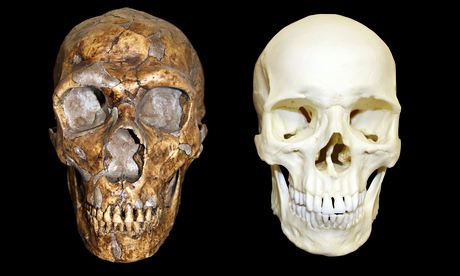
Neanderthal and modern human skulls.

