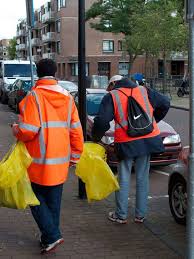
The men streaming in and out of a small clubhouse in east Amsterdam
could almost be construction workers at the end of a hard day,
taking off their orange reflective vests and cracking jokes as they
suck down a few Heinekens, waiting for their paychecks.
But it’s only noon, the men are alcoholics and the beers themselves
are the paycheque.
In a pilot project that has drawn attention in the Netherlands and
around the world, the city has teamed up with a charity
organization in hopes of improving the neighbourhood and possibly
improving life for the alcoholics. Not by trying to get them to
stop drinking, but instead by offering to fund their habit
outright.
Participants are given beer in exchange for light work collecting
litter, eating a decent meal, and sticking to their schedule.
“For a lot of politicians, it was really difficult to accept, ‘So
you are giving alcohol?“’ Amsterdam East district mayor Fatima
Elatik said. “No, I am giving people a sense of perspective, even a
sense of belonging. A sense of feeling that they are okay and that
we need them and that we validate them and we don’t ostracize our
people, because these are people that live in our district.”
In practice, the men – two groups of 10 – must show up at 9 a.m.,
three days a week. They start off with two beers, work a morning
shift, eat lunch, get two more beers, and then do an afternoon
shift before closing out with their last beer. Sometimes there’s a
bonus beer. Total daily pay package: 19 euros ($25), in a mix of
beer, tobacco, a meal, and 10 euros cash.

Participants say a lot of that cash also goes to beer.
The men who participate are a lively bunch. Many are obviously
buzzed at midday, and perhaps not highly effective at picking up
trash, but jovial. Some say they aren’t alcoholics, just heavy
drinkers.
The foreman of one group, Fred Schiphorst, takes his job seriously.
He wears a suit and tie under his reflective vest, which he says
gives him a feeling of dignity. He says he is treated with more
respect in the neighbourhood. But he admits his off-the-job
drinking is still up and down.
One introspective program participant is Karel Slinger, 50. He says
frankly that his life hasn’t been transformed by the program. His
alcoholism is not under control. But he says on the whole, things
have changed for the better.
“Yes, of course in the park it is nice weather and you just drink a
lot of beer,” he said of his old life. “Now you come here and you
are occupied and you have something to do. I can’t just sit still.
I want something to do.”
Elatik, of the Labor party, said she couldn’t quantify the cost of
the current program – its budget comes partly from donations to
Rainbow, partly from city funds – but it’s definitely less than
€100,000 ($130,000).
One critic of the project is politician Marianne Poot, of the rival
conservative VVD party. In a position statement on her website, she
praised the idea of forcing the men – who are on welfare – to
work.
“But then it’s not proper to give them an extra payment in
addition,” she said. “This really gives a completely wrong
signal.”