The architecture of the staircase combines form and function, upper
and lower space. It can represent power or status, or symbolise
spiritual elevation and the climb to knowledge. A new book
published by
Thames & Hudson, The Staircase: The Architecture of Ascent explores the
history and meaning of the staircase, from the simple,
straight-flight steps of the Mayan pyramids, to the radical spiral
ramp of Frank Lloyd Wright’s Guggenheim Museum and the
computer-aided designs of today.
The steps of the Toltec-Maya pyramid at Chichen Itza, Mexico are an
early example of the simple, straight-flight staircase - the
ancestor of all stair design. Appearing to stretch up to the sky,
this style of staircase came to symbolise an ascent to heaven and
infinity, and has captured artists’ imaginations from the Odessa
Steps in Eisenstein’s film Battleship Potemkin to the steps in
Orson Welles’s The Trial.
The
‘lantern’ at the dome of a staircase is an important design feature
— allowing the light to stream in. The view shown here of the
lantern of the chateau of Chambord in the Loire, France, shows the
flat ceiling embellished with coffering. Flanking the large windows
are eight niches intended to hold statues. The chateau marks a high
point in the development of the staircase, illustrating the
Renaissance architects’ fascination with the spiral structure
around an open space.

The upper part of the helix staircase of the Villa Farnese at
Caprarola, Lazio, built in 1559, makes a grand statement. Architect
Jacopo Vignola’s design was a blend of an Italina palazzo, a villa
and a French chateau. The monumental staircase rises to a third
floor and is supported by 30 pairs of Doric, Ionic and Corinthian
columns.

The
spirit of the Baroque emerges in the monumental staircase of the
Palazzo Canossa in Mantua, Lombardy, built in the 1600s for the
Gonzaga family, who ruled that part of northern Itlay from the 14th
to the 18th Centuries. The figures that greet the visitor on the
landing include two large hounds: dogs were the emblem of the
powerful family

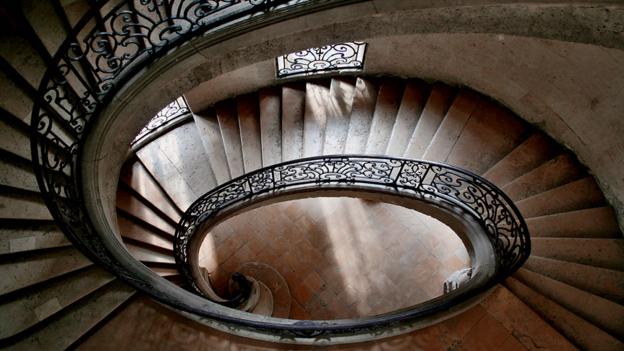
The
elegance of French architecture in the Age of Enlightenment is
typified by the elliptical spiral staircase at the Abbey of
Prémontré in the Aisne, built in the first half of the 17th
Century. Architects of the time understood the mystical mood set by
light on stone and tapering shadows on steps
The
palaces of Germany and Austria show German Baroque at its most
dramatic and rich. At the Würzburg Residenz – commissioned by the
city’s powerful dynasty of prince-bishops– the ceiling is covered
in a fresco by Venetian artist Giambattista Tiepolo depicting the
four corners of the earth above the great staircase.

At
Augustusburg Castle in Brühl, near Cologne, the architect Balthasar
Neumann built one of the most extraordinary of all German Rococo
staircases. The architect, in keeping with the style of the time,
was concerned less with the beauty of the individual materials than
with the overall visual effect when they were brought together, and
most of the marble is in fact imitation. No expense was spared,
though, on the trompe-l’oeil paintings, created by the most
outstanding artists of the day.

The
austerely elegant staircase at Seaton Delaval Hall in
Northumberland in the UK is inspired by the Palladian style –
grandiose but glacial. As in the rest of Europe, the staircase in
Britain became a symbol of prestige and ritual, and in the British
country house it reflected and reinforced the owner’s social
status, success or ambitions to power

The
Solomon R Guggenheim Museum in New York was Frank Lloyd Wright’s
final masterpiece, completed in 1959. The building’s iconic quality
derives from the spiralling ramp that surrounds the circular
atrium, celebrating the movement of visitors through the museum’s
six floors and unifying interior and exterior.

The
innovative Pompidou Centre in Paris was nicknamed the ‘gasworks’,
and typified the fascination with technology of the time. Opened in
1977, it was designed by Renzo Piano and Richard Rogers who, in a
grandiose theatrical gesture, strung stairways across the full
width of the main facade. A functional and geometric triumph, the
main staircase stretched across all six floors.

