
Burqa-clad female cartoon superhero triggers a debate about her
costume
ISLAMABAD - Cartoon fans in Pakistan have been excited by the
arrival of the country's first caped crusader, in the form of a
female superhero who flies through the air, battling villains using
pens and books.
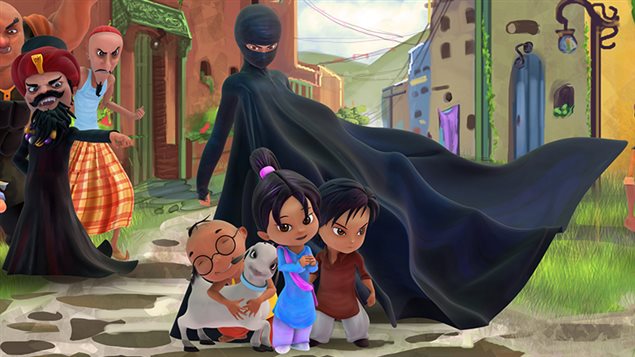
The heroine, Burka Avenger, is certainly an unusual role model for
female empowerment in Pakistan: a woman who uses martial arts to
battle colourful villains such as Baba Bandooq, a Taleban-esque
figure who tries to shut down her school, and Vadero Pajero, a
corrupt politician.
But the cartoon, in which a demure schoolteacher, Jiya, transforms
into the action heroine by donning a burqa, or traditional cloak
that covers the body, has also triggered an awkward debate about
her costume.
"Is it right to take the burqa and make it look 'cool' for
children, to brainwash girls into thinking that a burqa gives you
power instead of taking it away from you?" asked the novelist and
commentator Bina Shah in a blog post.

The criticism has not overshadowed the broader welcome that Burka
Avenger, which aired here for the first time on Sunday evening, has
received.
With slick computer animation, fast-paced action and flashes of
humour that even adults can appreciate, the character could offer
Pakistanis a new cultural icon akin to Wonder Woman in the United
States. The Urdu language show is the brainchild of one of
Pakistan's biggest pop stars, Mr Aaron Haroon Rashid, who conceived
it as a way to emphasise the importance of girls' education and
teach children other lessons, such as protecting the environment
and not discriminating against others.

The burqa debate centres on whether her use of the all-covering
cloak - albeit a more streamlined version of the one usually seen
in Pakistani villages - is subverting a traditional symbol of
segregation and oppression or reinforcing it.
Mr Rashid, who is certainly no radical Islamist, said he used a
burqa to give a local feel to the show, which is billed as the
first animated series ever produced in Pakistan.
"It's not a sign of oppression. She is using the burqa to hide her
identity like other superheroes," he said. "Since she is a woman,
we could have dressed her up like Catwoman or Wonder Woman, but
that probably wouldn't have worked in Pakistan."
The Burka Avenger character has obvious parallels with Malala
Yousufzai, the 16-year-old Pakistani schoolgirl who was shot by
Taleban gunmen last year for advocating education for girls and who
recently addressed a seminar at the United Nations headquarters in
New York.
Mr Rashid said work on the show had already started when Malala was
shot. But the attack on her only highlighted the importance of
protecting girls' education, a major theme of the show.
"Malala is a very brave girl, and her speech at the UN was
spectacular and wonderful," he said. "There has been a lot of
criticism of her in Pakistan which I can't understand."
Mr Rashid, who studied business at George Washington University,
said he first had an idea for an iPhone game. Then, after working
with cartoon animators and musicians in Islamabad, he developed it
into a cartoon series.
He funded much of the programme himself, but also had help from an
outside donor who preferred not to be credited.
Despite the burqa debate, some viewers said the images did not
bother them.
"It is a new take on purdah and a strong message of womanhood,"
said Ms Kulsume Hai, 35, after watching the show on Sunday evening.
Purdah is the tradition of veiling women to separate them from men
who are not close relatives.
"The burqa is shown as a strength rather than weakness," Ms Hai
added. "The idea is to show that a burqa-clad woman can be tough,
too."
