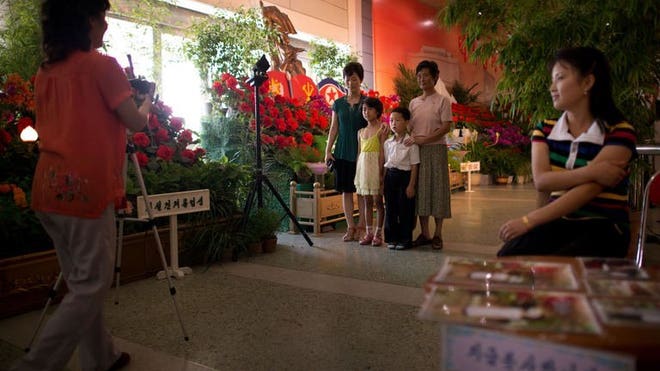
It's a long way from your average flower show, with mock missiles
bristling behind the begonias, and garden gnome-sized troops
lobbing grenades over a bed of orchids.
But then, as the North Korean staff inside the cavernous
bloom-decked exhibition hall in Pyongyang are quick to point out,
these are far from average flowers.
The red begonias are actually Kimjongilia, named after late leader
Kim Jong-Il, while the orchids are Kimilsungia -- after his father
and the nation's founder Kim Il-Sung.
"They are both beautiful and rare flowers named after the most
famous men in the world," one English-speaking guide to the
exhibition, Kim Chun-Kyong, told AFP during a tour for invited
foreign media on Friday.
Both flowers dominated the 70 large-scale displays taking up three
floors of the hall in a special show to mark the 60th anniversary
of the 1950-53 Korean War ceasefire.

The signing of the armistice is celebrated as "Victory Day" in
North Korea and the martial theme was laid on with a large
trowel.
Most of the floral displays utilised military statuary, many
showing a proud soldier carrying the national flag into battle over
the flowerpots.
Some went for actual battlefield action, with metre-high figurines
of heavy machine gunners and grenade throwers embedded between the
Kimjongilia, whose large blooms and thick stems provided better
cover than the more delicate Kimilsungia.
Also prominent were scaled down models of the Unha-3 rocket with
which North Korea successfully placed a satellite in orbit last
December.
Most of the international community viewed the launch as a
disguised ballistic missile test and the UN Security Council
tightened sanctions on Pyongyang as a result.
Each floral display was put together by a different state
institution, ministry or committee, and some chose to personalise
their efforts to reflect their own work.

Instead of armed troops, one trade body decorated its flower beds
with its products, including a CNC milling machine, some rolls of
patterned textiles and bags of fertiliser.
The Committee For the Peaceful Reunification of Korea had its
flowers arranged in the shape of a map of the entire Korean
peninsula, with Pyongyang marked by a slightly taller, rotating
flower pot.
The national flower of North Korea is the magnolia, and the blooms
named after the two late leaders were both provided by
outsiders.
Late Indonesian president Sukarno presented Kim Il-Sung with his
orchid namesake, and the Kimjongilia was grown by a Japanese
botanist.
Asked whether native Korean varieties would not have been more
appropriate, the guide said the fact that they were presented by
foreigners made them more significant.
"This shows our great leaders are praised all over the world, and
not only by the Korean people," she said, adding that current
leader Kim Jong-Un was likely to receive a similar honour in the
future.
"I know that world people also praise him as the greatest person in
the world, so maybe soon there will be a Kimjongunia," she
said.
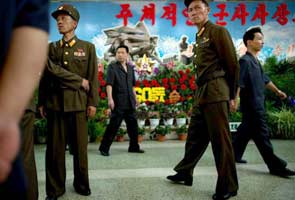
Factory worker Jiang Ok-Sil took time off work to visit the
exhibition with her five-year-old daughter.
"Like other Korean people, whenever we see these flowers we always
remember our great leaders, Kim Il-Sung and Kim Jong-Il," Jiang
said.
Pressed to choose her favourite, Jiang hesitated before opting for
the Kimilsungia which "looked more beautiful".
"But the Kimjongilia is very beautiful too," she added quickly.