Pre-dawn wake-up calls, days of silence and hunger may not be
everyone's idea of a holiday, but for tourists seeking spiritual
sustenance Myanmar's monasteries offer help on the path to Buddhist
nirvana.

The search for inner peace is
unlikely to appeal to those who take a more hedonistic approach to
vacations -- booze, beaches and bikinis are definitely out.
"When you first start it is a bit
like running into a brick wall, you know, you are having extreme
problems settling down and for your mind to settle," said Rupert
Arrowsmith, a British art historian.
He spent 45 days of total silence
in the "famously austere" Chanmyay Yeiktha monastery, a peaceful
compound of rooms for meditation and sleeping in the countryside
near Yangon.
"The new environment, different
way of dressing, different way of eating... It's like some sort of
military bootcamp. You've even got the same hairstyle," he told
AFP.
After their heads are shaved at an
ordination ceremony, new monks - foreign or Burmese -- retreat to
the quiet but challenging routine of monastic life.
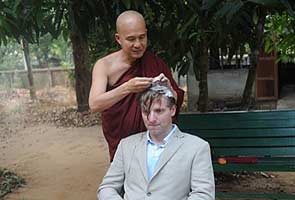
Rising at 3.30 am, they practise
sitting and walking meditation for the majority of the day,
spending long periods cross-legged in the complex, which is largely
silent apart from the sound of birdsong.
Food, though often sumptuous
dishes such as local curries, is served before noon. The last meal
of the day at Chanmyay Yeiktha is at 10.30 am and monks have
nothing more to eat before they retire to bed in the evening to
sleep in individual rooms on a bed with no mattress.
Arrowsmith urged those entering a
monastery to "be serious... this is not Disneyland", but he said
the experience -- his second at the monastery -- was worth it.
"It's more or less essential for
anybody who wants to understand how their own mind functions. I
mean this is probably the key point for people in the West," he
said.
"You know people who talk about
self knowledge, they really need to come and do some Vipassana
meditation in Myanmar," he said.

After years as an international
pariah under the former junta, Myanmar is stepping firmly back onto
the Southeast Asia tourist trail under a new reformist regime that
came to power in 2011.
With thousands of monasteries and
a regional reputation for being spiritually devout, the country
hopes to attract visitors interested in Buddhist practice.
Phyoe Wai Yar Zar, of the Myanmar
Tourism Board, said visas for meditation visits can now be "easily"
obtained and that spiritual tourism is on the rise -- although
authorities are currently unable to provide hard data.
Both men and women can enter
monasteries from two weeks up to several months.
Across the border in Thailand, an
established destination for spiritual tourists, Buddhist
authorities say some 1,000 people from abroad join monasteries for
meditation stints every year, while about 50 foreigners are fully
ordained as monks annually.

Abbot Bhaddanta Jatila of the
Mahasi Meditation Centre in Yangon said foreign visits dried up as
the country came to the end of its near half-century of military
rule.
"When the government opened, more
foreign meditators came. Many of them are coming now, especially
this year," he said.
A whole wing of accommodation has
been set aside for foreign visitors at his monastery, which
recently had about 20 people from Korea, Japan, China and the
United States among its 500 meditators and child novices.
Paradoxically, the rise in foreign
meditators could result in villagers in one of the world's poorest
countries feeding visitors from rich nations.
Monasteries rely for food and
funding on local people, who believe their donations earn them
"merit" and karmic reward in the cycle of rebirth that is a key
part of Buddhist faith.
Arrowsmith said the sight of
impoverished local people donating precious supplies of rice was
"quite difficult to accept", but that his abbot assured him that
donors were giving the food not to him as an individual, but "for
the potential for enlightenment in you" as a monk.

Myanmar's Buddhist clergy has
faced international scrutiny amid extremist anti-Muslim campaigns
by some monks that have been linked to recent deadly waves of
violence in the Buddhist-majority country.
But Arrowsmith said this should
not taint the Buddhist establishment as a whole.
"Personally, I have never
experienced Myanmar monks getting involved in anything other than
intensive meditation, non-violence, and the issuance of goodwill to
all living beings," he said.
Meditation, detachment and loving
kindness are just some aspects of the quest for nirvana -- and
freedom from the suffering of perpetual reincarnation.
Abbot Bhaddanta Jatila said
Buddhism helps practitioners to rise above a cycle of life that
"starts with being in the mother's womb, then involves getting old,
ill and dead".
That search for release was
particularly appealing to 36-year-old Shigenari Moriya, whose path
from working in the stock market in Japan, to entering the Mahasi
centre in Yangon was dominated by a battle with cancer.
Attracted to Myanmar because its
meditation practice was "directly inherited" from Buddha, he was
unperturbed by the drastic change to his lifestyle.
"I like the sunshine, the food is
delicious and above all, I'm happy meditating here because I
believe that the country has more dharma (truth) than any other
place on the planet," he told AFP.
Having initially planned to be a
monk for three months, Moriya said he was now unsure whether he
would ever go back to his old life.