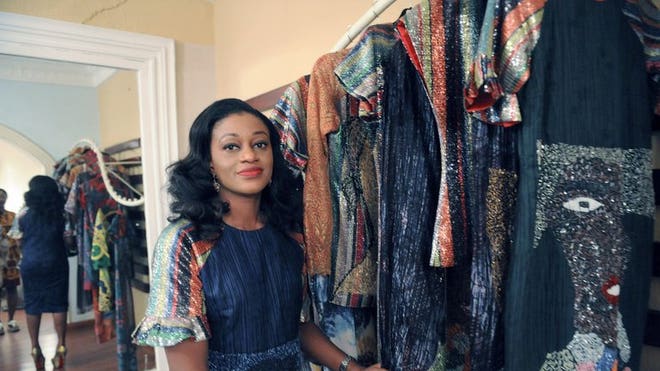
Shoppers ready to spend lavishly on clothes by elite designers sip
champagne in a discreetly located store that only those in-the-know
know exists.

Perhaps it's not an unusual scene
in Manhattan or Milan, but in Lagos, sub-Saharan Africa's largest
city, shops like Temple Muse are a novelty. A growing number of
boutique owners and fashion designers however are working to change
that.
Most of Nigeria's roughly 160
million people live in extreme poverty, but the upper class here
number among the wealthiest in Africa, including those who have
profited from the continent's largest oil industry.
Nigerians' sense of style is also
well-known, and the country boasts several fashion designers who
have made their mark internationally.
Just ask Michelle Obama, who wore
a blouse by Nigeria's Maki Oh on a recent trip to South Africa.
Or take the Wadhwani brothers, who
are Indian but were raised in Lagos. They saw there was a gap in
the city's luxury market.
The brothers opened a store that
aims to serve Nigeria's ultra-high-end shoppers who typically hop
on planes to Europe when their wardrobes need an upgrade.
"I found a niche in the market,"
said Avinash Wadhwani, co-owner of Temple Muse boutique in the posh
Victoria Island neighbourhood of Lagos.
He previously worked as a buyer
for the London department store Selfridges, learning first-hand the
appeal of Europe's top fashion lines. But he insisted Nigeria's
rich are also seeking a local look.
Some Nigerians "travel by plane
every other week and shop in the best boutiques around the globe,
but they still have that sense of pride and everyone wants
something from (their) own heritage," he said.
Temple Muse, which opened five
years ago, is protected from the hectic mega-city outside by a
thick metal door and is equipped with a champagne bar and a cafe.
Some garments come with pricetags of $3,000 (2,300 euros), and
there are fashion mavens ready to snap up several of them.
Odun Ogunbiyi, a customer who
claimed plenty of foreign shopping experience, told AFP the outfits
she buys in Nigeria are admired wherever she goes.
"I travel a lot. I go to Miami, I
go to London to visit friends and family. and they ask me 'where
did you get that from?'," said Ogunbiyi, a TV host.
When she tells people the outfit
is Nigerian, they say they "can't believe it," she said.
"It's gotten to the point where we
are on standard with international brands, which is great!"
Wadhwani agreed that Nigerian
designers are becoming increasingly respected abroad.
The US First Lady's recent
appearance in a Maki Oh blouse was seen as evidence of growing
exposure for designers here.
But Wadhwani knows that his local
clients also want to wear premium European names, so he stocks the
embroidered dresses of Nigerian designer Lanre Da Silva Ajayi
alongside Givenchy and Italy's Emilio Pucci.
Tope Edu is another fashion seller
hoping that wealthy Nigerians will shop more in Lagos. She manages
the Ermenegildo Zegna store on Victoria Island, the Italian line's
first and only outlet in sub-Saharan Africa, which opened in
April.
But in a reminder of the perils of
doing business in Nigeria, Edu said it took seven years to get the
luxury franchise opened.
Zegna first needed to be sure that
there was a consumer base to support the store but faced a lack of
reliable consumer data.
A series of made-to-measure Zegna
events were successful, giving confidence that a full-time
ready-to-wear store could survive.
Company chief executive Gildo
Zegna also had faith in the buying power of Africa's
super-rich.
He told the Financial Times that
customers from the continent on average spent 50 percent more in
Zegna's stores than buyers from other regions.
The next challenge was the venue
and ensuring, as Edu explained, that the Lagos "Zegna store looked
exactly like a Zegna store elsewhere in the world."
"It's a very difficult process,"
she conceded, citing Nigeria's nightmarish bureaucracy.
The stand-alone shop is on a
street lined with office buildings which hardly offers the majestic
surroundings of Paris's Champs-Elysees but inside business appears
to be thriving.
Especially on smart-casual items
like polo shirts, which are being scooped up at just under $500
each, Edu told AFP.
She debunked the notion that
Nigeria's elite are committed to exclusively shopping abroad.
"Once (they) know it's available,
I think that same customer will purchase from here," she said.
Like Zegna, Folake Folarin-Cocker
has growing faith in the Nigerian and wider African market.
Her Tiffany Amber line, launched
in 1998 and Nigeria's first ready-to-wear brand, has four
standalone stores in the country.
Her designs are also sold in Ghana
and South Africa, and will soon be available in oil-rich
Angola.
Shoppers in Milan and London can
also buy Tiffany Amber items, but for Folarin-Cocker, the European
and US markets are mainly for publicity.
Those markets "are saturated.
Africa is untapped," she said.
While her work is currently priced
at luxury rates, she is preparing a lower cost line because she
believes the continent is craving an accessible, ready-to-wear
brand.
An H&M or "Zara with an
African accent," she explained, referring to popular European
clothes shops.
Like the owners and shoppers at
Temple Muse, Folarin-Cocker takes pride in the growing respect and
exposure being given to Nigerian designers and said that talent in
the fashion industry can help change perceptions of the
continent.
"Fashion is one of the ways we are
going to be able to rebrand Africa," she said. "It's not 'We Are
The World, We Are the Children' anymore."