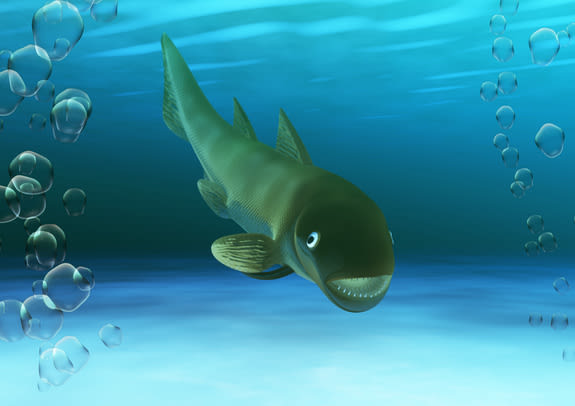
The fossilized remains of a 408-million-year-old fish species have
been found in Spain, a study reports.
Researchers found scales, spines and shoulder bones of the new
species (Machaeracanthus goujeti) in the town of Teruel
and to the south of the city of Zaragoza. The fish lived during the
Devonian period, and is a spiny
shark (Acanthodii), an extinct type of fish
that resembles both sharks and bony fish.
The discovery "expands our knowledge of the biodiversity that
existed on the peninsula 408 million years ago, when the modern-day
region of Teruel was covered by the sea," study researcher Héctor
Botella, a paleontologist at the University of Valencia, Spain,
said in a statement.
Little is known about the spiny sharks, other than that they only
lived during the Palaeozoic Era (540 million to 250 million years
ago) and really blossomed during the Devonian period (420 million
to 360 million years ago).
But bones in the spiny shark group usually grow differently than
the ones found here, suggesting the new species might be even more
like sharks and arose during the diversification of jawed
vertebrates.
Most of the fossil samples were from juveniles. The researchers
estimate the biggest of these fish would have been less than a
meter (3.3 feet) long.
The fossils were found in sediment layers in the Iberian
Mountains. They were probably from fish that lived in a large but
shallow saltwater body of water known as an epicontinental sea, the
researchers say, which might have served as a breeding ground.
Larger fossils were found in lower sediment layers.
The researchers also analyzed fossils from the Lower Devonian
period in northern Spain and western France, which were first
thought to come from
the Machaeracanthus species.
The new fossils are now kept in the Paleontology Museum of
Zaragoza, Spain. The findings were reported in the December 2012
issue of the journal Geodiversitas.