“The Tetons – Snake
River” Ansel Adams, 1942
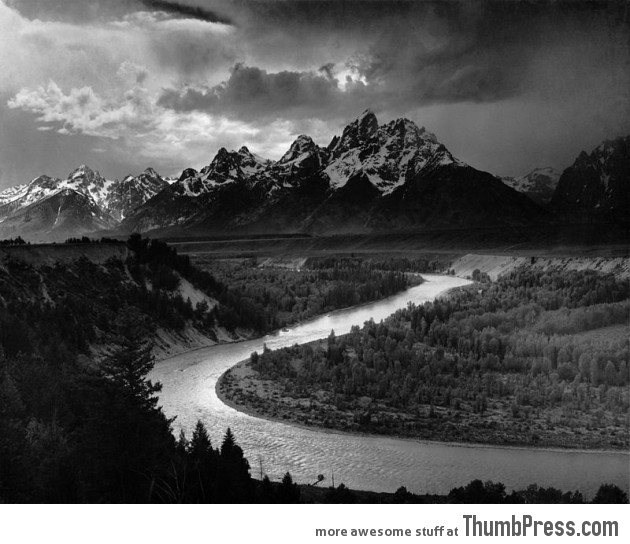
Brashly declaring photography to be “a blazing poetry of the real,”
Adams eschewed manipulations, claiming they were simply derivative
of other art forms. Instead, he preached the value of “pure
photography.” In an era when handheld point-and-shoot cameras were
quickly becoming the norm, Adams and other landscape photographers
clung to their bulky, old-fashioned large-format cameras.
Ultimately, Adams’ pictures turned photography into fine art.
What’s more, they shaped the way Americans thought of their
nation’s wilderness and, with that, how to preserve it.Some
claim photography can be divided into two eras: Before Adams and
After Adams. In Times B.A., for instance, photography wasn’t widely
considered an art form. Rather, photographers attempted to make
their pictures more “artistic” (i.e., more like paintings) by
subjecting their exposures to all sorts of extreme manipulations,
from coating their lenses with petroleum jelly to scratching the
surfaces of their negatives with needles. Then came Ansel Adams,
helping shutterbugs everywhere get over their collective
inferiority complex.
Adams’ passion for the land wasn’t limited to vistas he framed
through the lens. In 1936, he accompanied his photos to Washington
to lobby for the preservation of the Kings Canyon area in
California. Sure enough, he was successful, and it was declared a
national park.