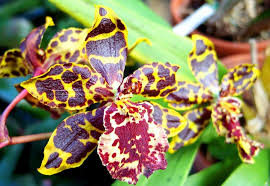
The last record of the tiger orchid seen blooming in the wild here
was in 1900
KEEP your eyes peeled the next time you drive down Holland Road, or
take a stroll at East Coast Park - you might just spy a graceful
giant last seen in Singapore over a century ago.
The tiger orchid - the world's largest tree-growing orchid - has
bloomed in the wild for the first time since the Botanic Gardens
re-introduced the native plant to the island in
1999.
One would have had to go back to 1900 for the last time the
maroon-speckled yellow flowers, which went extinct in the wild due
to habitat loss, were recorded being seen. But early last month,
about 20 of the plants, which can grow to the size of a car,
started flowering.
It has been a long wait for the Garden's senior orchid breeding
researcher Yam Tim Wing, who told The Straits Times that these
slow-growing orchids take at least five years to bloom.
Even then, a host of factors need to align: the right maturity,
adequate sunlight, a rich supply of nutrients, and an environmental
trigger such as heavy rain.
While 20 plants have flowered this time, about 800 others in places
such as Orchard Boulevard, Pulau Ubin and Upper Peirce Reservoir
have not.
The fragrant flowers may stay in bloom for another month, but are
at their peak now.
"The next two weeks are the perfect time for people to see them,"
said Dr Yam.
Of the 226 native species of wild orchids that used to grow here,
only 55 remain. The only specimens of species that are extinct in
the wild are at the Botanic Gardens.
Reintroducing orchids into the city and nature reserves is part of
the country's City in a Garden vision and 18 species of orchids,
including the tiger orchid, have been grown across the island to
date.
For now, Dr Yam has only a small window to study the flowers before
they wilt. Three times a week, he visits the blooms to search for
fruit.
The fruit will mature and split after about five months, casting
out millions of seeds which can be carried for kilometres by the
wind. Although the tiger orchid is found on trees, it may
occasionally grow on rocks. He said: "If the seeds are dispersed
successfully, we may see natural populations take root again. This
is our hope."
By the way, these tiger orchids are for your eyes only. It is
illegal to take plant samples or cuttings from public green
spaces.
SPOT THEM
Holland Road
On trees along Holland Road. The most spectacular - 2.4m wide and
with 12 orchid sprays - are on the road divider opposite the
Botanic Gardens
Napier Road
Along Napier Road, on the road divider opposite the US
embassy