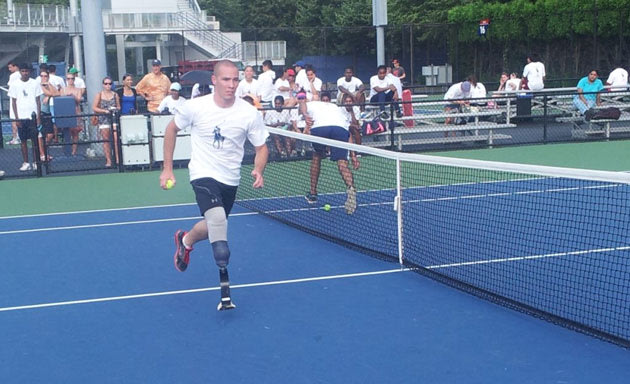
If you're one of the 250 people chosen to serve as a ball person
at the U.S. Open, here's what you can look forward to: long hours
spent in perpetual, knee-creaking vigilance, and chasing down
errant shots and missed serves in speed and silence. All this for
$7.75 an hour. Above all, do your best to be neither seen nor
heard.
For most ball people, that anonymity isn't a tough challenge.
They do their jobs so fast they've left your mind before the next
point even starts.
Most, but not all. Meet Ryan McIntosh, a 23-year-old ball boy
from Texas. He's an Army veteran who's doing everything his
colleagues are doing even though he lost a leg in Afghanistan. And,
like so many in his position, he's not letting the prosthesis below
his right knee define him:
"I don't look at myself as being disabled or handicapped or
anything else,"
"I want to experience everything, and live life to the
fullest."
He's doing exactly that; a family man and a counselor helping
soldiers at Fort Sam Houston deal with newfound disabilities, he's
a shining example of how there's grace in even the worst moments of
your life.
For McIntosh, a Colorado high school athlete, the day around
which his life now revolves was December 8, 2010.
[H]is unit was walking single file through the Arghandab River
Valley, not far from Kandahar, led by a soldier sweeping for mines,
a football field away from the base. McIntosh was sixth in the
procession. The area is known to be extremely dangerous. McIntosh
lifted up his right foot and took his next step and put it down on
top of a land mine, and in an instant came a blast that launched
him 10 feet in the air. He landed in a ditch. He crawled out. He
looked down and saw part of his foot was gone. He never lost
consciousness.
Only later did McIntosh find out that there were 40 pounds of
homemade explosives beneath the mine that never detonated.
"I would've been a goner," McIntosh said.
His leg was amputated below the knee. He immediately began
rehabbing both body and mindset, competing in various events
designed for Paralympic athletes such as himself. Last May, through
the United States Tennis Association's Military Outreach program,
he tried out for a ball person's role, and here he is, center stage
for one of tennis' marquee events.
And while he admits to psychological difficulties -- fireworks
like those that opened the U.S. Open are "gut-wrenching" even to
this day, he says -- his path is clear: Flushing Meadows now, the
Paralympics in Rio de Janeiro in 2016.
Impressive work for someone who's been through all he has, even
if McIntosh would probably prefer you didn't think of him that
way.