He rarely wears clothes and eats almost nothing
but rice cakes but Masafumi Nagasaki says the small inhospitable
Japanese island he chose to live on two decades ago is where he
wants to die.
Where most people look forward to winding down
when they retire, nothing was further from the mind of this
sun-scorched 76-year-old who gives a new meaning to the term
golden oldie.
In the early nineties Mr Nagasaki decided to shun
mainstream society to set up base on the little island of
Sotobanari, translation ‘Outer Distant Island’ to while out his
final years.
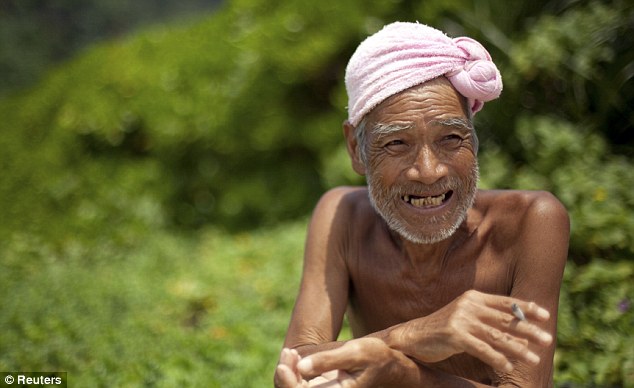
The remote spot, which is just a kilometre wide, is in
Japan's tropical Okinawa prefecture but is located closer to Taiwan
than Tokyo.
It is a world away from a traditional retirement
home in the sun. The currents that surround the kidney-shaped
island are so dangerous local fisherman rarely cast nets in the
area.
There is no natural water and since setting up
home there Mr Nagasaki has had to brave powerful typhoons and
biting insects.
Such difficulties have not deterred the wiry
hermit who no longer wears clothes apart from for his once a week
trip to a nearby island to pick up water and rice cakes with a
small $120 donation sent from his family.


He said: 'I don't do what society tells me, but I
do follow the rules of the natural world. You can't beat nature so
you just have to obey it completely.
'That's what I learned when I came here, and
that's probably why I get by so well.'
Ironically Mr Nagasaki says he spent years in the
limelight working in the entertainment industry before he decided
to get far away from civilisation.
His resolve was tested relatively soon into his
stay when a massive typhoon swept through Sotobanari, removing most
of the vegetation that he had relied upon for shade, as well as
carrying away the simple tent he lived in.
'I just scorched under the sun,' he said. 'It was
at that point I thought this was going to be an impossible place to
live.'
For the first year he lived there he says he
threw on clothes whenever boats passed his way, but slowly the
island stripped away his embarrassment.
He added: 'Walking around naked doesn't really
fit in with normal society, but here on the island it feels right,
it is like a uniform. If you put on clothes you'll feel completely
out of place.'
His staple food is rice cakes, which he boils in
water, eating whenever hunger strikes - sometimes four or five
times a day. Water for bathing and shaving comes from rain caught
in a system of battered cooking pots.
Each day is conducted according to a strict
timetable, starting with stretches in the sun on the beach. The
rest is a race against time as he prepares food, washes and cleans
his camp before the light fails and insects come out to
bite.
It isn't the healthiest of lifestyles, he
concedes - but that isn't the point.
'Finding a place to die is an important thing to
do, and I've decided here is the place for me,' he said.
'It hadn't really occurred to me before how
important it is to choose the place of your death, like whether
it's in a hospital or at home with family by your side. But to die
here, surrounded by nature - you just can't beat it, can
you?'

