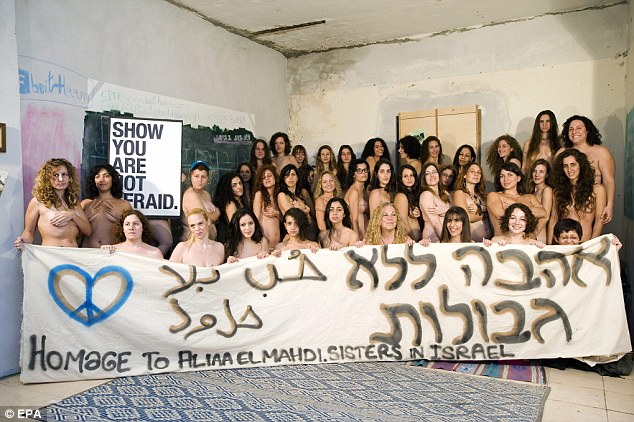
The women were supporting Aliaa Elmahdy, who sparked
outrage when she posted a nude picture on her blog to protest the
lack of freedom in Egypt
I wonder whether singaporean women would strip to protest lack
of freedom in Singapore.
She told CNN: 'Women under Islam will always be objects to use
at home.
She is confusing Islam with arabic and bedouin culture.
In such traditional Arabic society, the extended
family, not the individual, was the basic social unit; all property
was controlled by the patriarchal head of such a family and,
accordingly, most decisions were in his hands.
His control of the marriage of his male descendants was
ensured by the fact that a price had to be paid for a bride to her
family, and this would require the patriarch's consent.
Such a patriarchal family
arose from the fact that marriage was patrilocal, the young couple
residing with the groom's father so long as he lived, while he
continued to live with the groom's paternal grandfather until the
latter's death.
Such a death of the head of an extended family freed
his sons to become heads of similar extended families that would
remain intact, frequently for three or more generations, until the
head of the family dies in his turn.
Within such a family each male remains subject to the
indulgent, if erratic, control of his father and the indulgent, and
subservient care of his mother and unmarried sisters, while his
wife is under the despotic control of her mother-in-law until her
production of sons and the elimination of her elders by death will
make her a despot, in turn, over her daughters-in-law.
This Arabic emphasis on
the extended family as the basic social reality meant that larger
social units came into existence simply by linking a number of
related extended families together under the nominal leadership of
the patriarch who, hy general consensus, had the best qualities of
leadership, dignity, and social prestige.
But such unions, being personal and essentially
temporary, could be severed at any time.
The personal character of such unions and the
patriarchal nature of the basic family units tended to make all
political relationships personal and temporary, reflections of the
desires or whims of the leader and not the consequence or
reflection of any basic social relationships.
This tended to prevent the development of any advanced
conception of the state, law, and the community (as achieved, for
example, by the once tribal Greeks and Romans). Within the family,
rules were personal, patriarchal, and often arbitrary and
changeable, arising from the will and often from the whims of the
patriarch.
This prevented the development of any advanced ideas of
reciprocal common interests whose interrelationships, hy
establishing a higher social structure, created, at the same time,
rules superior to the individual, rules of an impersonal and
permanent character in which law created authority and not, as in
the Arabic system, authority created law (or at least temporary
rules).
To this day the shattered cultures along the whole
Pakistani-Peruvian axis have a very weak grasp of the nature of a
community or of any obligation to such a community, and regard law
and politics as simply personal relationships whose chief
justification is the power and position of the individual who
issues the orders.
The state, as a structure of force more remote and
therefore less personal than the immediate family, is regarded as
an alien and exploitative personal system to be avoided and evaded
simply because it is more remote (even if of similar character)
than the individual's immediate family
This
biological and patriarchal character of all significant social
relationships in Arab life is reflected in the familiar feature of
male dominance.
Only the male is important.
The female
is inferior, even sub-human, and becomes significant only by
producing males (the one thing, apparently,
that the dominant male cannot do for himself).
Because of the strong patrilocal character of Arab
marriage, a new wife is not only subjected sexually to her husband;
she is also subjected socially and personally to his family,
including his brothers, and, above all, his mother (who has gained
this position of domination over other females in the house by
having produced male children).
Sex is regarded almost solely as simply a physiological
relationship with little emphasis on the religious, emotional, or
even social aspects.
Love, meaning concern for the personality or developing
potentialities of the sexual partner, plays little role in Arabic
sexual relationships.
The purpose of such relationships in the eyes of the
average Arab is to relieve his own sexual desire or to generate
sons.
Such sons are brought up
in an atmosphere of whimsical, arbitrary, personal rules where they
are regarded as superior beings by their mother and sisters and,
inevitably, by their father and themselves, simply on the basis of
their maleness.
Usually they are spoiled, undisciplined,
self-indulgent, and unprincipled. Their whims are commands, their
urges are laws. They are exposed to a dual standard of sexual
morality in which any female is a legitimate target of their sexual
desires, but the girl they marry is expected to be a paragon of
chaste virginity.
The original basis for this emphasis on a bride's
virginity rested on the emphasis on blood descent and was intended
to be a guarantee of the paternity of children. The wife, as a
child-producing mechanism, had to produce the children of one known
genetic line and no other.
This emphasis on the
virginity of any girl who could be regarded as acceptable as a wife
was carried to extremes. The loss of a girl's virginity was
regarded as an unbearable dishonor by the girl's family, and any
girl who brought such dishonor on a family was regarded as worthy
of death at the hands of her father and brothers. Once she is
married, the right to punish such a transgression is transferred to
her husband.
To any well-bred girl,
her premarital virginity and the reservation of sexual access to
her husband's control after marriage ("her honor") have pecuniary
value.
Since she has no value in herself as a person, apart
from "her honor," and has little value as a worker of any sort, her
virginity before marriage has a value in money equal to the expense
of keeping her for much of her life since, indeed, this is exactly
what it was worth in money.
As a virgin she could expect the man who obtained her
in marriage to regard that asset as equivalent to his reciprocal
obligation to support her as a wife.
As a matter of fact, her virginity was worth much less
than that, for in traditional Arabic society, if she displeased her
husband, even if she merely crossed one of his whims, he could set
her aside by divorce, a process very easy for him, with little
delay or obligation, but impossible to achieve on her part, no
matter how eagerly she might desire it.
Moreover, once her virginity was gone, she had little
value as a wife or a person, unless she had mothered a son, and
could be passed along from man to man, either in marriage or
otherwise, with little social obligation on anyone's part.
As a result of such easy divorce, and the narrow
physiological basis on which sexual relationships are based, plus
the lack of value of a woman once her virginity is gone, Arab
marriage is very fragile, with divorce and broken marriage about
twice as frequent as in the United States.
Even the production of sons does not ensure the
permanence of the marriage, since the sons belong to the father
whatever the cause of the marriage disruption.
As a result of these conditions, marriage of several
wives in sequence, a phenomenon we associate with Hollywood, is
much more typical of the Arabic world and is very much more
frequent than the polygamous marriage, which, while permitted under
Islam, is quite rare.
Not more than 5 percent of married men in the Near East
today have more than one wife at the same time, because of the
expense, but the number who remain in monogamous union till death
is almost equally small...
http://real-world-news.org/bk-quigley/19.html#73