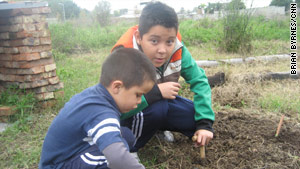
"It's like my happiest place to be," says 9-year-old
Alexis Ocampo of the community garden.
On his knees in the soggy soil, 9-year-old Alexis Ocampo digs
deep into the earth, his small gardening rake separating dirt from
rocks. "Look, I found a worm!" he shrieks.
Towering above is Andrea Girardini, calmly instructing Alexis
and the half-dozen other children working to clear spots for new
crops.
"We can put a squash plant here, and some lettuce over there,"
says Girardini, a director of Semillas al Viento, a community
organization that teaches neighborhood kids practical skills that
help them put food on the table.
"The children come here and learn how to farm and how to
cultivate their very own organic vegetables. Then they bring them
home to eat. It's a wonderful alternative to sitting in front of
the computer," she says.
The Semillas al Viento (Seeds to the Wind) farm is located in
Isidro Casanova, a poor area in Buenos Aires' sprawling urban rust
belt, where green spaces are few and far between. Five years ago,
the football-field sized area was overrun with garbage and
frequented by criminals, but following a community effort to
reclaim it, it now teems with trees, grass and flowers, as well as
eggplants, tomatoes, lemons and herbs. There's even a small pond
where kids and dogs happily splash around.
"I really enjoy being here. It's like my happiest place to be.
The fresh air is great," says Alexis.
The Semillas al Viento farm is a part of Huerta Nino (My
Garden), a nonprofit foundation that works to alleviate
malnutrition and starvation in Argentina. Since 1999, it has helped
build more than 50 small farms, many of them in isolated villages
in northern Argentina. Despite being one of the world's largest
agricultural-producing countries, Argentina still struggles to feed
its people.
"Hunger is one of the gravest problems that Argentina has right
now. At least 300,000 Argentine children are suffering from
undernourishment," says Juan Lapetini, executive director of Huerta
Nino.
Nearly 5,000 Argentine children have been educated about
sustainable farming practices through the "My Garden" program,
which has also been endorsed by Argentine celebrity chef Martiniano
Molina, and won various awards for its initiatives. Typically, the
program is introduced first at rural schools, where the crops that
students grow are then taken home to eat. The long-term objective,
coordinators say, is to have the children create vegetable gardens
at home with their parents.
<!-- Module ends: article-text-2--><!-- Area ends:
article-block-2--><!-- Area starts:
main-center-w-leftsky-bottom --><!-- Module ends:
article-text-1-->