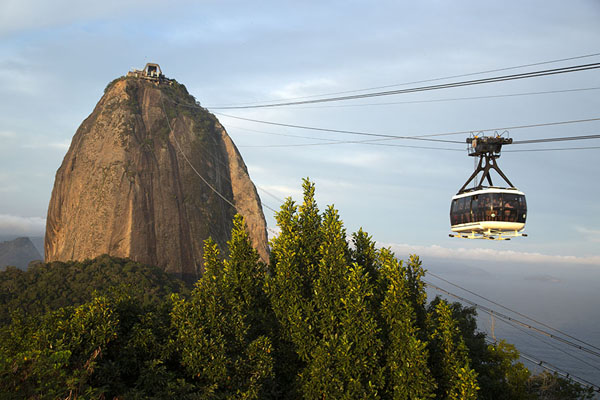
A mere 600 million years ago mother nature's geologic hand
formed a princely natural wonder, Pao de Acucar or Sugar Loaf.
Original inhabitants deemed it Pau-nh-Acqua, later to be changed by
the invading French who dubbed it “Pot de Beurre”. Portuguese
colonists renamed it “Pao de Assucar” or Bread of Sugar only to be
re-invaded by the French who assigned it “Pot de Sucre”. By the
Seventeenth century the Portuguese had regained their dominance and
Pao de Acucar was reborn to permanency. During this time sugar cane
was the primary export and upon completion of the processing the
finished product was packed into bread like loaves for shipment.
Hence the name Sugar Loaf.
Today Sugar Loaf is the most commonly recognized and sought
after tourist attraction in Rio. But it has served its past
inhabitants equally well. Navigators for years would spot the
imposing figure as the entrance to Guanabara Bay. The first
Portuguese arrivers chose the landmark as a settling location for
the magnitude of visibility afforded towards the sea and mountains
assuring their continued protection.
Today’s tourists enjoy the ease and comfort of a cable car ride
to the top of Sugar Loaf which was first installed in 1912,
blossoming the tourists industry to Rio.
Reaching the top of Sugar Loaf is actually done in two stages.
The first car ascends over 700 feet up Urca Hill affording
marvelous views of Corcovado Mountain, the Niteroi Bridge and
Guanabara Bay. Transferring to a second car then elevates you an
additional 1300 feet to the top where spectacular views of
Copacabana and other beaches can be admired.