The Type IX was designed with two objectives in mind – to be the
long range counterpart to the medium-range Type VII, and to serve
as a tactical command boat for the leader of a wolf pack. After the
fall of France, the second requirement became unnecessary as the
powerful land based transmitters on the French coast meant that
tactical command could be handled from shore.
The Type IXs were excellent sea boats, which had sufficient
range to operate in distant waters in the South Atlantic, Indian
and even the Pacific oceans - although some had even reached the
east coast of North America. It was designed to travel fast to and
from distant operational zones, while carrying an adequate supply
of torpedoes and stores for sustained solo patrols. It carried more
torpedoes than the Type VII but was handicapped with a slow diving
time and was more vulnerable to attack – mainly due to its
comparatively large size.
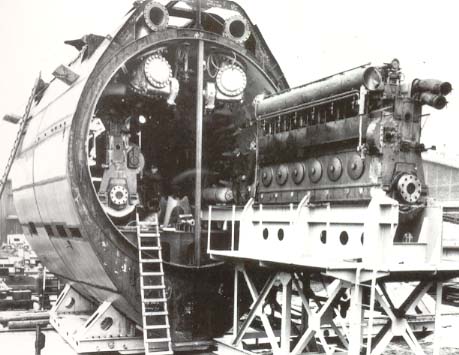
This model was much bigger, longer and employed more powerful
diesel engines. It used a supercharged 9-cylinder diesel instead of
the standard 8-cylinder on the Type VIIs. To balance the much
heavier weight, the engine room was located immediately rear of the
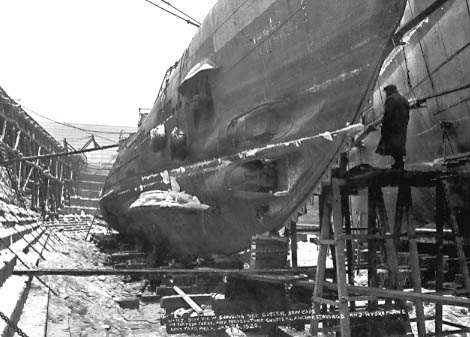
control room. The Type IX had a full double hull, with the outer
hull almost completely surrounding the pressure hull. The upper
deck was wide and flat, which provided additional space to store
ten torpedoes externally in watertight containers. When the war
started, the standard gunnery of the Type IX was one 105mm deck
gun, one 37mm flak and one C30 machine gun. It had four forward
torpedo tubes and two backward tubes, with a total capacity of 22
torpedoes.
Together with the Type VII, the Type IX combined to form the
backbone of the U-boat force, which had fought relentlessly for
control of the shipping lanes of the Atlantic. More than 200 Type
IXs were built in seven sub-classes.
The first of the original design, a total of eight Type IXAs
were built. The first was U-37, launched on May 4 1938, and
commissioned on August 4 1938. It was equipped with three
periscopes, two in the conning tower and one in the control
room.
Fourteen Type IXBs were built. The fuel capacity was increased
from 154 tons to 165 tons, giving a slightly extended range from
8,100nm to 8,700nm.

Fifty four Type IXCs were built. The main difference was an
increased fuel capacity to 208 tons, resulting in an extended range
from 8,700nm to 11,000nm. This subclass onward had two periscopes,
both housed within the conning tower.
Eighty seven Type IXC/40s were built. The fuel capacity was yet
further increased to 214 tons, giving an extended range to
11,400nm.
A highly desirable trait was for a U-boat which could combine
high speed with very long range. However given the technology of
the day, it was recognized that to develop such a boat would cause
excessive complications. Instead, it was decided to develop two
versions, one which maximized speed, and the other very long range.
This led to the design of the Type IXD1 (speed) and IXD2
(range).
Only two Type IXD1s were built, U-180 and U-195. Their standard
diesel engines were substituted with six Daimler Benz MB501
diesels, producing an output of 1,500hp each. Though the maximum
range was somewhat reduced, this design could achieve a respectable
top speed in excess of 20 knots. Considerable technical problems
were encountered, including overheating and the emission of white
exhaust smoke which was visible for miles. The unsatisfactory
engines were removed and the original MAN engines were reinstalled.
They were later converted to transport U-boats and could to carry
up to 252 tons of cargo. In this configuration, the torpedo tubes
were removed to provide additional cargo room. Both variants of the
Type IXD1s were equipped with a Focke Achgelis, a rotary winged
kite for making distant observations.
Twenty eight Type IXD2s were built. In addition to their
standard MAN diesel engines, this variant had two additional six
cylinder diesels which could be used for cruising on the surface.
They had additional fuel bunkers, giving them the exceptional range
of 23,700nm – the longest range of any German attack U-boat. Like
the IXD1, it was equipped with a Focke Achgelis kite.