I do not think China need to hide their military asset as they
are currently developing and expanding their influence.With the
amount of money thrown into their defence budget! Its just a matter
of time they will come out stronger than others.
China's development of stealth fighter takes U.S. by
surprise

The emergence of what is said to be a prototype jet, along with
news of advances on an anti-ship missile, raises concerns about
China's military intentions and the threat it poses to the U.S. in
the Pacific.
By Ken Dilanian, Los Angeles Times January 7, 2011
Reporting from Washington —
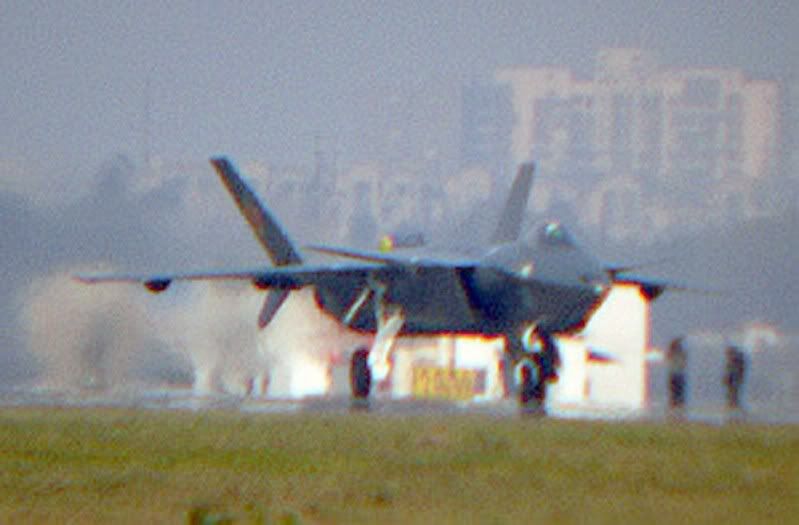
A few weeks ago, grainy photos surfaced online showing what several
prominent defense analysts said appeared to be a prototype of a
Chinese stealth fighter jet that could compete with the best of
America's warplanes, years ahead of U.S. predictions.
Days later, the commander of the U.S. Pacific Fleet disclosed that
a long-awaited Chinese anti-ship missile, designed to sink an
American aircraft carrier, was nearly operational.
As Defense Secretary Robert M. Gates heads to China this weekend,
analysts are expressing concern about Chinese military advances,
which appear to have taken the U.S. by surprise. The Pentagon had
predicted that China wouldn't have a stealth fighter for a decade
or more and Defense officials had given no previous indication the
anti-ship missile, which had long been tracked by the U.S., was
close to fruition.
The assertions came as Gates on Thursday outlined plans to cut $78
billion in projected growth from the Pentagon's budget over the
next five years and cut the number of troops on active duty.
Gates is expected to meet stiff resistance from contractors and
military officials who have long been accustomed to annual budget
increases and development of new hardware systems in response to
warnings of new foreign threats.
"We have been pretty consistent in underestimating the delivery …
of Chinese technology and weapons systems," Vice Adm. David J.
"Jack" Dorsett, deputy chief of naval operations for information
dominance, told reporters Wednesday. "They enter operational
capability quicker than we frequently project."
Dorsett acknowledged that the stealth fighter was real, but said it
would be years before the jet could be deployed. "Developing a
stealth capability with a prototype and then integrating that into
a combat environment is going to take some time," he said.
China watchers disagree about the extent to which the U.S. should
worry about China's steadily increasing military power, which
remains well behind American war technology. But there is one
emerging consensus: After a three-decade buildup and a raft of
technological secrets stolen through espionage, China has closed
the capabilities gap enough to pose a threat to U.S. freedom of
action in the western Pacific Ocean.
"It is true that China is doing some things that we need to be very
concerned about, and it's also true that they are in no danger of
matching U.S. capabilities," said Christopher A. Ford, a former
State Department official and author of "The Mind of Empire:
China's History And Modern Foreign Relations." "Their immediate
game is simply to make sure that it becomes vastly more complicated
for us to do what we might want to do in a crisis in their
particular neighborhood."
The anti-ship weapon, described as a mobile, land-based ballistic
missile capable of hitting a moving target 2,000 miles away, could
do that. Defense watchers were startled when Adm. Robert F.
Willard, who heads the U.S. Pacific Command, told a Japanese
newspaper last month that China had achieved an "initial
operational capability" for the missile.
The U.S. currently has no good defense against such a weapon, said
Richard Fisher of the International Assessment and Strategy Center
think tank in Alexandria, Va., who has tracked China's armed forces
for decades.
Some analysts believe China wants to end U.S. naval superiority so
it can dominate its neighbors, including U.S. allies Japan, South
Korea and Singapore.
In July, when U.S. diplomats rejected China's claim that the entire
South China Sea was part of its "core interests," the Chinese
foreign minister reportedly stared at a Singaporean diplomat and
said, "China is a big country and other countries are small
countries, and that's just a fact."
In September, when Japan detained a Chinese captain caught fishing
in disputed waters, China cut off exports of key minerals to the
nation. And in November, after North Korea shelled a South Korean
island, China criticized the U.S. decision to send the carrier
George Washington to the Yellow Sea, off China's coast.
A 2008 study by Rand Corp. asserts that, based on current trends,
the U.S. by 2020 would lose a military conflict with China over
Taiwan. A recent war game by an Australian think tank confirmed
that finding, assessing that the number of Chinese planes would
overwhelm U.S. forces, Aviation Week magazine said.
Skeptics argue that the U.S. has little to fear militarily from a
country that is its second-largest trading partner and biggest debt
holder. They also note that China still lags in certain key
technologies: It hasn't been able to produce its own fighter jet
engines, for example, and still buys them from Russia.
But the Pentagon is concerned about China's expanding military
prowess. In little-noticed remarks last month, Assistant Secretary
of Defense Wallace "Chip" Gregson said China "is pursuing a
long-term, comprehensive military buildup that could upend the
regional security balance."
The U.S. military's biggest worry, he said, is what are known as
China's "anti-access and area-denial" weapons, including submarines
and the anti-ship missile, designed to prevent the U.S. from
operating without fear in the Western Pacific.
Those weapons go beyond China's defensive needs and "threaten our
primary means of projecting power: our bases, our sea and air
assets, and the networks that support them," Gregson said.
Vice Adm. Dorsett said it was unclear when the aircraft would be
operational.
"They have been able to invest in a military buildup, and a stealth
fighter is just one aspect of that," he said. "The fact they are
making progress in that should not be a surprise."
Dorsett said he was more troubled by China's advances in space
weapons and cyberwarfare capabilities. In 2007, China demonstrated
that it could shoot a satellite out of low Earth orbit. And for
years, corporate and government computer systems in the U.S. and
elsewhere, including those of American defense contractors, have
been hit by cyberattacks traced to China, though a link to the
Chinese military hasn't been publicly established.
Some experts believe Chinese military hackers already have the
ability to take down U.S. power grids and disrupt the financial
system.
China is also developing and fielding "large numbers of advanced
medium-range ballistic and cruise missiles, new attack submarines
equipped with advanced weapons [and] increasingly capable
long-range air defense systems," says the U.S. military's 2010
Quadrennial Defense Review.
"It's China's goal to have a globally deployable military by the
2020s," said Fisher, of the Virginia think tank. "We have to
understand that what the Russians teach them they are absorbing
well. They are becoming military technology innovators, not just
copiers."
China has nuclear weapons and a modern air force, but it doesn't
have an aircraft carrier or bases abroad; its main military focus
has been Taiwan, the island allied with the U.S. that China
considers a province, despite it being ruled separately since the
end of a civil war in 1949. But China is building as many as five
aircraft carriers, analysts say, and is increasingly turning its
focus to projecting power beyond the Taiwan Strait.
China is the world's second-largest military spender after the
U.S., though the gap is large. China put its 2010 defense budget at
nearly $80 billion. The sum is less than a fifth of the U.S. level
of about $530 billion, which doesn't include costs in Iraq and
Afghanistan, but the U.S. believes the amount spent by China is
higher.