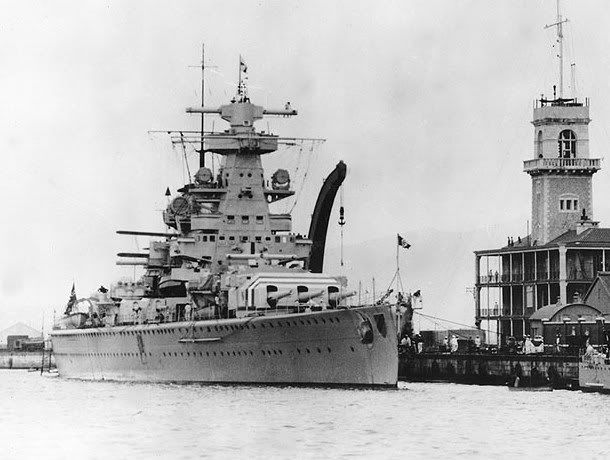
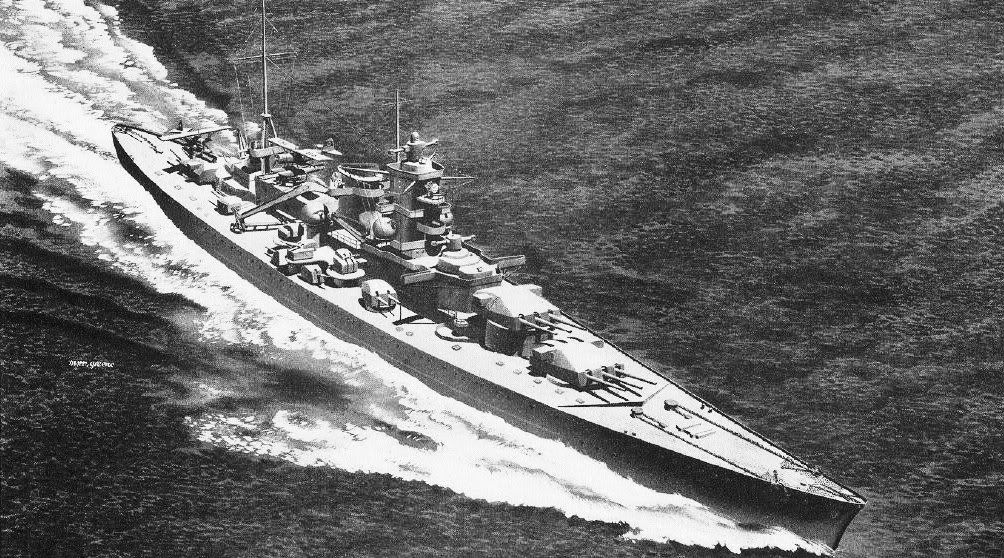
The design of the German Pocket Battleships built in the
mid-1930s, must be ahead of its time as seen in the
Admiral Graf Spee.
These Pocket Battleships were actually uprated heavy
cruisers as Germany was restricted by the Treaty of Versailles
signed after WW-1 - and can only construct warships
no larger then Battle Cruisers.
During the early period of WW-2, Germany sent out several pocket
battleships to terrorise Allied shipping in the Atlantic and Indian
Oceans, and was said to have sailed close to Singapore.
The Admiral Graf Spee was scuttled when she was cornered in
‘The Battle of the River Plate’ (*1) in
Argentina.
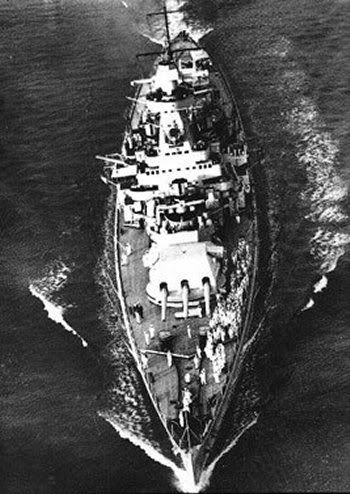
Admiral Graf
Spee
Specifications:
Keel laid: 1
October 1932
Launched: 30
June 1934
Commissioned: 6 January
1936
Scuttled: 17
December 1939
Displacement: 12,100
standard - 16,200 full load
Length:
186m
Beam:
21.65m
Draught:
7.34m
Propulsion:
Eight 9-cylinder double-acting two-stroke MAN diesels -
two propellors, 52,050hp
Speed:
28.5 knots
Range:
8,900 nautical miles at 20 knots, or
9,000 nautical
miles at 10 knots
Complement: 1001 to
1150
Electronic Warfare
and decoys:
Early version of ‘Seetakt
Radar
Armaments: 6
x 280mm (11 inch) 3 each in one front and one rear
turret
8 x 150mm (5.9 inch)
6 x 105mm (4.1 inch)
8 x 37mm
10 x 20mm
8 x 533mm (21 inch) torpedo tubes
Armor:
Turret face: 140mm
Belt: 100mm
Deck: 40 to 70mm
Aircraft
carried: 2 x
Arado 196 seaplanes, one catapult
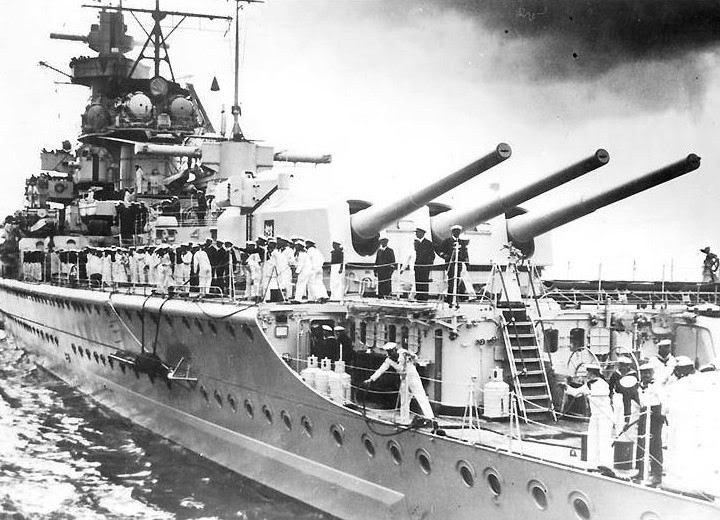
Admiral Graf Spee – aft
view