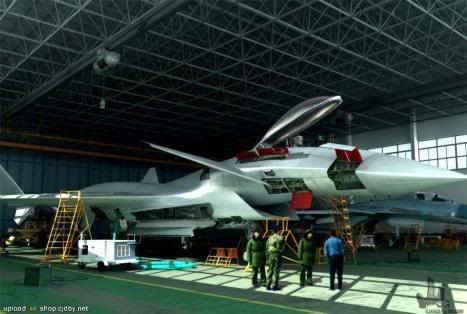
Here is an article from 2008 that surely must be the one that is
causing deep concern to the USA - and to a lesser extent
to the Europeans - which is caught by the typical
Western ambivalent greed to be involved with China's economic
developments, and concerned with the offering of dual use
technologies that will strengthen China's political-military
hand.
China’s Military
Employment of American Dual-Use Technologies
by Richard
Fisher, Jr.
Published on August 1st, 2008
ARTICLES
On June 5,
1989 President George H.W. Bush announced the United States
suspension of sales of items on the U.S. munitions list, or an arms
embargo, in response to the June 3-4 Tiananmen Massacre in Beijing,
China. In 1990 this policy was codified by the U.S.
Congress.[1] But almost from its inception successive
American presidents have made exceptions to this law, primarily by
issuing wavers to allow the purchase of Chinese satellite launch
services. In addition, by the mid-1990s the U.S. Commerce
Department has allowed a growing trade in so-called "dual-use"
items that may have a military use but are not weapons in and of
themselves.
In a 2005
exchange regarding U.S. exports of dual use technologies to China,
former Department of Defense official Lawrence Korb (then with the
Center for American Progress) told Peter Lichtenbaum, then Acting
Undersecretary for Industry and Security of the Department of
Commerce, that "…the United States exports equipment and technology
to China that actively contributes to Beijing's ability to wage
war." Korb noted that U.S. exports were not "…being used in a
manner consistent with our national security and nonproliferation
interests."[2]
Lichtenbaum
disagreed, noting, "The United States maintains an arms embargo on
China. Because dual-use items (such as computers) have important
commercial uses, we do not have an embargo on exports of dual-use
items to China. However, we have a general policy of denying export
license applications for dual-use items to Chinese military
end-users."[3] Nevertheless, it is clear that the State
and Commerce Departments have used this distinction to allow an
increasing traffic in American made or designed products to China
which do have a specific military use. Despite Mr. Lichtenbaum’s
assurance, these items are going directly into the People’s
Liberation Army (PLA) inventory, or are easily accessible by the
PLA from Chinese "civilian" entities.
Open
source information shows that the PLA and China’s People’s Armed
Police (PAP) are benefitting from many American made or designed
products. Some, like the AM General Humvee vehicle, were explicitly
designed for military use. Others, like jet airliners, utility
helicopters, all-terrain vehicles (ATVs) and Segway personal
transports may not have been originally designed for military or
police use, but are thus used in the West, and now in China. In the
case of airliners, it is proving the case that both the United
States and Europe have sold China a considerable potential military
capability. As such, one can conclude that the State Department and
the Commerce Department are not doing their job and ensuring that
these dual use items do not end up increasing China’s military
capabilities.
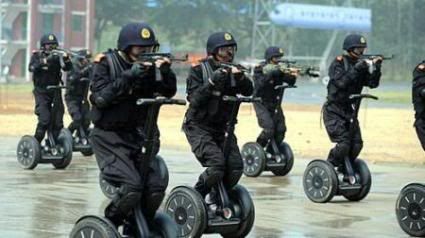
PAP
Segway Squad: As part
of sanctioned exports of US police technology, the People’s Armed
Police now uses the innovative American Segway transporter. Source:
Chinese Internet
From 2005
to the present, both the Bush Administration and the U.S. Congress
have expressed their opposition to Europe relaxing its 1989 arms
embargo. In 2008 the European Parliament and the U.S. Congress have
affirmed their support for Europe’s embargo. However, Europe also
has its problem in allowing a greater traffic in dual-use
technology that is increasing Chinese military capabilities. This
is especially true in the case of helicopter and transport aircraft
technologies. Despite the 1989 EU arms embargo Eurocopter has
sustained a technology relationship with Chinese helicopter
companies, and is now co-developing the EC-175/Z-15 advanced
utility helicopter with China. Furthermore, in its rush to secure a
greater share of the Chinese airliner market from rival Boeing,
Airbus has transferred an airline "kit" assembly line to Tianjin
that can only help China advance its own program to build a large
airliner by 2020, one that will likely be produced in multiple
military variants.
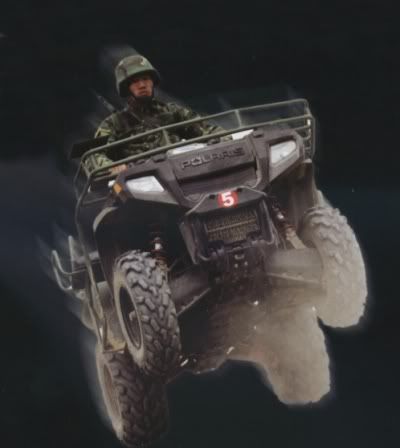
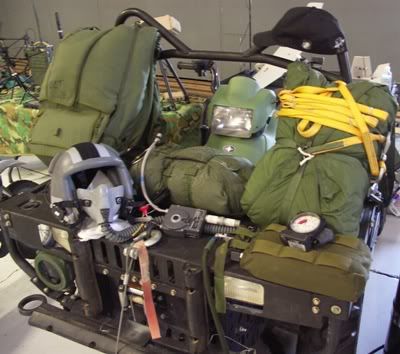
Not
A Toy: American
All Terrain Vehicle (ATV) maker Polaris has shifted much of its
production to China, which makes it easy for the PLA to use Polaris
ATVs as do U.S. Army Special Forces units (bottom), photographed in
May 2008. Source: Chinese Internet and RD Fisher
However,
it is critical that before Washington considers taking any
complaints to Brussels, that it review how American dual-use
exports to China are being used to improve PLA and PAP
capabilities. What follows is a list of U.S. dual-use technologies
that are benefiting China’s military.
While the
ubiquitous M998 High Mobility Multipurpose Wheeled Vehicle (HMMWV,
or Humvee) is now being quickly supplanted by thousands of more
heavily armored Mine Resistant Armor Protected (MRAP) vehicles in
U.S. service, tens of thousands of this AM General design have
entered the U.S. armed forces and about 45 other countries since
the early 1980s. Designed as the successor to the iconic Willy’s
Jeep of World War II fame, the 1.5 ton Humvee can carry a much
greater array of modern weapons and equipment and has been produced
in over twenty variants for the U.S. services alone, from utility
transport, to ambulance, anti-tank, anti-aircraft, electronic
warfare and weather station missions. The Humvee became a critical
system to fulfill new U.S. Army doctrines of the 1980s that
stressed greater mobility and firepower, and thousands were
successfully used during the 1990-1991 and 1993 wars against
Iraq.
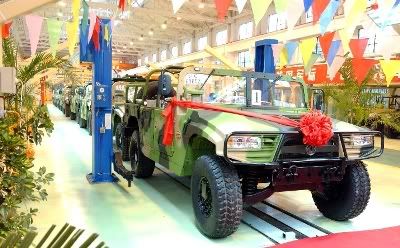
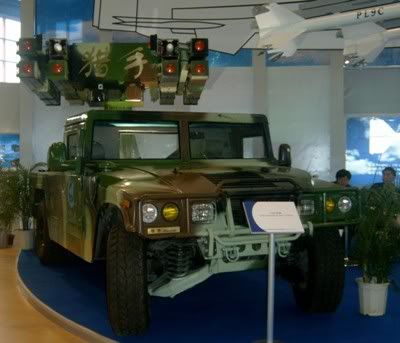
Dong
Feng Motors and Shenyang Humvees: A Dong
Feng Motors production line for Humvees and a Shenyang Aircraft
Corporation copy of the Humvee, with SAMs, seen at the 2004 Zhuhai
Airshow. Source: Chinese Internet and RD Fisher
While the
PLA was reportedly very impressed with the Humvee’s performance
during the first Gulf War, its introduction to this vehicle
predated that war. In 1988 AM General was reported to have
displayed the Humvee at a military exhibition in
Beijing.[4] Other Chinese sources have noted that the
U.S. Government may have given China a small number in the late
1980s as part of early anti-narcotics cooperation. However, at the
2000 Zhuhai Airshow this analyst noted that a picture of a
Humvee-like vehicle appeared in a brochure of the Shenyang Aircraft
Corporation. And then at the 2004 Zhuhai show, an actual Shenyang
copy was put on display, armed with the TY-90 anti-aircraft missile
of Luoyang Optoelectric Technology Company. But by this time it was
apparent that a second copy was also being produced by the Dong
Feng Motors Company, called the EQ2050 "Meng Shi." This version was
marketed at the 2005 IDEX show in Abu Dhabi armed with a turret
equipped with FN-6 short-range surface-to-air missiles
(SAMs)[5] that almost copied the Boeing FIM-92A
Avenger still in use by the U.S. Army.
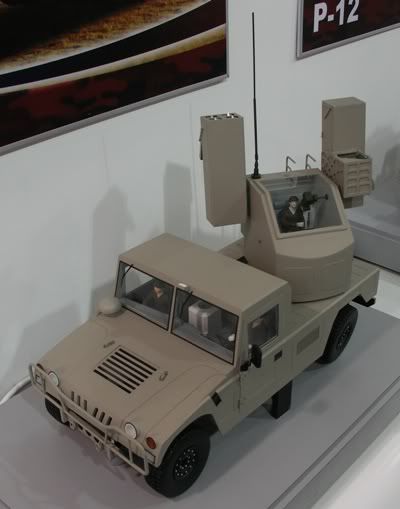
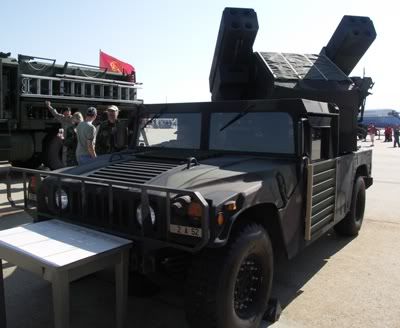
China’s
Avenger: A Boeing
FIM-92A Avenger Humvee-mouted SAM carrier, seen in May 2008, and a
Chinese facsimile, seen on a Dong Feng copy of the Humvee, in model
form from the 2007 IDEX show. Source: RD Fisher
Despite
repeated inquiries from 2005 onward, this analyst could not get a
response from AM General officials regarding the reasons why two
Chinese companies would be producing Humvee vehicles. This changed
in early 2008 when on AM General official, on condition of
anonymity, explained that the State and Commerce Departments
sanctioned the sale and co-production of the civilian H-1 version
of the Humvee for the Chinese market in the 1997 time frame. This
led to a partnership with Dong Feng Motors. It is less clear that
there was a formal relationship with the Shenyang Aircraft
Corporation. However, the official noted that AM General sells
parts to both companies. This official also acknowledged that the
PLA and the Chinese government are the main customers for these
co-produced Humvees. So far it appears that Dong Feng may produce
1,500 copies but that has not happened yet. However, neither
company has rights to sell versions to the civilian market. AM
General had also received in 2007 a reconfirmation from the
Commerce Department of its authorization to sell Humvees to the
Chinese market.
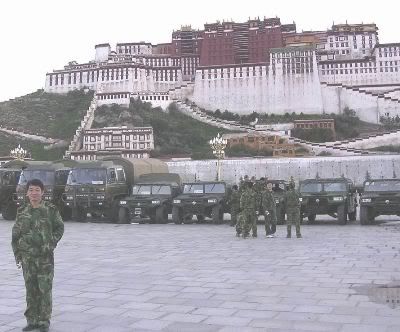
Dong
Feng “Humvees” In Tibet: A line of
Dong Feng Motors trucks outside a Tibetian monestary, which
includes versions of the Humvee. Source: Chinese
Internet
Currently
Dong Feng Motors appears to be the most active producer of
Chinese-made Humvee versions. Dong Feng made Humvees apparently use
a slightly more powerful diesel engine. One Chinese article
suggested that if Dong Feng were to enlist other companies, it
could produce up to 100,000 a year for wartime
production.[6] So far Chinese-made Humvees have been
purchased by Chinese Police departments, the PLA Marines, various
PLA Army units to very likely include Airborne and Special Forces
units. Dong Feng markets a version armed with a roof-mounted 23mm
cannon and another Special Forces version armed with a automatic
grenade launcher and a squad machine gun. Another version of the
Humvee forms the carrier for 81mm automatic mortar[7]
and a twin-23mm anti-aircraft gun, and are being used by a novel
PLA "Mechanized" Special Forces unit. The Poly Technologies arms
trading firm markets the "FB-6A Missile Launching Vehicle," which
is armed with eight FB-6A man-portable air defense system (MANPADS)
anti-aircraft missiles.[8] This vehicle is a virtual
copy of the Boeing Avenger system. Inasmuch as Taiwan makes
extensive use of several version of the Humvee, and has purchased
72 Boeing Avengers for Army air defense, the PLA’s growing
inventory of Humvee copies presents many opportunities for surprise
and deception operations against Taiwanese forces.
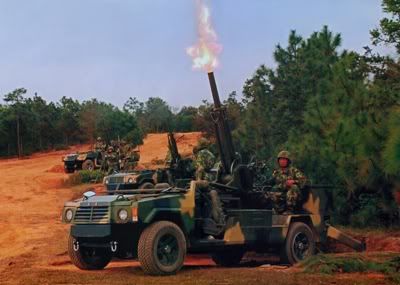
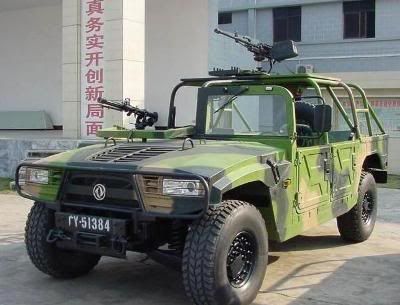
PLA
Special Forces Humvee Variants: This
variant Humvee chasis now carries a 81mm automatic mortar or a twin
23mm anti-aircraft cannon, as part of an effort to create a
“Mechanized” or more heavily armed helicopter-portable Special
Forces Unit. Dong Feng also makes a Special Forces variant (bottom)
Source: Chinese Internet
Despite
the capability that has been transferred to the PLA and the growing
threat this presents to U.S. friends like Taiwan, AM General faces
tough competition in the China military vehicle market from
European automakers. The Italian IVECO designed NJ2046 produced by
Chinese partner NAVECO is used by the PLA in several versions,
including one for Airborne Forces. The PAP uses one IVECO van
version as a mobile lethal-injection prisoner execution platform.
Germany’s Mercedes Benz has several truck versions in production in
China, and the PAP uses an armored Mercedes G-Class vehicle with an
anti-sniper detection device.
As it has
at various times during the Bush Administration there has been the
suggestion that the U.S. relent on Tiananmen related sanctions and
permit the sale of spare parts for the 24 Sikorsky S-70
Blackhawk helicopters sold to the PLA in the
1980s.[9] Most recently China requested these spare
parts for humanitarian concerns related to the S-70’s role in
relief operations responding to the devastating May 12, 2008
Sichuan earthquake. However, this idea has been repeatedly
rejected, in large part due to the S-70s overt military role; this
helicopter is regularly seen in PLA exercises carrying artillery
and Special Forces vehicles. It will almost certainly be employed
in any future operations against Taiwan—which also operates the
S-70 and is seeking more.
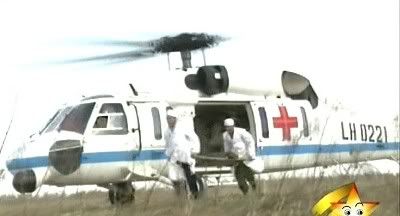
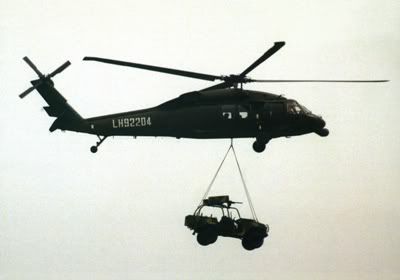
PLA
S-70s: The PLA’s
Sikorsky S-70 Blackhawk contributed to relief efforts following the
May 12 earthquake, and it could in the future carry Special Forces
vehicles to help attack Taiwan. Source: Chinese
Internet
However,
in part due to pressure from the U.S. helicopter industry the
Commerce and State Departments have relented in permitting sales of
U.S. helicopters to "civilian" Chinese entities. In 2001 United
Technologies subsidiary Sikorsky Aircraft Corporation sold S-76
transport helicopters to the Chinese Ministry of Communications,
and in 2005 sold S-92 helicopters to China Easter General Aviation
to support offshore oil drilling operations. In 2007 Sikorsky
entered into a partnership with Chinese helicopter maker Change
Aircraft Industries Corporation to co-produce S-76 airframes to
support Sikorsky production.[10] In 1998 Sikorsky
entered into a partnership with China’s AVIC-2 consortium to
co-develop the larger S-92 helicopter, and it manufactures the tail
of that helicopter. In 2003 Sikorsky established its Chinese
partner "Shanghai Sikorsky," and in 2008 AVIC-2, though its
subsidiary Change, became a shareholder of Shanghai
Sikorsky.[11] Change also co-produces the
Sikorsky-Schweitzer S-300, a lightweight training helicopter, which
also formed the basis for U.S. Navy’s Northrop Grumman MQ-8B
Fire Scout unmanned helicopter.
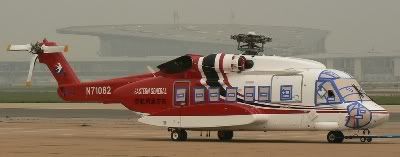
Sikorsky
S-92 Superhawk: Shown
being delivered to a branch of China Eastern Airways, the S-92 is
one of the most modern and capable helicopters in the world.
Source: Chinese Internet
Another
United Technologies subsidiary, the Pratt Whitney Canada aircraft
engine maker, sold ten of its PT6C-67C helicopter turboshaft
engines in 2000-2001 to assist the Chinese Medium Helicopter
program of the Chinese Helicopter Research and Development
Institute (CHRDI),[12] the chief designer of China’s
helicopters. In 2007 Pratt and Whitney Canada claimed they thought
they were assisting the "civilian" version of this
program,[13] which had been thought to include the 5.5
ton WZ-10 dedicated attack helicopter, and a 6 ton utility
helicopter based on the same drive train. The later has yet to
materialize, while several prototypes of the Z-10 military attack
helicopter are now flying powered by PT6C-67C engines. The Z-10 is
about the same size and configuration as the Eurocopter
Tiger, one of the world’s most modern and capable attack
helicopters. Full production of the Z-10 powered by Pratt Whitney
engines would give the PLA an unprecedented level of "aerial
artillery" to support amphibious invasion and subsequent operations
against Taiwan.
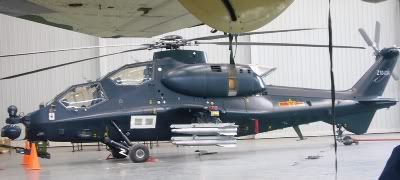
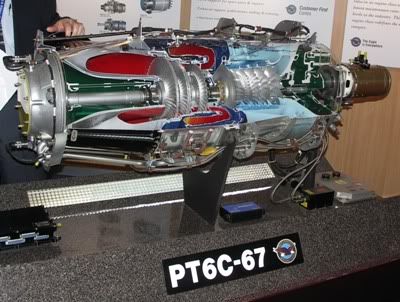
PLA Z-10
and United Technologies PT6C-67: A Pratt
Whitney Canada turboshaft engine (top) powers the current
prototypes of the PLA’s new sophisticated attack helicopter, which
is comparable to the Eurocopter Tiger and as capable at Taiwan’s
Bell AH-1 Cobra attack helicopters. Meanwhile, China is
blackmailing U.S. helicopter makers selling to Taiwan. Source:
Chinese Internet and RD Fisher
Bell
Helicopter Canada, a subsidiary of the American Textron Company,
sold its Bell-427 light helicopter in China after 2000, and in 2003
entered into a partnership with Hafei Aviation Industries to
manufacture airframes for the Bell-430
helicopter.[14]
However,
on a corporate or company level there is a thin-to-no distinction
between selling to a "civilian" and a "military" entity in China.
All of China’s helicopter companies perform either research and
development or manufacturing for the PLA. While one might quibble
that Sikorsky S-76 and Bell-430 airframes or S-300 helicopters are
relatively low-tech, it is likely that China’s intelligence
services have targeted these companies to ensure that Chinese
companies benefit from data gathered in China, or via cyber
espionage operations that could benefit from an understanding of
corporate data bases. In addition, all U.S. helicopters sold to
"civilian" Chinese entities are theoretically subject to emergency
military mobilization. This was demonstrated in the response to the
May 12 Sichuan earthquake when a S-76 helicopter sold to a
"civilian" operator was used along with Russian Mil Mi-17s and
European Eurocopter AS-332 helicopters sold to other Chinese
"civil" operators.[15] These helicopters are equally
likely to be used to support potential Chinese military operations
against Taiwan, Japan and India.
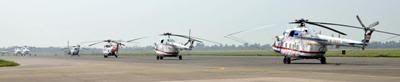
Civil
Helicopter Lineup: This
lineup of Chinese civilian helicopters aiding earthquake relief
efforts includes a Sikorsky S-76, an indication that the Chinese
government could mobilize these helicopters for military missions
against Taiwan as well. Source: Chinese Internet
As is the
case with autos, American helicopter companies believe they must
compete with Russian and European firms which gain political favor
by selling helicopters and technology to the PLA. The PLA has
purchased about 240 Russian Mil Mi-17I/V5 medium utility
helicopters and has just entered a kit-based co-production
agreement anticipated to add an additional 160 to its inventory
over five years.[16] While Russia may hope to safeguard
its technology,[17] it is apparent that Europe views the
transfer of its helicopter technology as key to securing future
helicopter market share. Eurocopter helped CHRDI design the drive
train for the Z-10 attack helicopter.[18] Since 2004
Eurocopter and China’s AVIC-2 have proceeded with a co-development
and co-production project to create a new 8-ton utility
helicopters, called the EC-175 in Europe and the Z-15 in China. Its
first flight is expected in 2009 and it is expected to be certified
in 2011. A Eurocopter official told this analyst that they do not
expect the Chinese military to use the EC-175.[19] But
Eurocopter’s record is not encouraging; Eurocopter’s SA321, SA365,
AS350 and HC-120, all co-produced in China, serve in the PLA, as
the Z-8, Z-9, Z-11 and HC-120.
At the
November 2004 Zhuhai Airshow this analyst noticed a peculiar
feature in a video presented by the Xian Aircraft Corporation. In a
section of the video that showed newly built H-6 bombers outside
the Xian factory, there was a Boeing B-737 jet transport with what
appeared to be new fairings atop the fuselage. When the author
asked Asian military contacts about this oddity there was a
surprising report: China had converted two Boeing 737 airliners to
serve as electronic control and monitoring platforms to support
testing for new long range Land Attack Cruise Missiles. Subsequent
Internet-source pictures of the aircraft revealed that new fairings
has been placed on top of and on the bottom of the fuselage. Such a
configuration could support a command and control or the suggested
cruise missile test monitoring mission. A more recent
Internet-source photo shows the aircraft to be part of a special
PLA Air Force squadron equipped with other electronic and radar
test aircraft.
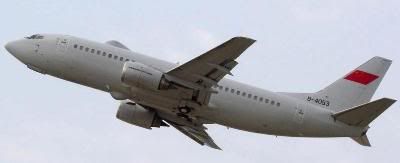
PLAAF’s
“Pirate” Boeing 737: A Xian
Aircraft Co. video from 2004 offered the first indication that
China had altered a Boeing 737 for military missions (top) and
subsequent internet photos show this PLAAF aircraft has new
fairings ontop and below the fuselage. Source: RD Fisher and
Chinese Internet
In early
2005 officials in the State and Commerce Departments told Bill
Gertz of the Washington Times that this PLA use of an
American-made aircraft was under investigation. A State Department
official reported to Gertz, "…commercial jets are permitted for
export to China without a license, but that converting a civilian
aircraft into a military jet is not allowed under U.S. export
rules." This official then stated, "It is unquestionably true that
these jets could not have been sold to the Chinese military without
a presidential waiver, which is very unlikely," Gertz also reported
that if China had violated U.S. export rules, "penalties could
range from fines to the imposition of economic sanctions on China
that would bar purchases of U.S. aircraft worth hundreds of
millions of dollars."[20] However, three and half years
later, there has been no action by the State Department or the
Commerce Department reacting to this flagrant Chinese military
employment of a controlled American technology. Instead, Boeing
continues to sell its B-737 airliners to Chinese airlines, which
now operate over 200. In March 2008 the Pentagon reported that
China could have as many as 250 new Land Attack Cruise Missiles
targeting Taiwan.[21] In early 2007 Taiwan’s Ministry of
Defense reported that only 100 such PLA cruise missiles were
deployed.[22]
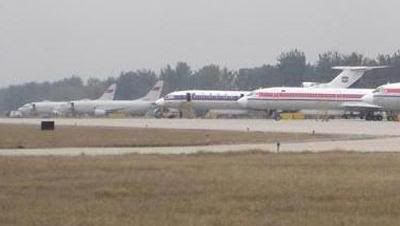
PLA’s
Boeing 737s In Regiment: This
Chinese Internet photo from 2008 shows two modified Boeing 737s in
a PLAAF regiment dedicated to radar and electronic warfare testing
aircraft.
PLA Use of American Cargo Airliners
for Military Operations
A more
ominous use of American made airliners is the PLA’s regular
incorporation of civilian airliners into military troop and cargo
transport missions. It has long been known that the PLA uses
China’s fleet of civilian airliners as a "reserve" air transport
resource. These airliners have been used to perform troop rotations
and are occasionally used in troop transport exercises. Following
the May 12 Sichuan earthquake the PLA again used Boeing and Airbus
airliners with China Southern and China Eastern airlines to make
emergency shipments of personnel and material. These supplemented
the use of PLAAF Ilyushin Il-76 and Xian Y-8 transports for the
same missions. But then in mid-June, perhaps capitalizing on the
need to hone emergency airlift mobilization, the PLA conducted
another exercise in which PLAAF Il-76 and both Airbus and Boeing
airliners were mobilized to move PLA Airborne troops.
However,
there was a unique addition to this mid-June exercise: the use of
at least one Boeing B-747F and one McDonnell Douglas MD-11F
dedicated cargo transports. A cursory count of U.S. made cargo
airliners used by Chinese airlines—which would now include Hong
Kong’s airlines-- indicates that they have at least 31 Boeing 747F
cargoliners of various models and 9 MD-11F models, for a current
total of 40 cargoliners.[23] An Il-76 can carry about 48
metric tons while a Boeing B-747F-400 can carry about 55 metric
tons. If one accepts current estimates that the PLAAF has about 20
Il-76 cargo transports, then the potential addition of U.S. made
cargoliners could potentially treble the PLA’s air cargo lift
capacity. But this is set to increase as Hong Kong’s Cathay
Airlines has 16 Boeing B-747 cargoliners on order, and China
Southern Airlines has six new Boeing B-777 cargoliners on order.
Enlisting "civilian" cargoliners in potential operations against
Taiwan would be very attractive to the PLA. These aircraft could
concentrate on moving the wide variety of palletized cargo, from
bullets to artillery rockets to beans, that would be needed to
sustain light and medium weight tracked and wheeled armored forces
that would be best moved by Il-76s. By using civilian cargoliners
to build up weapons and supplies, PLA Airborne armored forces sent
to capture a Taiwanese airport could quickly move from a defensive
to an offensive mission.
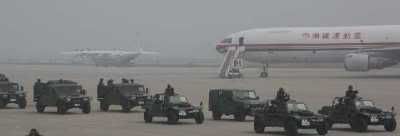
PLA
Cargoliners: A
mid-June 2008 PLA mobilization exercise saw the first noted use of
civilian Chinese Boeing B-747F and MD-11F cargoliners to help
transport PLA Airborne troops and their equipment. Source: Chinese
Internet
China’s Arms Embargo Of America
?
Despite
the U.S. and European arms embargos of 1989 responding to the
Tiananmen Massacre, an event for which the Chinese government
refuses still to acknowledge responsibility or offer justice,
China’s military is making flagrant and increasing military use of
American and European dual use technologies. In the case of the PLA
Air Force’s "pirate" Boeing B-737, the U.S. State Department and
Commerce Department cannot even organize themselves to define and
enforce American law. This aircraft has very likely made a major
contribution to the development of the PLA’s now rapidly growing
offensive cruise missile capabilities. Co-produced Humvees,
Sikorsky and Bell helicopters, plus Boeing and McDonnell Douglas
cargoliners all are available now to the PLA to undertake direct
attack or deception operations against Taiwan.
But there
is perhaps another lesson for American policy makers. Instead of
quietly increasing its exploitation of this growing instance of
American weakness, China’s leaders are instead pressing for their
own "embargo," actually threatening American aircraft makers
Boeing, Bell and Sikorsky that they cannot sell to the Chinese
market if they sell new weapons to Taiwan. In mid-May Defense
News reported:
"Over the
past two years, China has threatened to stop buying commercial
airliners from Boeing and civil helicopters from Bell Helicopter
and Sikorsky if the companies continue to sell weapons and
"advanced helicopter technologies" to Taiwan, sources said. Each of
the companies stands to lose billions of dollars in potential
orders, sources added… In 2006, China’s threats led Boeing to
shutter its Taipei office and move the staff to Singapore, sources
said."[24]
The fact
of the matter is that China cannot yet make its own
commercial/military high-capacity transport aircraft or even keep
pace with helicopter technology without foreign assistance. This,
however, could change dramatically in the next decade should Airbus
and Eurocopter, either willingly or otherwise, give China the
technology needed to make competitive aircraft that will form the
basis for indigenous military versions. Yet the Chinese leadership
believes that it is now strong enough to blackmail American
aircraft corporations into forcing the American government into
betraying a longstanding security interest in Asia: defending the
democracy on Taiwan.
The
regular and evidently intentional fudging of restrictions on dual
use and other exports is most likely understood as manifesting the
rarely-spoken but clear expectations that have set Washington’s
expectations since the 1970s. These are first that whatever
happens, China will sooner or later emerge as the supreme economic
and military power in Asia. The second is that it is therefore
essential for the United States to be friendly with that China,
regardless.
Expert
opinion is divided. Some believe China will indeed continue
smoothly on her present course and that her neighbors will sooner
or later acquiesce. The result will be a replication of the
China-centered tributary system that, although it never existed in
fact, was widely portrayed in traditional Chinese writings. Others
see dangers ahead for China—not just popular unrest and the problem
of keeping political control without elections or free speech, but
also environmental degradation, waste of resources—and if China
attempts to coerce her neighbors, the emergence of a powerful
coalition to balance her.
For
Washington to plump so firmly on one side of this debate, making
little provision for internal problems in China or external
adventures, is most unwise. For the moment, however, that seems to
be the signal being sent to China by the White House.
Reading
this, the Chinese see themselves as engaged in a classic test of
will what they consider the declining power of the United States
and its allies. Analyzing our policy choices, they see an
increasing willingness to defer to their wishes rather than to
consider the interests of Asia as a whole. Few things are more
dangerous in international affairs than a state that expects to be
able to step into a position of primacy, be it regional or global,
more or less effortlessly—indeed with the hegemon-emeritus
smoothing the way. That China would actually be able to assume such
a position and that the United States would knowingly smooth the
way are both most doubtful propositions. But if our actions, for
example with respect to dual use technologies, have the effect of
convincing China that we are packing up and leaving the field to
them, and leading our allies to think that they will soon be on
their own, the results are likely to be opposite to what Washington
intends—and potentially conflictual.
For
references click on the following:-
http://www.strategycenter.net/research/pubID.187/pub_detail.asp
Side notes:
- ‘China’s Hummer excel
the Original Hummvee ?’
-
‘Hummer sold to China 1’
- ‘Hummer sold to China
2’