‘The Military Experience – Confrontation
with Indonesia 1964 - 1965’ (*2)
The first Claret raids were shallow affairs
carried out by superb Gurkha troops and the SAS. The SAS participated in the
raids since it knew better where the Indonesians were and could guide the
Gurkha units to their objectives.
The SAS, permitted to run its own four-man
raids, was gleeful about the
chance to do something other than "watching and counting." The
SAS nicknamed itself "The
Tiptoe Boys" because of its ability to strike the enemy
hard and slip away, leaving only
empty space to receive the enemy counterattack.73
Infantry raids still assumed larger proportions
(up to company size) than SAS
raids, but they remained small enough to avoid precipitating a
violent Indonesian response.
As the risks were great, so were the precautions: "no
rifleman was allowed to eat, smoke,
or unscrew his water bottle without his platoon commander's permission.
At night, sentries checked any man who
snored or talked in his sleep.
Whenever the company was on the move, a reconnaissance section led the way, their packs
carried by the men behind."74
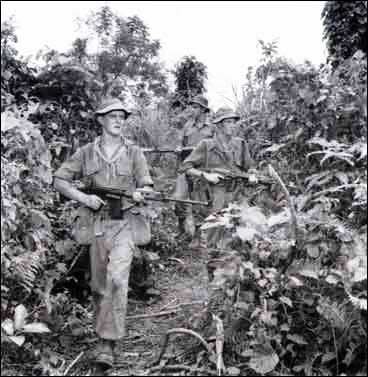
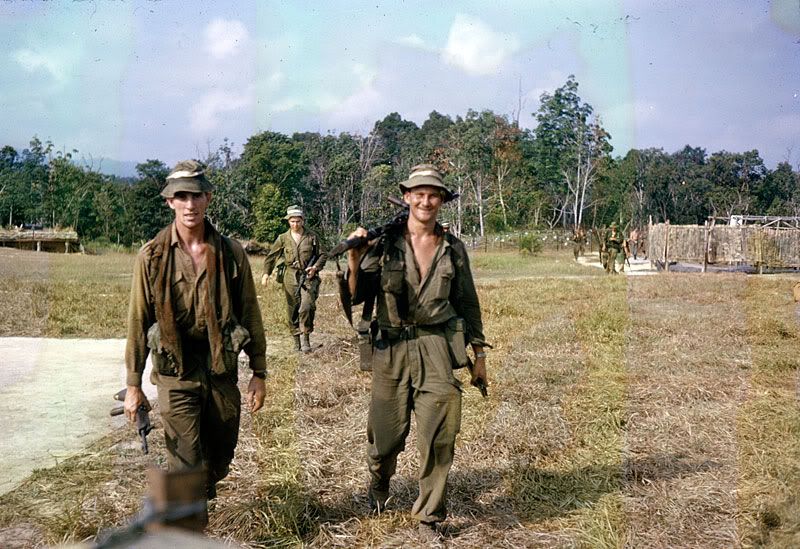
Appearing ghost like out of the jungle, these
parties of light infantrymen usually achieved complete surprise. After
conducting a trail or river ambush or an early-morning attack on an Indonesian
border post-forward base, the Gurkhas immediately returned to the friendly
side of the border. Pursuing Indonesians had to take care to avoid being
caught in an ambush.
As time passed, more and more of the experienced
infantry battalions were
given permission to participate in Claret operations. Walker also
increased the depth of
penetration from 5,000 yards to 20,000 yards. Ultimately,
the operations accomplished
their goal: the frequency of enemy offensive actions
in Borneo fell off as the
Indonesians became preoccupied with protecting themselves.
Throughout the war, the British never
acknowledged their raids into
Kalimantan territory. The Indonesians, on their part, were
embarrassed too much by the
raids to make a political issue of them.
Tactical Issues
The tactics, combat support, and individual
skills required by the British in Borneo resembled those practiced by their
light infantry in Malaya. Nevertheless, because three years had elapsed since the
struggle in Malaya, the troops initially deployed to Borneo required
extensive acclimatization to the jungle climate and retraining in jungle warfare.
As in Malaya, infantry units received their training at the Jungle Warfare
School, where they rapidly reacquired the necessary skills.
Significant differences did exist, however,
between the tactical style of operations used by the British in Borneo and
that in Malaya. Owing to the larger size of the threat in Borneo (the
Indonesians rarely moved in groups smaller than a platoon), the British infantry
generally operated more at the platoon level than at the squad level. In
addition, because the enemy fought more tenaciously in Borneo, the British devoted
more attention to conservation of ammunition. Isolated patrols could not afford
to run out.
Light infantry attacks in Borneo most often took
the form of ambushes. These
ambushes, as in Malaya, lasted for long periods of time. One
infantry unit, for example,
maintained an ambush in waist-to-shoulder-deep water
for three days, rotating
the men on the ambush site every ninety minutes.
75
In Borneo,
the infantry conducted more river ambushes than they had in
Malaya. The sparse settlement
in Borneo also permitted the British to set up remote
ambushes using claymores and other
mines-ambushes that were self-detonated by the victims.
Occasionally, these mines were triggered by
animals. However, even if the
Indonesians did not fall victim to these remote ambushes,
their nondetonation informed
the British that no enemy patrol had passed that
way.
Close-air and artillery support were used more
widely in Borneo than in Malaya, mainly because the Indonesians presented
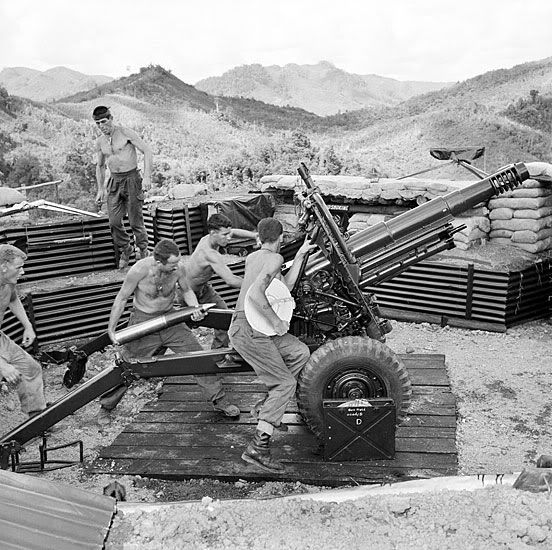
better targets. To support local patrolling, 105-mm howitzers were deployed
into jungle bases singly and in pairs.
Using these widely separated pieces was not
easy, however, because of the
difficulty in controlling indirect fires. Infantry NCOs had to be
proficient in calling for
fires, since they seldom had forward observers along.
Similarly, each gun section
had to have the capability to compute firing data. In
addition, a special
fire-control net was established. In view of the extraordinary
requirements of the
situation, the artillery command in Borneo published
special, area-specific
SOPs. 76 The RAF conducted no bombing operations in
Borneo.
Logistics
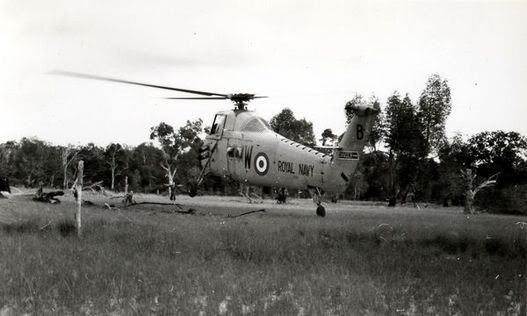
The greater difficulty of the terrain, the lack
of a decent road net, the wider decentralization of forces, and the
improvements in helicopter technology and techniques influenced the British to provide
90 percent of their logistic effort in Borneo by air.
The British also employed watercraft in
resupplying units. The
Hovercraft, in particular, was put to good use, carrying both
troops and cargo via inland
waterways. Watercraft, unlike helicopters, could also
operate at night.77
Owing to its precarious situation, the SAS
supplied itself by placing caches here and there for emergency use. It also
supplemented its light rations with jungle foods such as fruits, bamboo shoots,
animals, and other local fare. The jungle could have sustained the SAS completely,
but such an approach would have consumed too much of its time. The standing
requirement for SAS teams on
patrol was to be able to vanish for two weeks without having
to resurfacefor
resupply. 78
Weapons and Equipment
The mild controversy over weapons and equipment
that was generated during the
Emergency grew in intensity during the Confrontation. Walker
considered that none of the
available standard infantry weapons was satisfactory.
79
The issue rifle (SLR) was too long and heavy for
use in the jungle. Troops
much preferred the AR-15, the export version of the U.S. M-16.
Its lighter ammunition
(5.56-mm) and high velocity seemed much better suited to
their situation than the slower,
7.62-mm NATO round. Shotguns, once again, demonstrated their great utility for close
fighting in heavy vegetation.80
The British reevaluated their use of other
weapons. The aging, but highly regarded, Bren gun was in the process of being
withdrawn from the inventory during the 1960s, but its replacement, a
belt-fed medium machine gun was deemed too heavy and too susceptible to
malfunction from dirt and water.
In the
1950s, the ATOM manual declared that the 2-inch mortar had no
utility in the jungle;
nevertheless, in Borneo, the 81-mm mortar was thought to be
too heavy for patrolling, and units
preferred the 2-inch mortars. Its reduced range posed no problem in the close quarters of
jungle warfare. 81
Walker complained to his suppliers that many
other items of equipment weighed too much for light infantry work. He
identified tactical radios, airground radios, jungle clothing, and rations as items
requiring lightening.