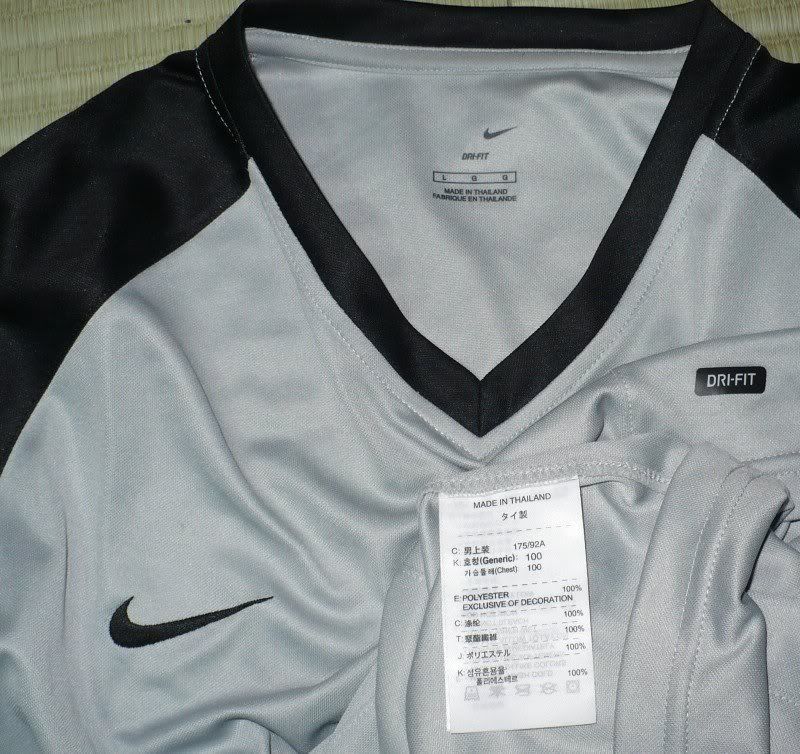
sweat wicking polyester and non sweat wicking polyester is very
different .
looks like you havn't worn a coolmax / polartec / drifit t-shirt
before.
its a t-shirt fabric, its NOT a shoe.
anyway, if the polyester is of the hollow fibre variety ,
its gonna wick sweat up in a jiffy and help the wearer stay dry
next to the skin as the sweat is carried away from the skin
layer to the outside layer.
SAF jogging uppers is made of such material.
50/50 "polyco" (polyester/cotton mix for the cloth) has been the
US norm for their GI BDU's, its just that SAF still is behind
them during the old no.4 era, but has since improved with
said new batch of pixilated no.4.
100% polyester will be a nightmare if exposed to fire risk ,
hence the polyco mix to make polyester burn away without adhereing
to the soldier's skin in a nasty hot liquid goop that cause
nasty 3rd degree burns.
The UVa UVb dye, thats a joke at best if washed with normal
"suds" detergent, i only use ATSKO SPORT WASH for all my polester
clothes and uniforms , no UVa/b reactive residues, no problem.
Softener isnt the problem to the UVa/b problem , its the
problem to the polyester hollow fibres that provide the
critical sweat wicking properties of the cloth. Basically, it
collapses the hollow fibre , rendering it into a normal "wedding
suit" as you said with NORMAL polyester wedding/police suits.
machine washed the new no.4's , dried up within 4 hours indoors,
ambient temp 24 degrees. Very fast drying compared to the old 100%
cotton wich takes ages to dry if not for sun.
POLYESTER - is POLYESTER until you begin to be more
accurate with your preferred definition of its type or its grade -
or until you become more exact in your intended use for the
material.
The polyester used in the manufacture of the shoe and used
in your T-Shirt fabric is from the same chemical base - except for
the difference in the final products - both are
Polyester.
Could you have mistaken "NYLON" for
polyester used in "your T-Shirt" ?
Do you know that there is very little difference between
Polyester and Nylon ?
Quote:
"Nylon has similar
characteristic as polyester - with both having the same
chemical structure, same melting point at 295 degrees C, quick
drying and mildew resistant, with both having significant strength degradation over
prolong UV exposure - while they are similarly strong,
NYLON has the edge and outperform Polyester in abrasion resistance
testing and is "EASIER to DYE". This
makes NYLON more favored in outdoor luggage and sports
application.
Polyester is more resistant to
stretching and shrinking than nylon, making nylon the preferred
fiber for applications where stretch and shock resistance are
required - such as in parachutes.
BOTH fibres are relatively
non-hydrophilic, but beling less moisture resistant polyester is
preferred in many anti-wicking applications - such as substrates
for pressure sensitive diaphragms.
DIFFERENCES: Where polyester and
nylon diverge significantly is in their chemical behavior. They are
chemical mirror image of each other. Polyester favors acidic
environments (pH<7.0), while nylon favors alkaline environments
(pH>7.0). Given exposure to the wrong chemical environment,
either fiber will deteriorate rapidly, expecially at elevated
temperatures."
The "breathability and strength" of the fabric is dependent also
on the density of the weaving per square centimeter - and will
surely help to go a long way in acheiving the intended design or
purpose for the chosen material.
Many sports wear manufacturers have generally termed the
material used in sports garments as "100% Polyester"
and do not identify the actual synthetic material used
when there are a wide variety of synthetic materials that
are available - (and done so for obvious reasons).
While maintaining the advantage of non-water retention with your
100% polyester, the military uniform has to take into consideration
more then your "rapid water removing" feature alone. Some of
these considerations will necessarily be protecting the
military personnel from the various natural and military
environments.
The following article - “Outdoor Clothing & Footwear
Recommendations” - offers some interesting points that can
be applicable for consideration but will require selective reading
to the portions that are related to this part of the world in
the equatorial region.
Note:
UV-A and UV-B were mentioned as affecting the dyes used in
printing the digital camo patterns, and nothing was mentioned about
detergent affecting "UVa or UVb dyes" - are there such dyes
?