AdelaideNow: Collins Class a
Triumph
DEREK WOOLNER
May 12, 2008 12:15am
PEOPLE in the street and some sections of the media
dismiss the navy's Adelaide-built Collins Class submarines as
monumental duds.
In stark contrast, most insiders
we interviewed, as the authors of the history of the project,
consider them a naval engineering triumph and a monument of
Australian nation-building.
From its inception in 1978 the project was seldom far from
controversy and it was mercilessly attacked by the media and the
Howard government for a myriad of technical failings – real,
exaggerated and imagined.
It is widely believed to have been a financial disaster,
yet it is one of the few
military purchases where the original budget was still relevant at
the end of the project.
Further, Australian
industry responded successfully to the challenge of building
submarines in this country, an achievement widely believed to be
beyond Australian capabilities and one in which many other
countries have failed disastrously.
During the 1970s the Australian Navy operated British-built
Oberon diesel-electric submarines on some of the most secret
intelligence-gathering missions of the ColdWar.
Nuclear submarines lacked the stealth for these covert
operations, and the U.S. Navy encouraged Australian military
planners and politicians to maintain the long-range
intelligence-gathering capability in the Oberons' successor
vessels.
At the same time the Australian submariners developed convincing
arguments that submarines were the most effective vessels for use
in long-range offensive operations in enemy waters.
Thus was born the desire to build the most modern long-range
conventional submarine in the world.
Modernity would be attained through a then-revolutionary idea:
Instead of taking whatever options for a combat system came with
the design, the navy would specify the combat system which best met
its needs and this would be developed separately from the
submarine.
Further, following intense debate, it was decided to build the
submarines in Adelaide as a focus for industrial regeneration and
to provide better long-term maintenance and support than was
usually received from overseas shipyards.
These factors determined
the nature of the Collins project. To U.S. submariner Admiral Phil
Davis, the project was a huge undertaking, a "monumental
feat".
"There is really nothing
in the history of submarine construction that has been done like
that," he said of the transformation of a small Swedish submarine
into a "radical new design", built 18,000km from the designer's
office "in a new yard with a new workforce".
Amazingly, the project's
objectives were largely delivered. Today, the Australian Navy
operates sophisticated long-range submarines.
Peter Sinclair, the first skipper of HMAS Collins, who has wide
experience with other conventional submarines, believes the Collins
is more capable than any conventional submarine at sea, with a
turning circle second to none and "super quiet at slow speed,
quieter than anything else in the world".
Few thought that
Australia's recession-ravaged industries of the early 1980s could
build a submarine. Yet, with the introduction of modern techniques
that accompanied the project, over 70 per cent of its value was
produced in Australia by hundreds of subcontractors who embraced
the exacting defence quality standards. The welding standards
remain some of the best achieved in the world.
THE project suffered its
share of problems but the only surprise, given the ambition of the
project, was that they were not better
anticipated.
With problems overcome through some remarkable defence science
and assistance from the U.S., the submarines were delivered close
to budget and an average of 26 months behind schedule.
This is one of the
shortest delays with any military purchase and remarkable for the
largest systems integration project in Australian
history.
The persisting failure has been the combat system, a testament
to both the inadequacies of some of the world's major arms
corporations and the unchecked ambition of Australian
submariners.
Even this disaster was salvaged by the expertise and ingenuity of
Australia's project engineers and defence scientists, cobbling
together a system to provide an acceptable
performance.
Derek Woolner is an expert on defence procurement
projects, and is Visiting Fellow at the Strategic and Defence
Studies Centre at the Australian National University. He is
co-author, with Peter Yule, of The Collins Class Submarine Story –
Steel, Spies and Spin.
The Australian navy has six Collins Class submarines, designed
by the Swedish company Kockums, and built by the Australian
Submarine Corporation at Adelaide between 1989 and 2003. The
construction of the Collins class submarines was Australia's
largest and most controversial military purchase. The submarine
project was subjected to an unprecedented level of media scrutiny
and criticism, became highly politicised and on several occasions
faced the prospect of being abandoned.
The general public perception of the submarine project is that
it was a hugely expensive failure and that the submarines are noisy
'dud subs'. While I am far from being an apologist for the navy, it
is amazing how wrong this perception is. The submarines were indeed
expensive - all modern weapons are expensive - but the submarine
project was one of Australia's few modern military purchases in
which the initial budget was still relevant at the end of the
project. The submarines were a financial success.
The Collins submarines had technical problems - all new and
complex machinery has teething problems - but the general
belief that they are 'noisy as a rock concert' is wrong. The
reality is that they are probably the second-quietest submarines in
the world, with the only quieter ones being the Swedish Gotland
class, Kockums' next design after the Collins class. The
minor noise problems of the early submarines, as with the other
mechanical issues, have long since been
solved.
However, the submarines suffered from one major defect which the
media and the public never really picked up on. The combat system -
that is the computer systems in the submarine used to find enemies
and fire torpedoes or missiles at them - has been by far the
largest problem for the Collins class submarines. The earlier
Oberon class submarines had a largely Australian-built combat
system which was one of the best in the world. When our submariners
began planning the combat system for the new submarines, they
naturally wanted an even better one. However, what they asked for
proved to be too hard to build and the combat system never worked
properly - in fact it was never finished - and it was abandoned in
2000.
The navy then ran a competition to select the best available
combat system already in operation in foreign submarines - a
competition won easily by a European electronics company. However,
the result was overturned by the coalition government, which
insisted that our submarines had to have an American combat system.
As the Americans did not have a combat system suitable for
non-nuclear submarines, the consequence was that it was not until
2007 that our submarines began to be fitted with a combat system of
the standard hoped for when the submarines were designed back in
the 1980s.
The media and the public
(and even to a surprising extent, the navy) never understood the
sheer scale, complexity and risk of the submarine project. Building
submarines is hard and getting harder - far harder than building
aeroplanes, the closest analogy is perhaps with space ships. To
build a hull to withstand extreme water pressures has always been
demanding but the increasing complexities of electronics and
computer systems make modern submarines among the greatest of
engineering challenges. Even countries with long histories of
submarine construction often have problems, while countries
attempting to build submarines for the first time regularly
experience disasters. Dilapidated or abandoned shipyards from
Buenos Aires to Bombay, littered with the relics of failed
submarine projects testify to the magnitude of the
challenges.
The submarine project was taken up with great enthusiasm by the
Hawke government in the 1980s as a major nation building endevour
to revitalise Australian manufacturing. Consequently the submarines
were built in Australia rather than overseas and over 70% of the
money spent on the submarines was spent in Australia - a far higher
proportion than with most military purchases. The end result of the
project is a squadron of submarines that are among the best
conventional submarines in any navy in the world and rank with the
F111s as Australia's most potent weapons. The Collins Class submarines were an
extraordinary engineering achievement and it is testimony to the
power of politics and the popular press (lionnoisy) that they are
regarded as a disaster.
Australia leads the way in Submarine development, not STK!
u can copy and paste any things.
Like US Navy sweetie comments on Collins capacity etc
Beware of conflict of interest.Yankee supplied the new combat
sys to Collins.
-
But can u tell me why---
1.No FOC or IOC have been declared for any Collins sub?
2.currently,only
so short of
crews that it can barely put three of its six Collins-class
boats to sea.
The hot econnomy and high pay in mining industries cannt explain
the sever
shortage of crews.Do u know one sub nearly sink when a host
bursted?
Oz ppple know their subs very well,too well.
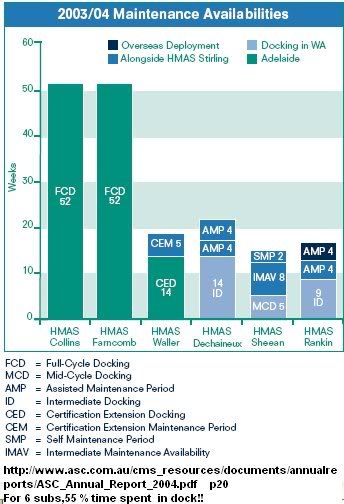
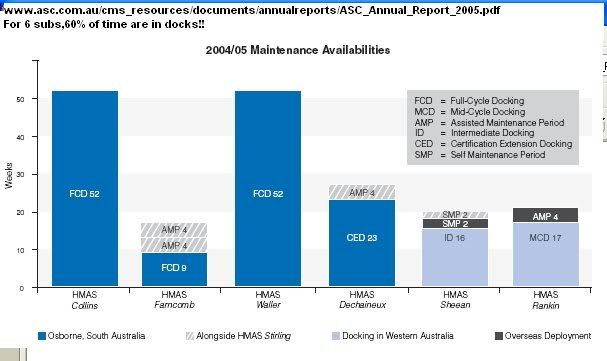
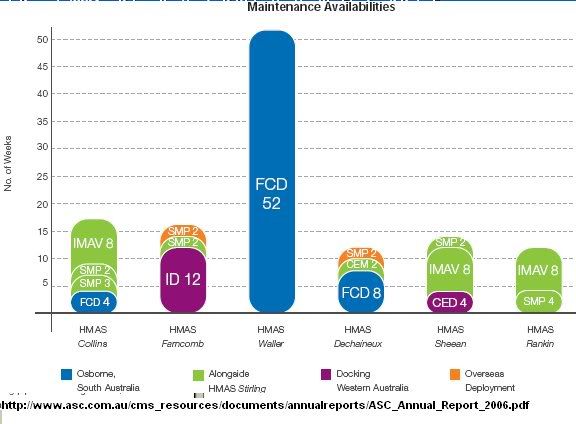
3.How can u explain almost two
third of 6 subs stayed in docks in
a year.Unbelieveable!! do u
think upgrade can exaplin every things.
I think The words "get well " programmes by Janes Fighting
Ships
is the best descriptions.The subs were sick!!
Time that 6 subs in docks!!57%,60%
and 39 %!!
OMG!U have to test the subs and train the crews after
docking.Right?
So,how many time that the subs can put to operations?
ss
d
mmmm