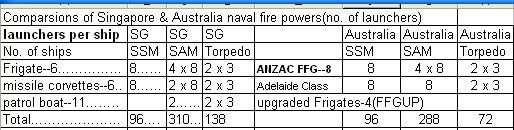
i am not sure on the details of oz two frigates upgradings.
pl share here.
:www.geocities.com/randomsran/AnzacFFH.html
www.ausmarinetech.com.au


unlike a lot of guys writing empty articles here.
@@@@@@@@@@@@22
Displacement, tons: 3,600 full
load
Dimensions,
feet (metres): 387.1 over all; 357.6 water
line x 48.6 x 14.3 (118;
109 x 14.8 x 4.35)
Main
machinery: CODOG: 1 General Electric LM 2500
gas turbines developing 30,172 hp (22.5MW) sustained; 2 MTU 12V
1163 TB83 diesels developing 8,840 hp(m) (6.5
MW) sustained; 2 shafts, controlled pitch propellers
Speed,
knots: 27
Range,
miles: 6,000 at 18 knots
Compliment: 174 (including 24
officers)
Missiles:
2 Mk.141 octuple system:
SSM: 8 McDonnell
Douglas RGM 84(?D?) Harpoon Block II
(currently only in 152, being retrofitted to other
units)
1 Lockheed-Martin
8-cell Mk.41 Mod.5 VLS:
SAM: 8 Raytheon
RIM-7P Sea Sparrow (150 and 151 only) or 32 RIM 162 Evolved Sea
Sparrow Missiles (ESSM), quadpacked [ESSM to
be retrofitted to 150 and 151]
[A Point Defence
Missile System (PDMS) is to be fitted, it is
believed that a pair of 6-round SADRAL launchers for MBDA Mistral 2
is the current preferred system]
Guns:
1 United
Defence 5 in (127 mm)/54/62 cal Mk.45 Mod.2;
dual purpose
4-12.7 mm Machine
Guns
Torpedoes:
6-324 mm Mk.32 tubes
(2 triple); Honeywell Mk.46 Mod.5; [Mk.46 to be supplemented and
eventually replaced by MU90]
Decoys: 2 G & D Aircraft
SRBOC Mk.36 Mod.1; fixed 6-barreled decoy launcher for SRBOC and
NATO Sea Gnat
4 British Aerospace
Nulka; 4 round launchers; expendable hovering
off-board decoys
FEL SLQ-25A; towed
torpedo decoy
ESM/ECM: Racal modified Spectre
A; radar intercept [Spectra A to be replaced by Thales Centaur]
Telefunken PST-1720 Telegon 10; communications intercept
Radar:
Air search: Raytheon SPS-49(V)8 ANZ; C-band
Air/surface search: Ericsson Sea Giraffe;
G/H-band
Navigation: Atlas Elektronic 9600 ARPA; I-band
Fire Control: CelsiusTech
9LV 453; J-band [To be replaced by CEA FAR; (?X?)-band]
IFF: Cossor AIMSMk.XII
Sonar:
Hull
mounted: Thomson Sinatra Spherion B
Mod.5; active medium-frequency search and attack
Thomson Marconi TMS
5424 Petrel high-frequency mine avoidance
CelsiusTech
9LV 453 Mk.3 optronics
director
Combat Data Systems:
CelsiusTech
9LV 453 Mk.3 [157 to have Mk.3E, and Mk.3E to be retrofitted
to older units]
Raytheon CW Mk.73 Mod.1 for RIM-7P [CEA SSCWI to
be fitted for ESSM]
OE-2 STACOM; Link 11
Helicopters: 1
Sikorsky S-70B-2 Seahawk [or Kaman SH-2G(A)
Seasprite when they finally become
available]
As one might guess
from the name, the Anzac class frigates are indeed a
result of a joint project between us and our trans-Tasman
neighbours. A total of ten, virtually identical, units were built
in modules by a number of yards, most in Australia one in New
Zealand, and assembled in Melbourne. The RAN received 8 ships and
the RNZN received 2 (the 2nd and 4th in the
production
run).
As with some other
ship currently in the RAN, the Anzac class are the result
of a flawed set of procurement imperatives. As will be discussed
later, they envisaged essentially as overgrown Offshore Patrol
Vessels, and as such were conceived horribly underarmed. As a
result of their heritage, the first units commissioned without any
ability to persecute surface contacts other than the main gun, and
without any meaningful anti-air capability. As it is, they still
don’t have a dedicated helicopter, although that can be blamed on a
separate program failure. Luckily, the ships were designed
with the ability to mount substantially more equipment than was
originally fitted, and this is being done relatively
briskly.
In service the
Anzac class are used as patrol frigates, and when the
Harpoon SSMs are fitted and their helicopter
finally arrives they will be a potent anti-ship asset, especially
in the littoral environment. Their main gun also gives them a
useful ability to persecute targets ashore in support of ground
forces (this is also true, although to a lesser extent, of the
Harpoon missiles). Interestingly, the main gun was used by HMAS
Anzac in support of British Royal Marines during the 2003
invasion of Iraq, which makes her the only ship currently in RAN
service to fire in anger.
With upgrades the
class will develop a meaningful point defence capability. This will
be through two layers of missiles (ESSM and probably Mistral 2)
guided most probably be a modern active
phased-array radar (the CEA FAR). The Anzacs could also
have a useful anti-submarine function if they are ever fitted with a towed
array sonar, although there is no plan to do so at the
moment.
Upgrades to the
baseline Anzac class frigate fall under several programs,
and are essential for turning these ships into fully useful members
of the fleet. Some upgrades were planned as part of the initial
project planning. This is particularly true of the Evolved Sea
Sparrow Missile (ESSM). Because the missile would not be available
for the commissioning of the first two vessels, they had to make do
with the older NATO Sea Sparrow missile. From HMAS Warramunga onwards, ESSM have been carried from
build, but the intention was always to refit the older vessels to
the same standard. The major upgrade is the replacement of the CW
Mk.73 Mod.1 with the Australian developed and manufactured CEA
SSCWI. The SSCWI offers roughly similar functionality to the CW
Mk.73 (the major difference being the ability to control ESSM), but
is a more advanced solid-state design which is substantially more
reliable. Interestingly enough, the RAN is the first of the 10
navies in the ESSM program to declare its ESSM capability
in-service, a notable achievement.
It was originally envisaged, prior to
Anzac’s commissioning, that all the class would go through
the so called Weapons Improvement Programme (WIP). This plan was
shelved as the price of the project rose. For a while, therefore,
there was few plans for major upgrades in the
early service life of the ships.
With the release of
the 2000 Defence White Paper, upgrades were back on the cards. One
of the stated aims of the White Paper as it related to the RAN, was to improve
anti-missile capabilities across the fleet. For the
Anzac’s this was already partially in hand with the
arrival of the ESSM into service, but it was decide that more
needed to be done. Consequently project SEA 1448 Anzac ASMD
(Anti-Ship Missile Defence) Upgrade was born. There are two
essential planks to the ASMD being proposed, a new inner layer
weapons system, and a new fire control radar
to make better use of the ESSM.
Given the engagement
envelope of the ESSM it was presumed by most (myself included) that
the Government would opt to add the proven, already in RAN service,
Vulcan Phalanx CIWS as a last ditch missile defence system. Indeed
the RNZN Anzacs already have a Phalanx mounted aft, at
rear end of the hanger roof. The pundits, myself included, were wrong. As of 2003 the Department of
Defence instead expressed a preference for a missile based system,
an Point Defence Missile System (PDMS).
Further they expressed a preference for the French Sadral system firing Mistral 2 missiles. This decision
didn’t make a whole lot of sense to those of us yet to be
enlightened by behind-the-scenes work on the project. An PDMS makes a certain amount of sense, but Mistral does
not.
There are a variety
of PDMS options available, the best by virtually any means of
measurement being the American-German RAM (Rolling Airframe
Missile) system. Compared to the Sadral
system the RAM is: longer ranged, has a superior seeker, is being
produced in larger numbers (i.e. for the USN and Kiegermarine), and can be self contained (in the
SeaRAM variant, itself a modification of the
Vulcan Phalanx system). The big advantage of SADRAL is that it is
cheaper for initial purchase… The fundamental effectiveness of the
system remains to be seen, but is still an improvement over
nothing. At the moment
plans call for the instillation of a pair of 6 round launchers at
the after end of the hanger (see image of one potential
installation, made by AMT).
The second component
of SEA 1448 is investigating the fitting of a
new active phased array fire control radar, the Australian
designed and manufactured CEA FAR. To this end HMAS Arunta was fitted with a single FAR panel for
tests during 2003, although this image
from AMT would seem to suggest that there were provisions for more
(from the pictures, it would appear that 6 is the preferred
number). Reports from the test were positive, although not
gushingly so. It is expected to fit the completed system to ships
between 2008 and 2010. Options for instillation include a
multi-panel version of the trial installation, or mounting them on
the mast (see this AMT
generated CAD for one such option). To make full use of the new
radar and other systems being integrated into the class, the
CelsiusTech 9LV 453 Mk.3 consols are being
replaced by the Mk.3E standard COTS (Commercial Off
The Shelf) consols, which are ergonomically better and will
improve processing speeds.
The other major
upgrade announced for the Anzacs in the 2000 White Paper
was the fitting of anti-ship missiles (SSM). The logical choice was
the Boeing Harpoon II system, which has a useful secondary land
attack capability. The contract for 64 missiles (i.e. 8 missiles
for the 8 Anzac class, with no war
stocks) was signed in late 2002. HMAS Warrmunga is the first ship so fitted, during a
scheduled refit period in late 2004, and others will follow.
Interestingly the two Mk.141 launchers have been placed forward of
and below the bridge (a very British place to put them…), while
they have been mounted behind the bridge (and at least two decks
higher up) in other MEKO 200 ships. Officially this has been
explained as a measure to improve stability in the class which is
apparently a cause for concern. It is possible that this concern is
precautionary given the likely inclusion in the near future of the
CEA FAR instillation.
Otherwise this
concern bodes badly for the class, as top weight growth is
inevitable as part of SEA 1448. Some comment has been raised as a
result of the first photos of the instillation that the cabling has
been poorly done, being exposed and unarmoured (which poses
reliability and damage control problems). It is unclear as to
whether these problems have been either: a). imagined, b).
rectified. It is also possible that the photos did not show the
final instillation and the concerns are therefore
invalid.
Finally as with the
Adelaides, the Anzacs will
be fitted with the Thomson Marconi TMS 5424 Petrel mine avoidance
sonar, and have space and weight provisions for a towed array
sonar. Also as with the FFGs, there are
currently no plans to fit a towed array sonar, which is
disappointing given the growing submarine forces to Australia’s
immediate North (one of the few regions in the world where the
submarine threat is growing).
In the future there are a number of further
options. The design has weight and space margins exist to fit
another 8-cell VLS next to the existing system. The instillation of
this extra VLS would make sense if the RAN decides to use the
upgraded Anzacs as ‘goal-keepers’ for the yet to enter
service LHDs instead of an AWD/FFG. The
goal-keeper was a British innovation whereby an important ship with
poor air-point-defence is guarded by a ship with good point-defence
AA which holds position very close to it’s
charge. In this role the upgraded Anzac makes better sense
than an AWD/FFG, as it’s radar instillation is tailored to close
range ASMD, and the PDMS has range to keep another ship within the
‘last-ditch’ engagement envelope (unlike the CIWS of the FFG). The
additional 8 VLS cells would give another 32 ESSM, which is
important given the goal-keeper doctrine which emphasises the
saturation of any potential threat, and thus the extra missiles
would be of great use. NB: At the moment no plans exist for this
instillation.
Home---EOQ