This report comes with a photo of the Iskander E
Missile on its carrier, and details of its operational data.
Russia Eyes New
Customers For Iskander E Missile
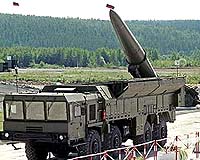
The Iskander-E is
relatively small and light, with a launch weight of 3,800 kilograms
(8,360 pounds), RIA Novosti said. That means it can be moved on a
transporter erector launcher vehicle that can hold two of them,
greatly increasing survivability from pre-emptive air attack and
doubling the launch system's firepower.
by Martin
Sieff
Washington
(UPI) Oct 3, 2008
A surprising
number of countries, including some with warm ties to the United
States, are interested in buying Russia's short-range but
formidable Iskander-E ballistic missile.
A senior executive of Rosoboronexport, the coordinating Russian
arms exporting agency, stated Wednesday that Kuwait, South Korea
and the United Arab Emirates -- all traditional U.S. allies -- were
interested in buying the Iskander, RIA Novosti reported
Thursday.
"Syria, the UAE, Malaysia, India and some other countries have
shown an interest in the missile system," said Rosoboronexport
official Nikolai Dimidyuk. Russia also will seek to export the
Iskander-E to Algeria, Kuwait, Singapore, Vietnam and South Korea,
he added.
The United States currently manufactures and exports nothing
like the Iskander-E -- NATO designation SS-26 Stone. RIA Novosti
described the weapons system as "a tactical surface-to-surface
missile complex designed to deliver high-precision strikes at a
variety of ground targets at a range of up to 280 kilometers (170
miles)." The Iskander-E carries only a single warhead with a
payload of up to 880 pounds, staying within the parameters
determined by the Missile Technology Control Regime.
The Iskander-E is relatively small and light, with a launch
weight of 3,800 kilograms (8,360 pounds), RIA Novosti said. That
means it can be moved on a transporter erector launcher -- TEL --
vehicle that can hold two of them, greatly increasing survivability
from pre-emptive air attack and doubling the launch system's
firepower.
The report also noted that the Iskander-E is equipped with
"stealth" technology and it has the capacity for variable flight
trajectory, making it much more difficult for ballistic missile
defense to shoot it down.
Because the missiles are solid-fueled, they can be launched
extremely quickly, again reducing to virtually zero the chances of
knocking them out before launch with a pre-emptive airstrike. RIA
Novosti said the second missile on a TEL could be fired within a
minute of the first one being launched.
The missiles are also exceptionally accurate with a
circular-error probability -- CEP -- of only 30 meters (around 100
feet).
RIA Novosti said a single Iskander battery includes a number of
TELs, loaders and a command vehicle. "Target acquisition is
supported by a mobile data-processing center," it said.
Dimidyuk said the Russian armed forces were already creating a
combat brigade of Iskander-M SRBM -- short-range ballistic missile
-- systems that would have "longer ranges and heavier payloads than
the export -- Iskander-E -- version."
"The system has been adopted in service with Russia's armed
forces, and, as far as I know, a brigade (of Iskander systems) is
being formed," Dimidyuk said.
Russia already has threatened to deploy the Iskander in its
Kaliningrad region on the Baltic Sea.
RIA Novosti cited three-star Col. Gen. Viktor Yesin, a former
commander of the Russian Strategic Missile Forces, as telling the
Moscow newspaper Nezavisimaya Gazeta in July that the Kremlin could
rapidly move its Iskander-M missiles to Kaliningrad or the former
Soviet republic of Belarus, a loyal Russian ally, to put them
within range of hitting the new U.S. BMD base being built in
Poland.
The Iskander is the ideal weapon to use in any pre-emptive
strike to knock out the kind of high-tech ballistic missile defense
system, such as the U.S. Army's Patriot and the Israeli Arrow, that
is designed to be effective against intermediate-range ballistic
missiles -- IRBMs -- or shorter-range weapons. That makes them a
deadly threat to the new BMD base to hold 10 Ground-based
Mid-course Interceptors -- GBIs -- that the United States is
building in Poland to defend Western Europe and the Eastern
Seaboard of the United States from the threat of any future Iranian
intercontinental ballistic missile --ICBM -- that could carry
nuclear warheads.
The Iskanders therefore would pose a formidable threat to the
U.S. GBIs in Poland, and if Russia sells them to Syria, they could
knock out Israel's most advanced early warning radar facilities in
a pre-emptive strike, leaving the country defenseless against
nuclear-capable Iranian IRBMs and cruise missiles.
If Russia sold Syria enough Iskander-Es, they also would pose a
threat, combined with Hezbollah's more than 10,000 missiles, mainly
on multiple-launch rocket systems -- MLRS -- of disrupting
mobilization procedures of the Israeli army in any future war with
Syria on the Golan Heights.
The beauty of the Iskander concept is that it employs a
venerable, highly reliable, mature technology, cost-effectively
allowing it to knock out the vastly more expensive BMD systems that
it targets.
In this respect, it parallels the effectiveness of the U.S. Army
Air Force's North American P-51 Mustang piston engine combat
fighters in World War II that shot down hundreds of technically
vastly superior, but far less numerous and far less cost-effective
German Messerschmitt Me-262 jet fighters.
The Iskander therefore serves notice that even in the
cutting-edge, super-high-tech world of ballistic missile defense,
there is an important role for older, simpler, far cheaper
technologies to play "spoiler" roles that can destroy or disrupt
the much more ambitious -- and expensive -- defense systems that
nations put their trust in.

