BEST SSK IN THE WORLD

State-of-the-art
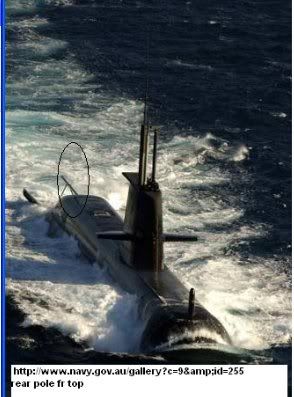
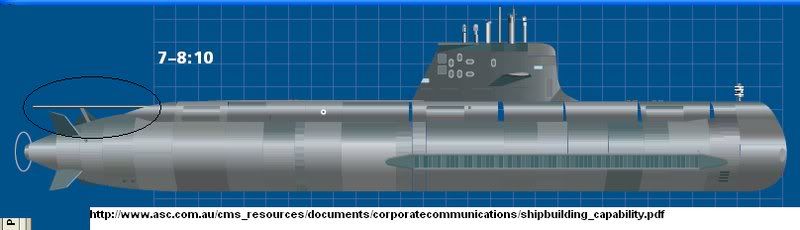
A Collins Class submarine is a
long-range, multipurpose patrol submarine capable of both short
duration coastal missions, and long-duration open sea defensive and
offensive operations. The submarines have a patrol endurance of more than two
months, most of the time submerged.
The
Collins Class submarines have all the attributes expected of a
state-of-the-art submarine, including high manoeuvrability, low
signature patterns, high firing rates, and excellent shock
endurance.
They are
also adapted to the specific environmental conditions and
operational profiles applicable to the Royal Australian
Navy.
Largest in
the world
With a displacement of 3000 tonnes, the Collins Class submarines
are the largest, and without
a doubt the most advanced and efficient conventional submarines in
the world.
Collins class can
also land Austalian Special Forces who wrecked havoc in
Afganistan!

Force Structure

To celebrate the
50th anniversary of the Australian Special Air Service,
the Perth mint has produced the Australian SAS 1957 – 2007 1oz
Silver Proof Coin
Special Air Service
Regiment (SASR) is a Special Forces regiment modeled on the
original British SAS and also drawing on the traditions of the
Australian World War II 'Z' Special Force commando unit, as well as
the Independent Companies which were active in the South Pacific
during the same period. It is based at Campbell Barracks,
Swanbourne, Perth, Western Australia and is a unit of the Royal
Australian Corps of Infantry, part of the Australian Defense Force.
They have been widely regarded as one of the better special forces
units in the world; ranking alongside the British SAS/SBS and US
Navy SEALs special forces.
The Australian SAS is the
crack Regiment revered as the 'eyes and ears' of the Australian
Defense Force, and the regimental motto is 'Who dares
wins'.
Fully supported by the
SAS itself, this spectacular Perth Mint release offers collectors
of Australian military commemoratives a magnificent tribute with
which to celebrate the Regiment’s many vital contributions
throughout the world.
The coin's reverse
depicts SAS soldiers in action in a variety of operational
contexts. The design, which includes colored elements and the words
AUSTRALIAN SAS 1957-2007, also portrays the SAS badge incorporating
the words WHO DARES WINS.
Issued as legal tender
under the Australian Currency Act 1965, the coin’s obverse depicts
the Ian Rank-Broadley effigy of Her Majesty Queen Elizabeth
II.
The coin is struck from
1oz of 99.9% pure silver in proof quality with a Coloured Reverse
Design and is housed in a stylish presentation case and superbly
illustrated shipper
No more than 7,500 of
these coins will be released by The Perth Mint and each will be
accompanied by a numbered Certificate of
Authenticity.
The Australian SAS
1957 – 2007 1oz Silver Proof Coin is going to be a much sought
after coin by coin enthusiasts.
Australia also developing Heavyweight
ADCAP Torpedo with Americans, making them far in advance of
anything the Singapore Navy has.

Project SEA 1429 Phase 2
Replacement Heavyweight Torpedo will acquire a replacement
anti-surface warfare (ASuW) and anti-submarine warfare (ASW)
heavyweight torpedo for the COLLINS Class submarine. This
acquisition is to replace the Mk 48 Mod 4 heavyweight torpedo (HWT)
currently in service with the Royal Australian Navy
(RAN).
A Memorandum of
Understanding (MOU) between the Australian and the United States
Governments has been established to jointly develop the Mk 48
Advanced Capability (ADCAP) Common Broadband Advanced Sonar System
(CBASS) Heavyweight Torpedo. A Joint Project Office (JPO) has been
established in Washington DC to manage the CBASS program under an
Armaments Cooperative Project arrangement.
The Project Scope includes
the acquisition of the weapons, associated logistic support, weapon
system interface equipment and transition into
service.
The submarines will be
progressively upgraded to accommodate the Replacement Heavyweight
Torpedo, in conjunction with the
Replacement Combat System (SEA 1439 Phase 4A), as part of the
submarines' docking program from 2006 through to
2013.
Australian Navy Gets ADCAP Torpedos,
Most Advanced Torpedo in Region

Torpedoes are self-propelled guided projectiles that operate
underwater and are designed to detonate on contact or in proximity
to a target. They may be launched from submarines, surface ships,
helicopters and fixed-wing aircraft. The three major torpedoes in
the Navy inventory are the Mark 48 heavyweight torpedo, the Mark 46
lightweight and the Mark 50 advanced lightweight.
The MK-48 is designed to combat fast, deep-diving nuclear
submarines and high performance surface ships. It is carried by all
Navy submarines. The improved version, MK-48 ADCAP, is carried by
attack submarines, the Ohio class ballistic missile submarines and
will be carried by the Seawolf class attack submarines. The MK-48
replaced both the MK-37 and MK-14 torpedoes. The MK-48 has been
operational in the US Navy since 1972. MK-48 ADCAP became
operational in 1988 and was approved for full production in 1989.
The SSN 714 Norfolk fired the first ADCAP torpedo on 23
July 1988, sinking the FORREST SHERMAN class destroyer DD 938
Jonas K. Ingram. MK-48 and MK-48 ADCAP torpedoes can
operate with or without wire guidance and use active and/or passive
homing. When launched they execute programmed target search,
acquisition and attack procedures. Both can conduct multiple
reattacks if they miss the target.
A highly capable weapon, the MK 48 can be used against surface
ships or submarines, and has been test fired under the Arctic ice
pack and in other arduous conditions. The ADCAP version, in
comparison with earlier MK 48 torpedoes, has improved target
acquisition range, reduced vulnerability to enemy countermeasures,
reduced shipboard constraints such as warmup and reactivation time,
and enhanced effectiveness against surface ships. The MK 48 is
propelled by a piston engine with twin, contra-rotating propellers
in a pump jet or shrouded configuration. The engine uses a liquid
monopropellant fuel, and the torpedo has a conventional,
high-explosive warhead. The MK 48 has a sophisticated guidance
system permitting a variety of attack options. As the torpedo
leaves the submarine's launch tube a thin wire spins out,
electronically linking the submarine and torpedo. This enables an
operator in the submarine, with access to the submarine's sensitive
sonar systems, initially to guide the torpedo toward the target.
This helps the torpedo avoid decoys and jamming devices that might
be deployed by the target. The wire is severed and the torpedo's
high-powered active/passive sonar guides the torpedo during the
final attack.
The MK 48 Mod 5 ADCAP torpedo is an improvement to the MK 48
submarine launched torpedo. It is a heavyweight acoustic homing
torpedo with sophisticated sonar and a fuzed warhead. The ADCAP
enhancement includes all digital guidance and control systems,
digital fuzing systems, and pro-pulsion improvements which add
speed, depth, and range capability. The Navy will produce about
1046 MODS ADCAPs, replacing an equivalent number of baseline (Mod
5) ADCAPs, and maintaining the total inventory of ADCAP torpedoes
at 1046. One of the major advantages of using readily available
technology to develop an updated weapon using the current torpedo
body and off the shelf systems resulted in significant savings and
reduction in the development time for the ADCAP torpedo. In
addition, by using currently installed systems in place for
operating and maintaing the MK-48 torpedo very little additional
cost is incurred in new facilities for maintenance and repair.
The Navy developed two hardware modifications to ADCAP, called
the G&C (Guidance and Control) MOD and the TPU (Torpedo
Propulsion Upgrade) MOD. The G&C MOD replaces the obsoles-cent
guidance and control set with current technology, improves the
acoustic receiver, and adds additional memory and improves
processor throughput to handle the expanded software demands
anticipated for near term upgrades. The TPU MOD improves the
propulsion unit as discussed in the classified version of the FY96
Annual Report. Both modifications were combined into one torpedo,
the MK 48 Mod 6 (MODS ADCAP).
Software Block Upgrade III (BU III) is intended to provide a
near-term improvement for use in the baseline G&C for improved
performance in some key scenarios.
Software Block Upgrade IV is intended to provide a mid-term
upgrade for use in the MODS G&C for improved performance in key
scenarios as discussed in the classified version of this report. It
will use advanced sonar and signal processing algorithms.
One engineering change planned for the MODS ADCAP, the Common
Torpedo Development Vehicle (COT-DV), is planned for fleet
introduction in the FY01 time frame. COT-DV is a common processor
to be used on all advanced U.S. torpedoes, that will use COTS
hardware and be significantly more capable than the current MODS
G&C. It will initially use BU IV software.
Another hardware upgrade, Common Broadband Advanced Sonar System
(CBASS), is planned for IOC in FY04. Additional information about
CBASS is contained in the classified version of this report.
The ADCAP torpedo OPEVAL was completed in August 1988, and the
B-LRIP report was sent to Congress in December 1988. ADCAP was
reported to be operationally effective against certain threats, but
not operationally effective against other threats at that time. The
system was reported operationally suitable. The Navy subsequently
authorized full-rate production, but Congress constrained
procurement because of the concerns identified in test reporting.
Modifications were implemented by the Navy to improve performance
in certain scenarios, upgrade fuzing systems, and improve
reliability. These modifications were considered effective. In 1994
a second software upgrade was introduced to improve performance and
reliability.
The MODS ADCAP (MK 48 Mod 6), when properly employed, is more
effective than the ADCAP torpedo (MK 48 Mod 5). Unfortunately,
production MOD 6 ADCAPs have shown a significant vulnerability,
differing from the test units. This production problem is typical
of problems seen in the initial phases of LRIP. The program office
is investigating. DOT&E will continue to follow this.
Performance in some environments of both ADCAP and MODS ADCAP,
against certain targets employing advanced tactics and equipment,
still needs to be improved. Shortfalls are discussed in the
classified version of this report. The program office is
aggressively working to upgrade these modes.
The MK 48 ADCAP torpedo R&D program focuses on two specific
areas through FY99: Guidance and Control (G&C) software block
upgrades and wideband sonar capability. The Chief of Naval
Operations continues to stress shallow water (less than 600 feet)
as a critical operating area to counter third world diesel electric
submarines. Torpedo testing in shallow water has demonstrated that
in-service ADCAP has less than full capability in this difficult
environment. However, this testing, in conjunction with laboratory
simulation efforts, has shown that significant performance
improvements can be made by implementing changes to weapon tactics
and software algorithms. Development, implementation and testing of
these changes is being accomplished under the ADCAP G&C
software block upgrade program.
The focus of the MK 48 ADCAP torpedo R&D program for FY99
and out has shifted from being primarily concentrated on Software
Block Upgrade efforts to a coordinated hardware/software upgrade
for countering evolving threats and maintaining robust performance.
Countermeasure (CM) sophistication and availability on the open
market directly affects ADCAP kill proficiency and its ability to
counter rapidly evolving threats. The Common Broadband Advanced
Sonar System (CBASS) program will develop and field a wideband
sonar capable of identifying CMs and discriminating them from the
target. CBASS received an ACAT III designation on 17 April 1997,
with full rate production scheduled to begin in FY04.
The introduction of phased prototyping in FY01 will provide a
more rapid technology transition path for incremental torpedo
improvements and upgrades (including the development and test of
New Technology Concepts from the R&D community (6.2) and
contractor Independent Research and Development (IR&D)). This
approach will incorporate accelerated in-water testing of the new
concepts allowing early Fleet input into future ADCAP upgrades and
help to provide the foundation for Next Generation Torpedoes. These
efforts will continue torpedo development investment at a lower
cost and shorter term than traditional torpedo development
programs.
Primary Function Heavyweight
torpedo for submarines Contractor
Gould Power Plant Air Turbine
Pump Discharge (ATPD) system;
liquid (Otto) fueled swash plate engine with pumpjet propulsor.
Length 19 feet (5.79 meters)
Weight 3,434 lbs (1545.3 kg)
(MK-48);
3,695 lbs (1662.75 kg) (MK-48 ADCAP)
Diameter 21 inches (53.34
centimeters) Range Officially
"Greater than 5 miles (8 km)"
Weapon acquisition range 1600
yards Min/Max ASROC launching
ranges 1500 to 12000 yards
Speed Officially "Greater than 28
knots (32.2 mph, 51.52 kph)"
Reportedly - 40 - 55 kt.
Actual 55 knots Depth Officially
"Greater than 1,200 ft (365.76 meters)"
Reportedly 3,000 ft Search/attack depth
settings Minimum 20 yards
Maximum 1500 yards Run
characteristics 6-8 minutes
downward Guidance System Wire
guided and passive/active acoustic homing
Warhead 650 lbs (292.5 kg) high
explosive Date Deployed
1972
1988 ADCAP Unit Cost $2.5
million
$3.5 million (?) ADCAP
Advanced Technologies
Perfected for Collins class and future Submarine
Class

"So what can we expect in the
future?" That's a question regularly posed to Defence scientists.
It's not an unreasonable question given the public's fascination
with technological advances in all fields, let alone defence
science.
Yet a question that is asked less
frequently, but which is probably far more pertinent is "What's
happening now?"
For DSTO, the short answer is
"plenty". While DSTO is leading and taking part in many projects
that have a long-term focus on future warfare concepts, a
substantial proportion of our work is directed towards supporting
the current capabilities of Australia's air, naval and land forces,
in both training and operational modes.
DSTO has developed a number of key
capabilities designed to enhance the current ADF. These
capabilities include:
One of DSTO's longest-running,
continuous projects has been support for the Collins-class
submarine. DSTO has been providing vital scientific and technical
support for the Collins class submarine since the design was first
proposed in 1986.
Much of the focus has been on
addressing current capability issues, and our work has resulted in
significant benefits, including vastly improved stealth performance
as a result of a number of magnetic and acoustic
investigations.
Demagnetisation enhancements have
achieved low variability in the final platform magnetisation, and
have also greatly reduced the amount of required deperming
treatment time, resulting in considerable operational cost
savings.
DSTO's acoustics work has produced
better signature prediction as well as valuable strategies and
solutions for management of the acoustic signature.
And, in the combat system, DSTO
was instrumental in developing a new open architecture environment
which has been of major benefit for the capability.
DSTO's involvement in the F-111
Sole Operator Program (SOP) has also been widely recognised. Among
research activities conducted as part of the SOP have been a
full-scale tear-down of an F-111 fuselage, full-scale fatigue
testing of an F-111 wing, countermeasures trials aimed at reducing
the susceptibility of aircraft to infra-red and radar-guided
missiles, and the development of a PC-based engine diagnostic and
acceptance system that has been installed in the engine-test cells
at RAAF Amberley for ground testing the aircraft's TF30
engines.
DSTO's involvement in the SOP is
ensuring the safe and effective operation of the F- 111 fleet to
its planned withdrawal from service.
An excellent example of support to
operations has been the successful conduct of trials by DSTO and
the Air Force's Joint Electronic Warfare Operational Support Unit
to validate the effectiveness of countermeasures to protect C-130J
aircraft against threats like infrared-guided man-portable air
defence systems, commonly referred to as shoulder-launched
missiles. These trials were part of a rapid acquisition fitment of
electronic warfare self-protection equipment. In September, the
C-130J departed for Iraq operations and was farewelled by the
Minister for Defence, Robert Hill, who acknowledged the success of
the rapid acquisition program.
DSTO's expertise in air accident
investigation has been called on several times over the years. The
organisation provides support to the Directorate of Flying Safety
to investigate aircraft accidents and has several key investigators
on call to respond immediately.
Central to DSTO's success in
accident investigation has been the use of global positioning
system technology to map the crash debris over an accident
site.
In recent years, our accident
investigators have conducted forensic investigations of crashes of
Black Hawk helicopters, a Eurocopter Tiger helicopter, a US Marine
Corps F/A-18, and a Russian-made Ilyushin IL-76 cargo jet aircraft
in East Timor.
One major fear of all submarine
and ship personnel is an outbreak of fire, and DSTO has been
involved in fire and smoke research since 1989. Our research
provides Navy with advice on the measures required to minimise the
risk of, and combat the spread of, fire and smoke, as well as of
equipment failure. While we conduct some full-scale experiments,
most of the research revolves around numerical and salt water
modelling.
Numerical modelling involves the
use of computational fluid dynamics to study possible fire
scenarios, while salt water modelling involves the injection of
salt water (the analogue of hot smoke) into fresh water (the
analogue of air), and the subsequent study of the resulting
behaviour.
Modelling is also a central
component of the wide range of DSTO's human factor-related
research, which includes human-machine interface design, task
workload analysis, predictive modelling and the development of
training systems.
There are many more examples of
DSTO's work supporting the current ADF; examples that come from all
divisions within the organisation.
And therein lies the secret behind
DSTO's success: strength through diversity. Deep pockets of
technical knowledge exist throughout the organisation, and this
knowledge is able to be brought together and drawn on to solve
problems.
But it is not just the internal
units of DSTO that we rely on to support the ADF. DSTO readily
acknowledges that the goal of enhancing the ADF's existing
capabilities a wide range of parties, including those in industry
and academia.
We have forged strong
relationships with companies and institutions that have the
appropriate intellectual capabilities and expertise.
DSTO is working to further
encourage Australian industry to become a key player in the
development of the required support.
Wherever Australian military
personnel are operating or training, wherever Australian military
platforms and technology are being used, DSTO's fingerprints can be
detected. While research and development into future warfare
technologies and practices is critical, the development of
solutions to today's problems can never be
underestimated.
Dr Sare is Director of the
Platforms Sciences Laboratory, DSTO

The role of seeking and destroying an enemy submarine is one of
the most difficult faced by Australia's six new Collins class
submarines. The success off Hawaii in
August has boosted morale dramatically among submarine crews who
have had to endure years of hearing their boats condemned as noisy
and vulnerable.
A 1999 report by the then CSIRO chief, Malcolm McIntosh, and
former BHP managing director John Prescott said the Collins' combat
system should be junked, the vessels were noisy and vulnerable to
attack, their engines broke down regularly, a badly shaped hull and
fin made too much disturbance when they moved at speed under water,
the view from the periscope was blurry, the communications system
outdated and the propellers were likely to crack.
Commander Steve Davies, chief-of-staff in the navy's submarine
force, said that during the past
three years those problems had been fixed to the point where the
submarines were able to match the best of the US Navy's giant
underwater fleet.
During its mock attacks on the Olympia and on two US destroyers,
the Sheean fired 28 torpedoes. Commander Davies said "a
respectable percentage" of shots
Sheean fired at Olympia were hits that would have destroyed the
powerful US vessel.
Commodore Davies, Australia's most experienced Collins
commander, said the two vessels were very evenly matched. The
submarines also practised landing special forces.
The exercises provided a crucial test for the Australian
submarine, which has been as much criticised at home as it has been
feted abroad.
The Olympia, 110 metres long and 12 metres across the beam, is
twice the displacement of the Sheean, at 80 metres by eight metres.
The Olympia carries up to 120 crew; the Sheean 45. Many of the
Americans are engineers caring for their reactor.
The Collins is powered by diesel and electric motors and its
roles include undersea warfare - finding and destroying other
submarines - destroying enemy warships and merchant ships,
surveillance and intelligence collection, support for special
forces and covert transport.
Commander Davies said the US sub's size was not an advantage:
"It just means you make more noise when you go faster."
He said cooperation with the US submarine force had increased
significantly recently. "That has
come about because they're interested in the Collins class and in
our submarine force generally."
While the Americans run the
world's most powerful submarine arm, they acknowledge that changes
in international conditions in the past decade and new priorities
have left them with tactics to learn from the small Australian
submarine arm.
Commander Davies said Australian submariners were used to
operating in shallow water. "That's
one of the things the Americans are looking towards us for
experience in.
"Ten years ago their submarine force was chasing Russian
submarines around the deep ocean. Now, as with all submarine
forces, it's more focused on closer inshore operations,
intelligence collection or working with special forces. They're
looking to us as a submarine force which has a long experience in
that sort of thing."
The six Collins' combat systems
are to be upgraded further and they will get more modern torpedoes.
Those the Sheean used in its clashes with the Olympia were
developed in the 1970s; the Americans used a far more sophisticated
generation.
While smaller than the US nuclear boats, the Collins is one of
the world's biggest conventional submarines. It was designed to
cover long distances and the Sheean easily reached Hawaii without
refuelling.