U have to make the weapons u want with current technology and materials,not wait and
wait till the sun disappear.
Is SG SSW heavier than XM 29?read again lah,expert!!
WRONG again.
If the Yanks rushed and made the MBT 70 without waiting for
technology to mature we would not have gotten the M-1 Abrams,
which is a far superior tank.
Simple, you wait when you know that a new generation of
technologies are coming to take the best use of it. 40mm grenades
are reaching the limit of their performance envelope, the Yanks
were right to develop and explore other alternatives that are up to
500 percent more effective.
We on the other hand, are running into a performance dead end
with the 40mm.
Heavier?
Use your common sense, this is like the case of you mixing up us
having a large number of 500 ton lightweight ships for having a
larger navy then the RAN. 
You go by bang-for-pound, not just pound.
In terms of bang-for-pound the OICW is FAR superior to the SSW.
And note it never achieved it's original design specs which would
have made it LIGHTER and even MORE EFFECTIVE.
There is a thing called prudence, you do not rush into things
when they can be done better in time.
Of course given how you rush into things like making your posts
I am not surprised you screw up yet again.
If you look at the original design specs of the OICW:
It must be 6.8 kg
loaded
Have FIVE HE module
rounds
Plus a 30-round 5.56mm KE
module.
And these were the specs laid abourt a decade
ago
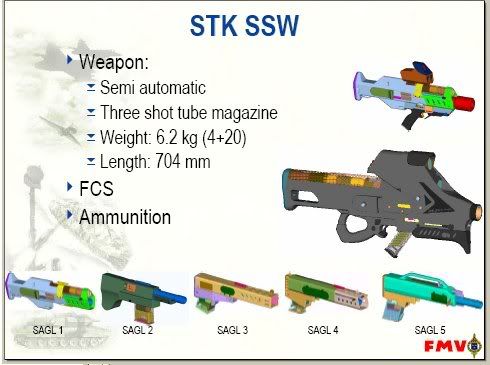
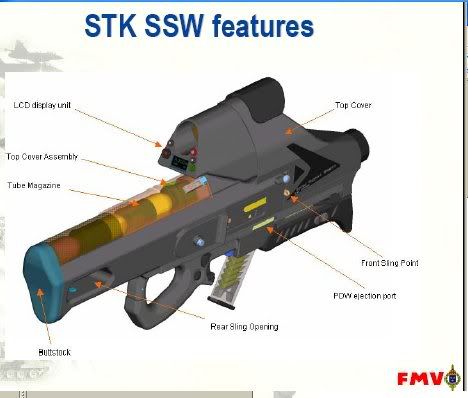
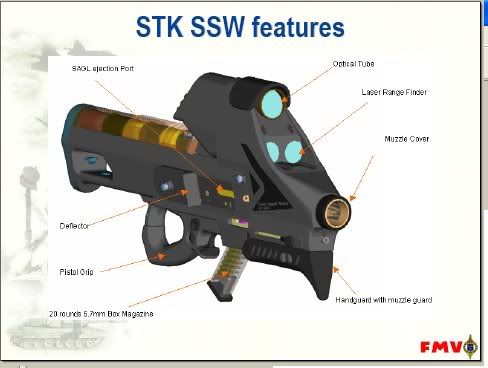
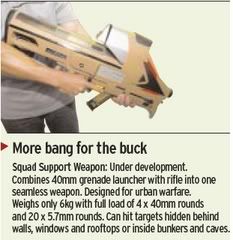
In the SSW, despite having 10 years to work things out we
cheated, we cut
corners on the KE module by using a puny, 20 round 5.7mm
PDW module instead of the full fledged 5.56mm KE
module on the OICW. Plus the HE module of the SSW only
sports THREE shots of HE.
Hence actually in terms of combat-effectiveness, we are carrying
a HEAVIER weapon in terms of its effectiveness.
The OICW KE and HE module can hit further and harder with far more
precision (rifle vs PDW fire), plus they have additional staying
power with 10 extra KE rounds and 2 HE rounds and each of the HE
rounds are more combat-effective then our own 40mm rounds.
That is a BIG difference in killing power, for just 800
grams.
US cant solve some problems lah.eg FCS,i think.
can they squeeeeeeeze FCS like this
WRONG.
If you look at the real reasons behind why they decided to call
off the project is because they had MORE AMBITIOUS ideas for it and
didn't want to commit to a system when they felt they could put a
better system into the hand of the grunts.
We on the other hand, are rushing into things with a previous
generation concept.
In terms of FCS, advanced HE rounds (thermobaric) and concepts,
the yanks are far, far ahead of us.
u feed info and FCS control grenade when and where to
explode!!
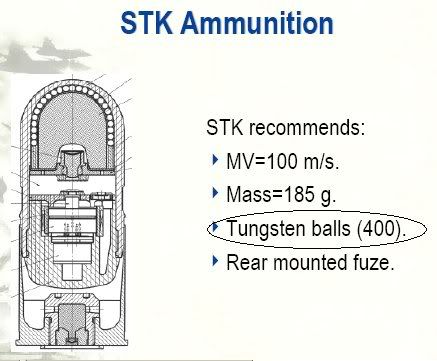
Tungsten balls ,besides targeting at human hide behind
walls,
in trench,on roof,around the corner etc,also
act as vision killer to blind sights of tanks,ACP etc
So what?
Can this match up to a thermobaric warhead that has the
potential to totally destroy a room? Plus 25mm projects much
further then 40mm, is easier to aim, and you can carry more of
these as well.
 The 20mm
shell of the OICW has been replaced by a 25mm shell. The 20mm was
originally adopted because the weapon and the ammo would be
lighter, and the weapon was too heavy as it was. The XM29's weight
was a major factor in its cancellation. Splitting the grenade
launcher off into its own weapon allowed the step up to the 25mm
shell, which increases performance by about 50%.
The 25mm shell in the XM-25 provided some more options, and, it
is hoped, more lethality. The US has fired over 30 million 25mm
shells from the cannon on its M-2 Bradley armored vehicles and was
satisfied with the lethality of that shell against infantry.
One of the new options with a larger shell is a fuel-air
explosive (or "thermobaric") shell for the XM-25. Such a shell
would cause greater blast effect in an enclosed space, and actually
suck most of the oxygen out of a cave or closed room long enough to
make surviving troops at least a bit groggy. In combat, every bit
helps.
The 20mm and 25mm "smart shells" use a computer controlled fuze
in each shell. The M-25 or M-307 operator can select four different
firing modes via a selector switch on the weapon. The four modes
include "Bursting" (airburst). For this to work, the soldier first
finds the target via the weapons sighting system. This includes a
laser range finder and the ability to select and adjust the range
shown in the sight picture. For an air burst the soldier aims at an
enemy position and fires a round. The shell is optimized to spray
incapacitating (wounding or killing) fragments in a roughly six
meter radius from the exploding round. Thus if enemy troops
are seen moving near trees or buildings at a long distance (over
500 meters), the weapon has a good chance of getting them with one
shot. M-16s are not very accurate at that range, and the
enemy troops will dive for cover as soon as M-16 bullets hit around
them. With smart shells, you get one (or a few) accurate shots and
the element of surprise.
The other modes are "PD" (point detonation, where the round
explodes on contact), PDD (point detonation delay, where the round
detonates immediately after it has gone through a door, window or
thin wall) and "Window", which is used for firing at enemy troops
in a trench, behind a stone wall or inside a room. The round
detonates just beyond the aiming point. For buildings, this would
be a window or door frame, cave entrance or the corner of a
building (to get enemy troops thought to be around the corner.)
The 25mm shell for the XM25 was originally developed for the
XM307 grenade launcher, which is to replace the current 40mm M19
grenade launcher found on many vehicles, especially Humvees and
Strykers. The XM307 has a much longer range than the M19, and it's
more accurate and lethal. Good stuff.