Originally posted by tankee1981:
Quote: Originally posted by
Atobe:
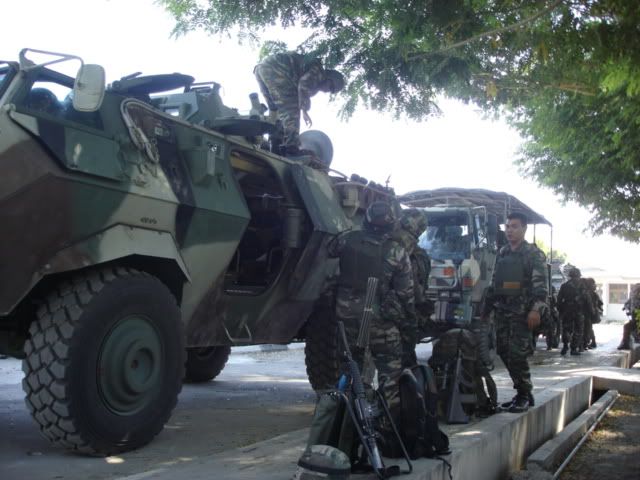
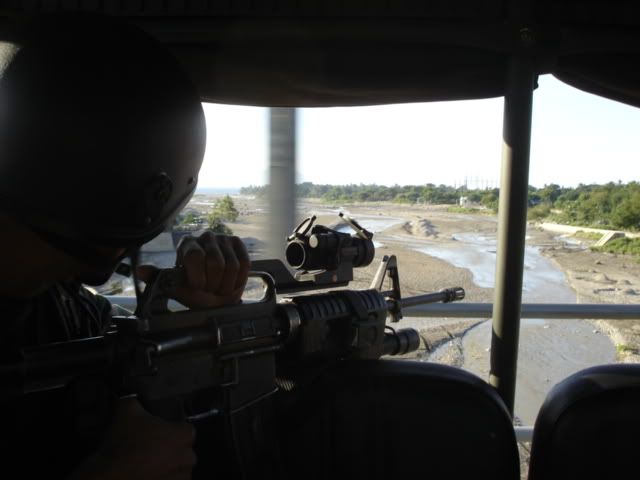
Great news for any potential adversary to the MAF.
Singapore's 'liquid armor'
will have less problem in withstanding the impact of a 5.56 round
fired from this Malaysian manufactured M4
carbine.
-------------------------------------------------------------------------------------------------------------------
Care to elaborate? 
There was a news item reported in
the Straits Times in 2006, when a Singaporean hobbyist accidentally
discovered 'Liquid Armor'
while toying around with chemicals.
The Mindef DSTA guys were excited, and the matter hushed up after a
week of proud publicity.
While trying to 'google'
for this news item, the following was found about a similar
development in the USA.
Army scientists, engineers develop liquid body
armor
Army News Service
Release Date: 4/21/2004
By Tonya Johnson
ABERDEEN PROVING GROUND, Md. (Army News Service, April 21, 2004) --
Liquid armor for Kevlar vests is one of the newest technologies
being developed at the U.S. Army Research Laboratory to save
Soldiers' lives.
This type of body armor is light and flexible, which allows
soldiers to be more mobile and won't hinder an individual from
running or aiming his or her weapon.
The key component of liquid armor is a shear thickening fluid. STF
is composed of hard particles suspended in a liquid. The liquid,
polyethylene glycol, is non-toxic, and can withstand a wide range
of temperatures. Hard, nano-particles of silica are the other
components of STF. This combination of flowable and hard components
results in a material with unusual properties.
"During normal handling, the STF is very deformable and flows like
a liquid. However, once a bullet or frag hits the vest, it
transitions to a rigid material, which prevents the projectile from
penetrating the Soldier's body," said Dr. Eric Wetzel, a mechanical
engineer from the Weapons and Materials Research Directorate who
heads the project team.
To make liquid armor, STF is soaked into all layers of the Kevlar
vest. The Kevlar fabric holds the STF in place, and also helps to
stop the bullet. The saturated fabric can be soaked, draped, and
sewn just like any other fabric.
Wetzel and his team have been working on this technology with Dr.
Norman J. Wagner and his students from the University of Delaware
for three years.
"The goal of the technology is to create a new material that is low
cost and lightweight which offers equivalent or superior ballistic
properties as compared to current Kevlar fabric, but has more
flexibility and less thickness," said Wetzel. "This technology has
a lot of potential."
Liquid armor is still undergoing laboratory tests, but Wetzel is
enthusiastic about other applications that the technology might be
applied to.
"The sky's the limit," said Wetzel. "We would first like to put
this material in a soldier's sleeves and pants, areas that aren't
protected by ballistic vests but need to remain flexible. We could
also use this material for bomb blankets, to cover suspicious
packages or unexploded ordnance. Liquid armor could even be applied
to jump boots, so that they would stiffen during impact to support
Soldiers' ankles."
In addition to saving Soldiers' lives, Wetzel said liquid armor in
Kevlar vests could help those who work in law enforcement.
"Prison guards and police officers could also benefit from this
technology," said Wetzel. "Liquid armor is much more stab resistant
than conventional body armor. This capability is especially
important for prison guards, who are most often attacked with
handmade sharp weapons."
For their work on liquid armor, Wetzel and his team were awarded
the 2002 Paul A. Siple Award, the Army's highest award for
scientific achievement, at the Army Science Conference.
(Editor's note: Tonya Johnson is a member of the Army Research
Laboratory Public Affairs Office.)
If the penetrating power of a 5.56
round from a M4 is degraded by its short barrel length, the liquid
armor maybe able to hold up.
This will surely help to lighten the overloaded Future
Combatant.
.